ESP32-C3AliExpress price is the practical low-cost choice when a project needs 2.4 GHz Wi-Fi, Bluetooth Low Energy and modern security without the extra power, pins or price of a larger ESP32AliExpress price. It is a much more capable successor to the ESP8266AliExpress price, but it is not a pin-for-pin replacement and it is deliberately simpler than the original ESP32.
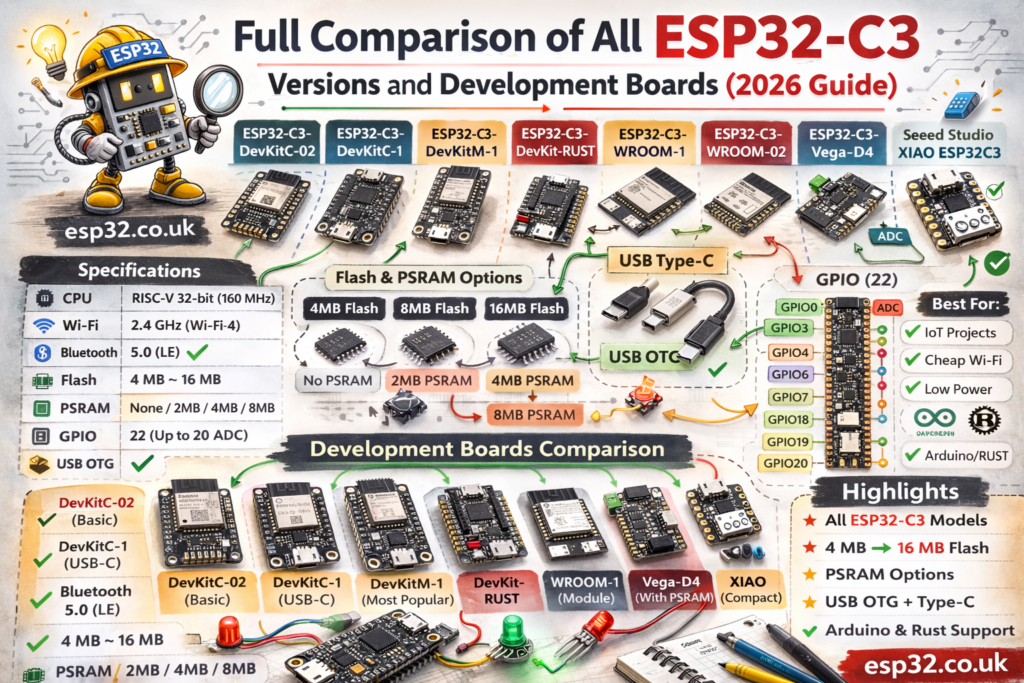
Short answer: choose the ESP32-C3-DevKitM-1 for a compact official board with dependable documentation, the DevKitC-02 for the larger WROOM module format, the XIAO ESP32C3 for a small battery-powered node, the LOLIN C3 mini for D1 mini shields and broad documented toolchain support, or a SuperMini only when minimum size and price matter more than consistent hardware.
Which ESP32-C3 board should you buy?
All of these boards use the same basic ESP32-C3 architecture, so the real decision is the board around the chip: connector, antenna, battery circuit, number of broken-out pins and quality of documentation.
| Board | Best for | Why choose it | Main trade-off |
|---|---|---|---|
| ESP32-C3-DevKitC-02 | General development | Official WROOM board, full headers and predictable documentation | Larger board and Micro-USB |
| ESP32-C3-DevKitM-1 | Compact official board | Official MINI module board with most I/O broken out | Still uses Micro-USB |
| Seeed XIAO ESP32C3 | Battery sensors and wearables | 21 × 17.8 mm, USB-C, battery charging and included external antenna | Only 11 GPIOs; one advertised analog pin uses ADC2 |
| Adafruit QT Py ESP32-C3 | Plug-in I²C sensors | STEMMA QT connector, XIAO-compatible shape and strong tutorials | No battery charger, DAC or capacitive touch |
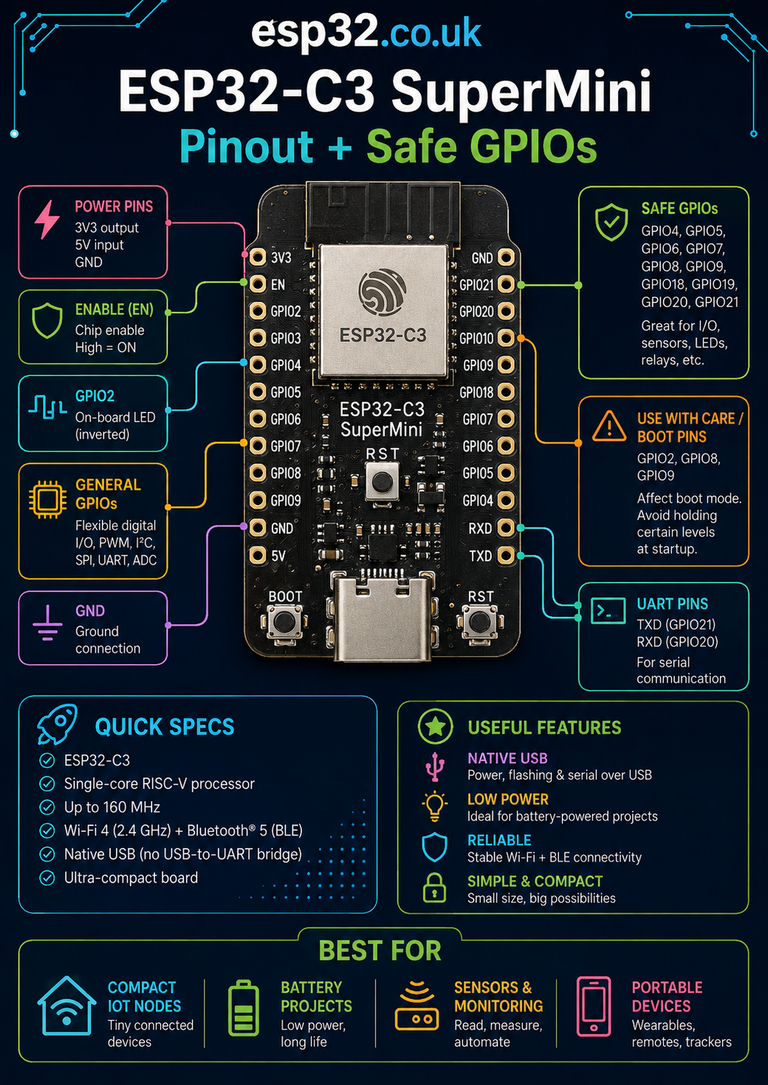
| ESP32-C3 SuperMini | Smallest low-cost builds | Tiny USB-C format and easy to embed | No single standard design; LEDs, pin labels and power circuits vary |
| LOLIN C3 mini | D1 mini shields and firmware choice | 12 I/O, USB-C, RGB LED and documented Arduino, ESP-IDF, MicroPython and CircuitPython support | 34.3 × 25.4 mm, so it is not the smallest C3 board |
Best default: buy the DevKitM-1 if you want the least ambiguous starting point. Choose the XIAO for a battery project, LOLIN for existing D1 mini hardware, and SuperMini for a finished design where you have already verified the exact schematic and pinout.
What every ESP32-C3 shares
- 32-bit RISC-V single-core processor running at up to 160 MHz
- 2.4 GHz Wi-Fi 4 and Bluetooth 5 Low Energy, including Bluetooth Mesh features
- 384 KB ROM, 400 KB SRAM with 16 KB used for cache, and 8 KB RTC SRAM
- Fixed-function full-speed USB Serial/JTAG controller
- UART, SPI, I²C, I²S, RMT, LED PWM and a TWAI controller compatible with CAN 2.0
- Two 12-bit SAR ADCs with up to six channels, depending on the chip and board
- No classic Bluetooth, DAC or native capacitive-touch peripheral
The bare chip can reach about 5 µA in deep sleep under datasheet conditions, but a development board normally consumes more because its regulator, LEDs, USB circuitry and battery components remain connected.
ESP32-C3 chip versions in 2026
The letters and numbers describe the flash arrangement, flash temperature grade and flash size. The current Espressif datasheet uses F for in-package flash, H or N for the flash temperature grade, and a number such as 4 or 8 for flash capacity in megabytes. An X suffix identifies newer v1.1 silicon variants.
| Chip | In-package flash | GPIO count | 2026 status |
|---|---|---|---|
| ESP32-C3 | None; external flash required | 22 | Original v0.4 option |
| ESP32-C3FH4 | 4 MB | 22 | High-temperature flash option |
| ESP32-C3FH4X | 4 MB | 16 | Recommended v1.1 variant |
| ESP32-C3FH8X | 8 MB | 22 | v1.1, now in mass production |
| ESP32-C3FN4 | 4 MB | 22 | End of life |
ESP32-C3FH4AZ is also listed as not recommended for new designs. Most people buying a development board do not need to choose a bare-chip suffix, but the suffix matters when comparing flash capacity, available GPIOs or a module for a custom PCB.
WROOM versus MINI modules
ESP32-C3-WROOM-02 and WROOM-02U
WROOM-02 is the larger module family used on the official DevKitC-02. The standard module has a PCB antenna; WROOM-02U replaces it with an external antenna connector. Espressif’s DevKitC-02 guide specifies 4 MB flash for the modules fitted to that board.
ESP32-C3-MINI-1 and MINI-1U
MINI-1 is physically smaller and is used on the official DevKitM-1. The standard version has a PCB antenna, while MINI-1U provides an external antenna connector. The current module family includes recommended 4 MB and 8 MB variants, although the DevKitM-1 user guide describes its fitted module as a 4 MB configuration.
The letter U describes the external-antenna version; it does not mean USB. Choose a U module for a metal or difficult enclosure, remote antenna placement or more repeatable RF positioning. Remember to connect a suitable 2.4 GHz antenna before transmitting.
DevKitC-02 versus DevKitM-1
| Feature | DevKitC-02 | DevKitM-1 |
|---|---|---|
| Module | WROOM-02 or WROOM-02U | MINI-1 or MINI-1U |
| Flash in official guide | 4 MB | 4 MB |
| Programming connector | Micro-USB through USB-to-UART bridge | Micro-USB through USB-to-UART bridge |
| Native USB pins | GPIO18 D− and GPIO19 D+ broken out | GPIO18 D− and GPIO19 D+ broken out |
| Onboard RGB LED | GPIO8 | GPIO8 |
| Best reason to choose it | Larger WROOM module format | Smaller official board and module |
Both official boards are strong tutorial targets because Espressif publishes the header tables and schematics. The smaller DevKitM-1 is usually the better general recommendation; the DevKitC-02 makes more sense when the WROOM module format or its antenna option is important.
ESP32-C3 Mini versus SuperMini versus XIAO
“C3 mini” is ambiguous. It can mean the LOLIN C3 mini, an Espressif MINI module, or simply any small C3 development board. Those products do not share one pinout.
- LOLIN C3 mini: a documented 34.3 × 25.4 mm board with 12 I/O, 4 MB flash, a WS2812B LED and compatibility with D1 mini shields.
- Generic SuperMini: normally smaller and cheaper, but there is no single manufacturer specification. Check the LED pin, USB connection, regulator, boot circuit and silkscreen before copying a pinout.
- XIAO ESP32C3: a documented 21 × 17.8 mm board with 11 GPIOs, USB-C, battery charging and an included external antenna.
- Adafruit QT Py ESP32-C3: a XIAO-shaped board with a STEMMA QT connector and detailed tutorials, best when plug-in I²C sensors matter more than the lowest price.
If you want the smallest inexpensive board and control your own firmware, a verified SuperMini is reasonable. If you want repeatable hardware, published dimensions and a supported board definition, buy XIAO, QT Py or LOLIN instead.
Which board has the best firmware support?
For ESP-IDF and Arduino, every genuine ESP32-C3 is built around the same supported SoC. The difference is how much board-specific setup you must do.
- Official DevKitC-02 or DevKitM-1: safest for Espressif examples, reference pinouts and generic C3 development.
- LOLIN C3 mini: widest explicitly documented selection; LOLIN lists MicroPython, Arduino, CircuitPython and ESP-IDF.
- XIAO and QT Py: strong maker documentation and named board definitions, reducing pin-mapping surprises.
- SuperMini clones: often work with a generic ESP32-C3 board profile, but onboard LED, USB and boot behaviour may need manual configuration.
For pre-built systems such as ESPHome or Tasmota, check that the exact board or a tested generic profile is supported before buying a large batch. “ESP32-C3 compatible” confirms the processor family, not the board’s LED, relay, USB or pin assignments.
USB Serial/JTAG is not USB OTG
ESP32-C3’s hardware USB controller provides a CDC serial console, firmware flashing and JTAG debugging over GPIO18 and GPIO19. It is fixed-function hardware. Unlike the configurable USB OTG controller in ESP32-S2 or ESP32-S3, it cannot be changed into a keyboard, mouse, game controller or mass-storage device.
If firmware reconfigures GPIO18 or GPIO19, or the chip enters deep sleep, the USB Serial/JTAG device disappears from the computer. The official DevKitC-02 and DevKitM-1 avoid this during normal programming by using a separate USB-to-UART bridge on their Micro-USB connector. Tiny USB-C boards often wire the connector directly to the C3’s Serial/JTAG pins.
Battery and low-power considerations
The XIAO ESP32C3 is the strongest documented battery option in this group. Seeed specifies lithium-battery charge and discharge management, a 380 mA fast-charge mode and approximately 44 µA board-level deep-sleep consumption. Its included external antenna also helps when the board is mounted close to a battery or enclosure.
A bare ESP32-C3 chip can sleep lower than a complete development board. On SuperMini and other clones, the regulator’s quiescent current, power LED and USB circuitry can dominate the sleep budget. Measure the complete board before designing around a catalogue deep-sleep figure.
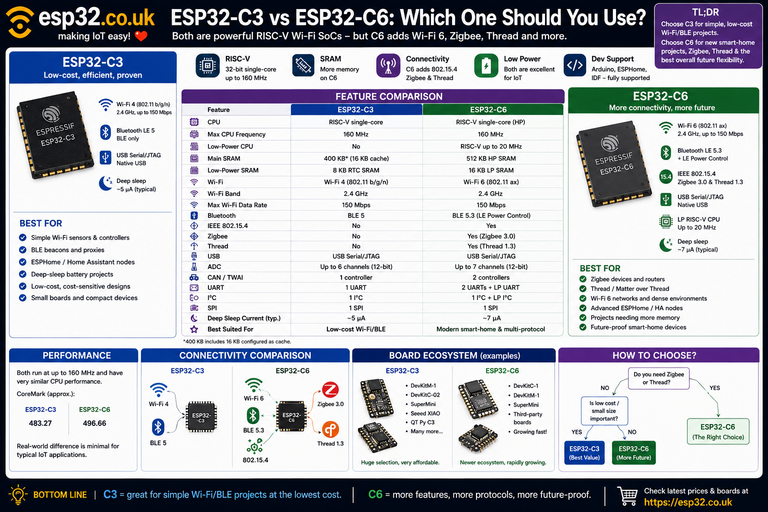
ESP32-C3 versus ESP8266, ESP32-S3 and ESP32-C6
| Family | CPU | Wireless | USB | Choose it when |
|---|---|---|---|---|
| ESP8266 | Older single core | Wi-Fi 4 only | None in the chip | Maintaining an existing low-cost design |
| ESP32-C3 | RISC-V single core, 160 MHz | Wi-Fi 4 + Bluetooth 5 LE | Fixed Serial/JTAG | Building a low-cost Wi-Fi/BLE sensor, relay or gateway |
| Original ESP32 | Xtensa dual core, up to 240 MHz | Wi-Fi 4 + BLE + classic Bluetooth | None in the chip | You need classic Bluetooth, more GPIOs, DAC or touch |
| ESP32-S3 | Xtensa dual core, up to 240 MHz | Wi-Fi 4 + Bluetooth 5 LE | USB OTG + Serial/JTAG | You need configurable USB, more processing or vector instructions |
| ESP32-C6 | RISC-V single core, up to 160 MHz | Wi-Fi 6 + BLE + 802.15.4 | Fixed Serial/JTAG | You need Thread, Zigbee or 2.4 GHz Wi-Fi 6 |
C3 remains the sweet spot for ordinary Wi-Fi and BLE devices. Move to S3 for configurable USB, displays, cameras or heavier processing, and to C6 when Matter-over-Thread, Zigbee or Wi-Fi 6 is a requirement. See our ESP32-C family comparison for the broader C2/C3/C5/C6/C61 differences.
Important C3 peripheral limitations
- No DAC: use PWM plus filtering or an external DAC when a true analogue output is required.
- No native capacitive touch: add an external touch controller or choose another ESP32 family.
- TWAI needs a transceiver: the chip contains the CAN-compatible controller, but it cannot connect directly to a CAN bus.
- ADC availability is board-specific: the SoC offers up to six channels, but not every board exposes them. Seeed warns that XIAO’s A3 uses ADC2 and can produce unreliable readings; prefer A0, A1 or A2 for dependable analogue input.
- GPIOs are 3.3 V only: use level shifting or a divider for 5 V signals.
- Boot and LED pins vary by board: GPIO2, GPIO8 and GPIO9 are C3 strapping pins, while onboard LEDs and buttons may also occupy them.
For exact wiring, use the pinout for your specific board rather than a generic C3 diagram. Our ESP32-C3 DevKitM-1 pinout guide covers safe GPIOs, boot pins, ADC, I²C, SPI and UART.
Common buying mistakes
- Buying a U module without ordering and connecting a suitable external antenna.
- Assuming USB-C means configurable native USB or USB OTG.
- Using a SuperMini pinout for a different clone revision.
- Expecting classic Bluetooth, DAC or capacitive touch because the original ESP32 has them.
- Comparing the chip’s deep-sleep current with the consumption of a complete development board.
- Choosing only by flash size without checking exposed GPIOs, antenna type and firmware definition.
ESP32-C3 FAQ
What is the best ESP32-C3 board for beginners?
ESP32-C3-DevKitM-1 is the safest compact starting point because it is an official Espressif board with a published schematic, header table and predictable module. DevKitC-02 is equally well documented if you prefer its larger WROOM layout.
Is ESP32-C3 SuperMini the same as C3 mini?
No. SuperMini describes a class of tiny third-party boards, while LOLIN C3 mini is a specific documented product and ESP32-C3-MINI-1 is an Espressif module. Their dimensions, pinouts and peripherals differ.
Can ESP32-C3 act as a USB keyboard?
No. Its USB Serial/JTAG controller is fixed to serial, flashing and JTAG functions. Choose an ESP32-S2 or ESP32-S3 when the microcontroller must present itself as a keyboard or another configurable USB device.
Does ESP32-C3 support classic Bluetooth?
No. ESP32-C3 supports Bluetooth 5 Low Energy, not Bluetooth Classic. Use the original ESP32 when an existing Bluetooth Classic profile is essential.
Can ESP32-C3 connect to a CAN bus?
Yes, through its TWAI controller, but an external CAN transceiver is required between the 3.3 V logic pins and the physical bus.
How much flash does ESP32-C3 have?
It depends on the chip, module and board. Common official C3 development boards use 4 MB, while current chip and MINI module families also include 8 MB variants. Check the full part number instead of assuming every C3 has the same flash.