Choose the ESP32-C6AliExpress price if the project needs Zigbee, Thread, Matter-over-Thread or the more complete smart-home feature set. It combines 2.4 GHz Wi-Fi 6 and BLE with an IEEE 802.15.4 radio, 512 KB HP SRAM and a separate 20 MHz low-power RISC-V processor. Choose the ESP32-C61 when the project only needs Wi-Fi 6 + Bluetooth LE and would benefit from a simpler, potentially lower-cost platform with newer Bluetooth, up to 16 MB flash and 8 MB PSRAM in current WROOM configurations. Despite the name, the C61 is not a more powerful C6: it removes the C6’s 802.15.4 radio and several peripherals in exchange for a more streamlined Wi-Fi/BLE architecture.
Materials You’ll Need
For experimenting with these two chips, the following hardware is useful:
| Item | Why you may need it |
|---|---|
| ESP32-C61-DevKitC-1 | Test the C61’s Wi-Fi 6, BLE and PSRAM capabilities |
| ESP32-C6-DevKitC-1AliExpress price | Test Wi-Fi 6, BLE, Zigbee and Thread |
| USB-C data cable | Programming and power |
| Breadboard | Easy prototyping |
| Dupont jumper wires | Connecting sensors and modules |
| SHT40, BME280 or another I²C sensor | Simple comparison project |
| Optional Zigbee/Thread coordinator or border router | Useful when testing the C6’s 802.15.4 radio |
| Multimeter | Useful for power and GPIO testing |
For a basic Home Assistant sensor, only one development board, a USB-C data cable and a sensor are really required.
Affiliate links can be added cleanly to the individual items above without interrupting the technical sections of the article.
ESP32-C61 and ESP32-C6 at a glance
The names make these chips sound as though the C61 is simply a newer C6.
That is misleading.
Both are 160 MHz RISC-V ESP32 chips with 2.4 GHz Wi-Fi 6 and Bluetooth LE, but their design priorities are different.
The C6 is Espressif’s multiprotocol smart-home chip.
The C61 is a streamlined Wi-Fi/BLE IoT chip.
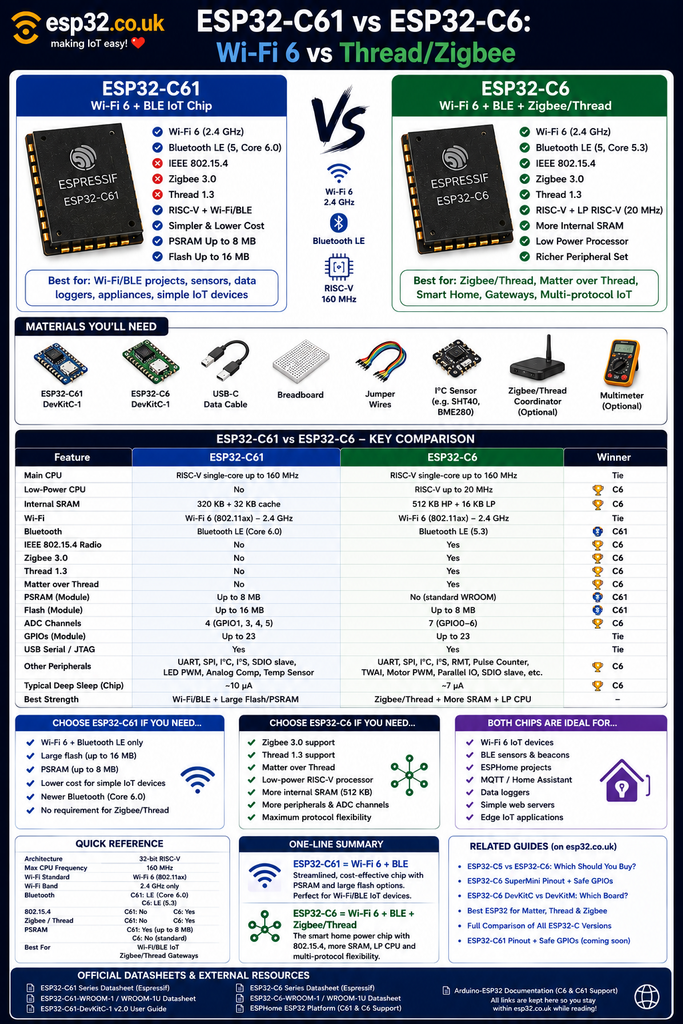
| Feature | ESP32-C61 | ESP32-C6AliExpress price |
|---|---|---|
| Main CPU | RISC-V single-core | RISC-V single-core |
| Max CPU speed | 160 MHz | 160 MHz |
| Separate LP CPU | No | RISC-V up to 20 MHz |
| Internal SRAM | 320 KB | 512 KB HP + 16 KB LP |
| Wi-Fi | Wi-Fi 6 | Wi-Fi 6 |
| Wi-Fi frequency | 2.4 GHz | 2.4 GHz |
| 5 GHz Wi-Fi | No | No |
| Bluetooth | Bluetooth Core 6.0 | Bluetooth 5.3 |
| IEEE 802.15.4 | No | Yes |
| Zigbee | No | Yes, Zigbee 3.0 |
| Thread | No | Yes, Thread 1.3 |
| Matter over Thread | No | Yes |
| Module flash | Up to 16 MB | Up to 8 MB |
| Module PSRAM | Up to 8 MB | No on standard C6-WROOM |
| ADC channels | 4 | 7 |
| USB Serial/JTAG | Yes | Yes |
| Typical chip deep sleep | ~10 µA | ~7 µA |
| Best for | Wi-Fi/BLE IoT | Zigbee/Thread/Matter |
The most important distinction is therefore simple:
C61 = Wi-Fi 6 + BLE
C6 = Wi-Fi 6 + BLE + Zigbee/Thread.
First, both chips have Wi-Fi 6
The title of this comparison can easily create the wrong impression.
The C61 does not have Wi-Fi 6 while the C6 lacks it.
Both support:
2.4 GHz Wi-Fi 6 / IEEE 802.11ax
with backwards compatibility for:
- 802.11b
- 802.11g
- 802.11n
Both can reach approximately:
150 Mbps
under appropriate Wi-Fi conditions.
So the decision is not:
Wi-Fi 6
vs
Zigbee
It is more accurately:
Wi-Fi 6 + BLE
vs
Wi-Fi 6 + BLE + Zigbee/Thread
That distinction matters when deciding which chip actually fits the project.
Neither chip has 5 GHz Wi-Fi
Another common source of confusion is the C-series naming.
Neither the C61 nor the C6 supports 5 GHz Wi-Fi.
Both operate in the:
2.4 GHz band
only.
If the requirement is:
2.4 GHz + 5 GHz Wi-Fi 6the relevant ESP32 is the:
not the C61.
This is especially important when comparing online product listings because some sellers loosely use phrases such as “new Wi-Fi 6 ESP32” without making the frequency band clear.
Both use a 160 MHz RISC-V main CPU
Raw application-CPU performance is very similar.
ESP32-C61
32-bit RISC-V
single-core
up to 160 MHz
ESP32-C6
32-bit RISC-V
single-core
up to 160 MHz
C61’s current datasheet gives a CoreMark figure of approximately:
553.78 CoreMark at 160 MHz.
For ordinary embedded workloads such as:
- reading sensors
- MQTT
- Home Assistant
- web APIs
- GPIO
- relays
- BLE
both have plenty of processing power.
A BME280 does not care which one has the more advanced internal architecture.
The real differences begin when memory, low-power processing and radio protocols are considered.
C6 has a second low-power RISC-V CPU
One of the C6’s less obvious advantages is its separate:
20 MHz low-power RISC-V processor.
The main 160 MHz processor can be powered down while the LP processor handles suitable low-complexity tasks.
Conceptually:
160 MHz main CPU
        ↓
      sleeps

20 MHz LP CPU
        ↓
monitors selected events
        ↓
wakes main processor
This can be valuable for:
- sensor threshold monitoring
- low-power event detection
- periodic background tasks
- battery devices
The C61 does not have an equivalent separate programmable LP RISC-V core.
So despite being the newer-looking part number, C61 actually has the simpler processor architecture.
C6 has significantly more internal SRAM
This is another major difference.
ESP32-C61
Provides:
320 KB SRAM
32 KB L1 cache
ESP32-C6
Provides:
512 KB HP SRAM
16 KB LP SRAM
The C6 therefore has considerably more internal working memory.
That can matter for:
- networking
- TLS
- ESPHome
- Zigbee
- Thread
- Matter
- large JSON documents
- multiple tasks
- protocol gateways
If the application stays entirely inside internal memory, the C6 has the stronger architecture.
But C61 has much better external-memory options
This is where the C61 becomes interesting.
Current ESP32-C61-WROOM-1 modules support configurations with up to:
16 MB flash
8 MB PSRAM
The standard ESP32-C6AliExpress price-WROOM-1 family provides up to:
8 MB flashand does not provide PSRAM in the same way.
So the memory comparison is not simply:
C6 has more memory.
It is:
C6 has more internal SRAM.
C61 can have far more total memory through PSRAM.
That makes C61 surprisingly attractive for some Wi-Fi applications involving:
- large buffers
- web interfaces
- large JSON objects
- data logging
- caching
- audio buffers
- bigger ESPHome configurations
The current C61 DevKit has PSRAM
The official ESP32-C61-DevKitC-1 v2.0 is built around ESP32-C61-WROOM-1.
Espressif’s current board documentation describes configurations providing up to:
8 MB SPI flash
and:
2 MB PSRAM.
That already gives the C61 development board an interesting advantage for projects that benefit from external RAM.
The wider C61-WROOM module family can go beyond that, with configurations reaching up to 16 MB flash and 8 MB PSRAM.
C6 has the critical 802.15.4 radio
This is the main reason the C6 exists in so many smart-home projects.
ESP32-C6AliExpress price contains a native:
IEEE 802.15.4 radio
operating at 2.4 GHz.
That hardware enables:
- Zigbee
- Thread
- Matter over Thread
The C61 does not contain an 802.15.4 radio.
This is not something that can be added with firmware.
If a C61 project later needs Thread or Zigbee, it will require a separate external radio.
With C6, the radio is already built into the chip.
C6 supports Zigbee 3.0
ESP32-C6 supports:
Zigbee 3.0
using its integrated 802.15.4 hardware.
That makes it useful for projects such as:
- Zigbee temperature sensors
- Zigbee relays
- smart switches
- door sensors
- motion sensors
- lighting controllers
- Zigbee routers
- gateways
For someone building a modern Home Assistant Zigbee project, choosing C6 over C61 is straightforward.
C61 cannot act as a native Zigbee radio.
C6 supports Thread 1.3
ESP32-C6 also supports:
Thread 1.3.
That is particularly relevant for Matter devices.
Thread provides an IP-based low-power mesh network and is increasingly used for:
- smart plugs
- environmental sensors
- switches
- thermostats
- Matter accessories
Again, the C61 lacks the required radio.
If the project requirement contains the word:
Thread
choose:
C6.
Matter over Wi-Fi is different
The absence of 802.15.4 does not mean C61 is useless for Matter.
Matter can also run over Wi-Fi.
Conceptually:
C61
→ Matter over Wi-Fi
may be possible with an appropriate software stack.
But:
C61
→ Matter over Thread
is impossible without another radio.
The C6 is therefore the more flexible Matter platform because its hardware can support both Wi-Fi networking and Thread networking.
C61 has newer Bluetooth hardware
C61 gets an advantage on the BLE side.
Current Espressif documentation lists it as:
Bluetooth Core 6.0 certified.
Its BLE functionality includes features such as:
- LE Power Control
- Direction Finding
- AoA/AoD
- PAwR
- LE Connection Subrating
- extended advertising
- Bluetooth Mesh 1.1
The C6 WROOM family is currently documented as:
Bluetooth 5.3 certified.
For a conventional BLE sensor, this distinction may not matter.
For newer BLE applications or products with a longer commercial lifespan, the C61’s newer Bluetooth implementation is appealing.
Neither supports Bluetooth Classic
Both chips provide:
Bluetooth Low Energy only.
Neither provides legacy Bluetooth Classic.
So projects requiring older Bluetooth Classic profiles should not choose either chip solely because it says “Bluetooth.”
For:
- BLE sensors
- beacons
- provisioning
- BLE Mesh
- Home Assistant BLE integrations
both are appropriate.
C61 is deliberately more streamlined
The C61 does not merely remove the 802.15.4 radio.
Its peripheral set is also simpler.
It retains useful interfaces such as:
- UART
- SPI
- I²C
- I²S
- USB Serial/JTAG
- LED PWM
- ADC
- temperature sensor
- SDIO slave
- analog comparator
But the C6 contains a richer peripheral set including functionality such as:
- pulse counter
- RMT
- motor-control PWM
- TWAI
- parallel I/O
- low-power peripherals
depending on the specific function being used.
For a simple connected sensor, this difference may be irrelevant.
For a sophisticated controller, the C6 provides more hardware flexibility.
C61 has fewer ADC inputs
C61’s current chip specification provides a:
12-bit ADC with up to four channels.
ESPHome currently maps those to:
GPIO1
GPIO3
GPIO4
GPIO5
C6 provides:
seven ADC channels
on:
GPIO0–GPIO6So if several analog sensors are required:
C6 is more convenient.
For most modern digital environmental sensors using I²C, this difference is much less important.
GPIO availability is broadly similar
The bare C61 supports up to:
30 programmable GPIOs.
C61-WROOM modules expose up to:
23 GPIOs.
The C6 chip is available in configurations with 30 or 22 GPIOs, while the common C6-WROOM module exposes:
23 GPIOs.
So neither chip has a major practical GPIO advantage at WROOM-module level.
The actual development board layout matters more.
Both have native USB Serial/JTAG
Both C61 and C6 include:
USB Serial/JTAG.
This is useful for:
- flashing firmware
- serial debugging
- JTAG debugging
without necessarily requiring an external USB-to-UART converter.
It should not be confused with the more capable general-purpose USB OTG functionality found on chips such as ESP32-S3.
For typical development-board programming, however, USB Serial/JTAG is extremely convenient.
Deep-sleep current surprisingly favours C6
Because C61 is positioned as a streamlined IoT chip, it would be reasonable to assume it always uses less power.
The current headline chip figures do not support that assumption.
Espressif specifies approximately:
ESP32-C61
Deep sleep ≈ 10 µA
while C6 is approximately:
ESP32-C6
Deep sleep ≈ 7 µA
under the relevant datasheet conditions.
The difference is small, but interesting.
For a sensor sleeping almost all the time, the older C6 can actually have the theoretical advantage.
Board-level power matters far more
A difference of:
3 µAat chip level means very little if the development board contains:
- a power LED
- an inefficient regulator
- USB circuitry
- voltage dividers
- external PSRAM
consuming hundreds of microamps or several milliamps.
For serious battery design:
measure the complete board.
Do not select C61 or C6 purely from one datasheet sleep-current number.
Why would C61 exist if C6 has more features?
Because not every product needs Zigbee and Thread.
Suppose a commercial product only needs:
Wi-Fi
+
BLE commissioning
Including an 802.15.4 radio that will never be used adds unnecessary silicon complexity.
C61 focuses on the enormous market for ordinary Wi-Fi/BLE products such as:
- smart plugs
- appliances
- sensor hubs
- data loggers
- consumer electronics
- POS devices
- industrial telemetry
It also offers strong external-memory configurations.
That makes it a practical cost-focused option rather than a replacement for the C6.
Think of C61 as a different branch, not C6.1
The name C61 is unfortunately easy to interpret as:
C6.1or:
upgraded C6That is not a useful way to think about it.
The architecture is closer to:
ESP32-C6
Wi-Fi 6
BLE
802.15.4
Thread
Zigbee
LP CPU
larger internal SRAM
ESP32-C61
Wi-Fi 6
newer BLE
simpler system
PSRAM options
larger flash options
The C61 is therefore more specialized, not universally better.
Which is better for ESPHome?
In 2026, ESPHome supports both:
variant: esp32c6and:
variant: esp32c61The current ESPHome platform documentation explicitly describes the C61 as a lower-cost C6-family option without the 802.15.4 radio. ESPHome also added C61 PSRAM support in the 2026.4 release.
For something simple such as:
SHT40
+
Wi-Fi
+
Home Assistant
either is capable.
C61 becomes interesting if:
- PSRAM helps
- newer BLE matters
- Zigbee/Thread will never be required
C6 remains more flexible for smart-home experimentation.
Which is easier with Arduino IDE?
Today:
ESP32-C6 is easier.
The normal Arduino-ESP32 documentation lists C6 as a fully stable supported target.
C61 is supported, but Espressif currently notes that it requires either:
- using Arduino as an ESP-IDF component, or
- rebuilding the Arduino static libraries
rather than the same straightforward precompiled-board workflow used by fully supported targets.
This is an important practical difference.
For someone whose entire workflow is:
Arduino IDE
→ choose board
→ compile
→ upload
C6 is currently the safer choice.
C61 software support is catching up quickly
The situation is improving rapidly.
ESP-IDF already has dedicated C61 support, current ESPHome recognizes the C61 platform, and PSRAM support has been added.
So C61 should not be regarded as unsupported hardware.
It is simply less mature in the standard Arduino workflow than C6 at the moment.
For ESP-IDF users, this disadvantage is much smaller.
Which is better for Home Assistant?
For a normal Wi-Fi Home Assistant sensor:
Either.
For example:
ESP32
+
SHT45
+
ESPHome
+
Home Assistant
does not need an IEEE 802.15.4 radio.
If a C61 board is cheaper and well supported by the firmware being used, it can make perfect sense.
But for someone buying one board to experiment with:
- Wi-Fi
- BLE
- Zigbee
- Thread
- Matter
the C6 clearly gives more possibilities.
Which is better for Zigbee?
This one is easy.
ESP32-C61
No native Zigbee
ESP32-C6
Zigbee 3.0
Winner:
Which is better for Thread?
Again:
ESP32-C61
No 802.15.4 radio.
ESP32-C6
Thread 1.3.
Winner:
Which is better for Matter?
For:
Matter over Thread
choose:
C6
For:
Matter over Wi-Fi
C61 can be interesting, especially where PSRAM and larger flash are useful, assuming the chosen framework supports the intended configuration.
For maximum flexibility:
C6 remains the safer Matter-development board.
Which is better for BLE projects?
This is closer.
For ordinary BLE sensors:
Either
For more recent BLE features:
C61
has the more modern Bluetooth Core 6.0 implementation.
For BLE combined with Zigbee or Thread:
C6
wins because the required 802.15.4 radio is also present.
Which is better for a web server?
Potentially:
C61
despite its lower internal SRAM.
Why?
Because C61 WROOM modules can provide:
up to 16 MB flash
+
up to 8 MB PSRAM
That gives large applications far more external memory for:
- HTML
- buffers
- JSON
- cached data
- file systems
For a modest configuration page, either chip is fine.
Which is better for a battery sensor?
For a very basic sleep-heavy node:
C6 has the better published chip deep-sleep figure.
But C61 may still be competitive in a real product depending on:
- board regulator
- wake duration
- Wi-Fi connection time
- peripheral current
- sensor design
The final answer should be based on measuring the actual hardware.
Which is better for a simple Wi-Fi relay?
Probably:
C61
if it costs less and the development environment supports it conveniently.
A relay does not need:
- Zigbee
- Thread
- 512 KB SRAM
- LP CPU
- seven ADC inputs
The C61 is exactly the sort of chip that makes sense when unnecessary functionality can be removed.
Which is better for a smart-home gateway?
C6
A gateway may benefit from simultaneously supporting:
Wi-Fi
+
BLE
+
Zigbee
+
Thread
That combination is the C6’s main strength.
C61 would require an external 802.15.4 radio to provide equivalent Zigbee/Thread capability.
Which is better for a basic Wi-Fi sensor?
This depends largely on price.
If the project is:
Temperature
Humidity
Wi-Fi
MQTT
both chips are excessive in terms of processing capability.
C61 may be attractive as the lower-cost option.
C6 becomes worthwhile if the possibility of migrating the product to Zigbee/Thread later has value.
C61 vs C6 by project
| Project | Better choice |
|---|---|
| Basic Wi-Fi sensor | C61 |
| Wi-Fi relay | C61 |
| BLE sensor | C61 / C6 |
| Advanced BLE project | C61 |
| Large Wi-Fi app with PSRAM | C61 |
| Large flash requirement | C61 |
| Zigbee sensor | C6 |
| Zigbee router | C6 |
| Thread sensor | C6 |
| Matter over Thread | C6 |
| Smart-home gateway | C6 |
| Many analog inputs | C6 |
| Rich embedded peripherals | C6 |
| Simplest Arduino workflow | C6 |
| ESPHome Wi-Fi node | Either |
| Maximum protocol flexibility | C6 |
Why C6 remains the better all-rounder
C61 has several interesting advantages, particularly:
- newer BLE
- PSRAM
- larger flash options
- potentially lower product cost
But C6 remains the more versatile microcontroller.
It provides:
- more internal SRAM
- low-power processor
- Zigbee
- Thread
- Matter-over-Thread capability
- more ADC channels
- richer peripherals
- mature Arduino support
- slightly lower specified deep-sleep current
So when the future project requirements are unknown:
C6 remains easier to recommend.
Why C61 is still important
The C61 solves a different problem.
There are millions of embedded devices that will never need:
Zigbee
Thread
Matter-over-Thread
but may benefit from:
Wi-Fi 6
BLE
large flash
PSRAM
lower cost
For those products, C61 can be the more efficient engineering choice.
It avoids paying for capabilities that will never be used.
The simplest buying decision
Ask one question first:
Could this project need Zigbee or Thread?
If:
Yes → ESP32-C6
If:
No → continue
Then ask:
Do large flash or PSRAM matter?
If:
Yes → ESP32-C61 becomes very interesting
If:
No → choose whichever board is cheaper, easier to obtain and better supported by the chosen framework.
For Arduino IDE beginners today, C6 still has the smoother software path.
Related ESP32 Guides
These articles are natural internal links from this comparison:
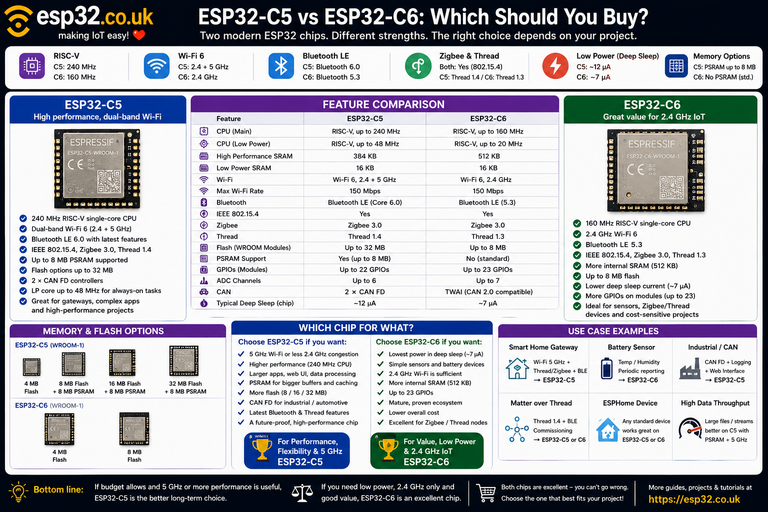
- ESP32-C5 vs ESP32-C6: Which Should You Buy?
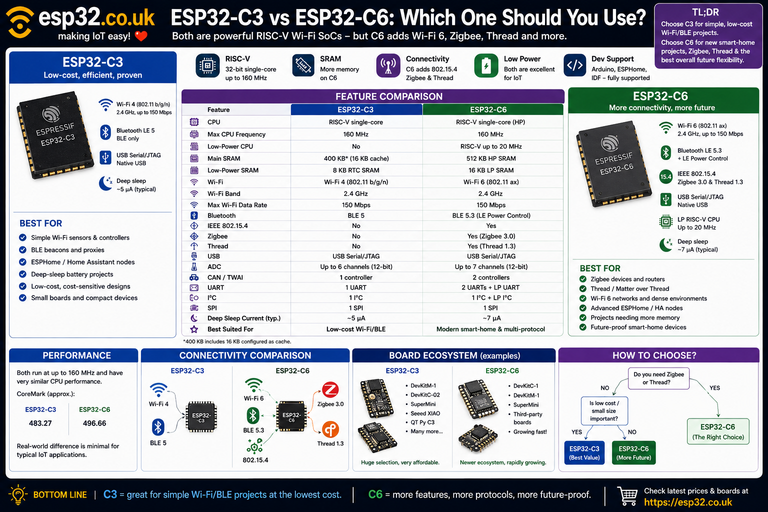
- ESP32-C3 vs ESP32-C6: Which One Should You Use?
- ESP32-C6 DevKitC vs DevKitM: Which C6 Board Should You Buy?
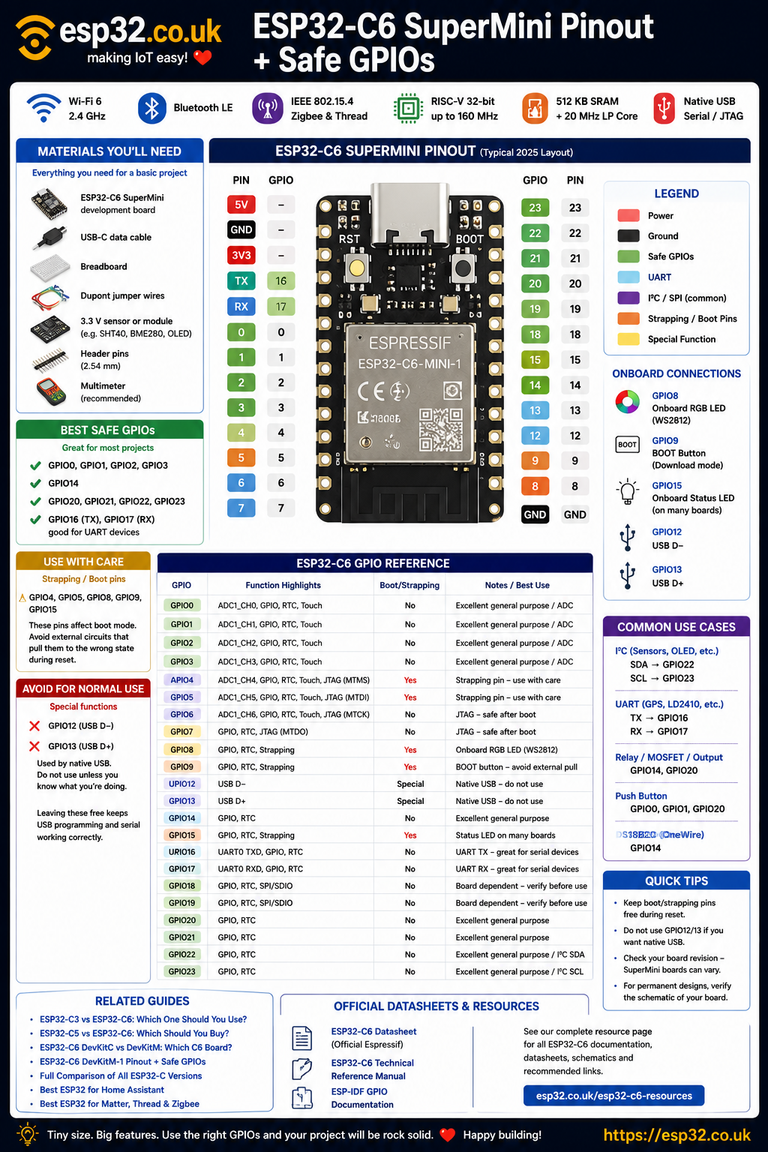
- ESP32-C6 SuperMini Pinout + Safe GPIOs
- Full Comparison of All ESP32-C Versions and Development Boards
- Best ESP32 for Matter, Thread & Zigbee
- ESP32-H2 vs ESP32-H21 vs ESP32-H4
These should be linked internally in the published article to keep readers moving through the esp32.co.uk C-series and smart-home clusters.
Final recommendation
The ESP32-C61 is not a replacement for the ESP32-C6.
It is better thought of as a more streamlined alternative.
Choose ESP32-C61 for:
Wi-Fi 6
+
Bluetooth LE
+
large flash / PSRAM options
when Zigbee and Thread are unnecessary.
Choose ESP32-C6 for:
Wi-Fi 6
+
Bluetooth LE
+
Zigbee
+
Thread
+
Matter-over-Thread
and when the richer low-power and peripheral architecture is useful.
For a cheap Wi-Fi sensor:
C61 can be the smarter choice.
For a smart-home development board:
C6 wins easily.
And for someone buying just one of them with no fixed project yet:
Buy the ESP32-C6.
It gives up the C61’s large PSRAM/flash options, but its combination of Wi-Fi 6, BLE, Zigbee and Thread gives far more directions for future projects.
Official Datasheets & External Resources
All manufacturer and software documentation is collected here so the article body remains focused and does not repeatedly send readers away from esp32.co.uk.
Espressif ESP32-C61 Series Datasheet — official CPU, SRAM, Bluetooth, GPIO, ADC and power specifications. (Espressif Documentation)
Espressif ESP32-C61-WROOM-1 / WROOM-1U Datasheet — flash, PSRAM, module GPIO and antenna configurations. (Espressif Documentation)
Espressif ESP32-C61-DevKitC-1 v2.0 User Guide — official development-board configuration and module details. (Espressif Systems)
Espressif ESP32-C6 Series Datasheet — Wi-Fi 6, BLE, Zigbee, Thread, memory, ADC and power specifications. (Espressif Documentation)
Espressif ESP32-C6-WROOM-1 / WROOM-1U Datasheet — official C6 module specifications. (Espressif Documentation)
Arduino-ESP32 Supported SoCs — current C6 and C61 Arduino support status. (Espressif Systems)
ESPHome ESP32 Platform Documentation — current ESP32-C61 and ESP32-C6 platform support. (ESPHome – Smart Home Made Simple)