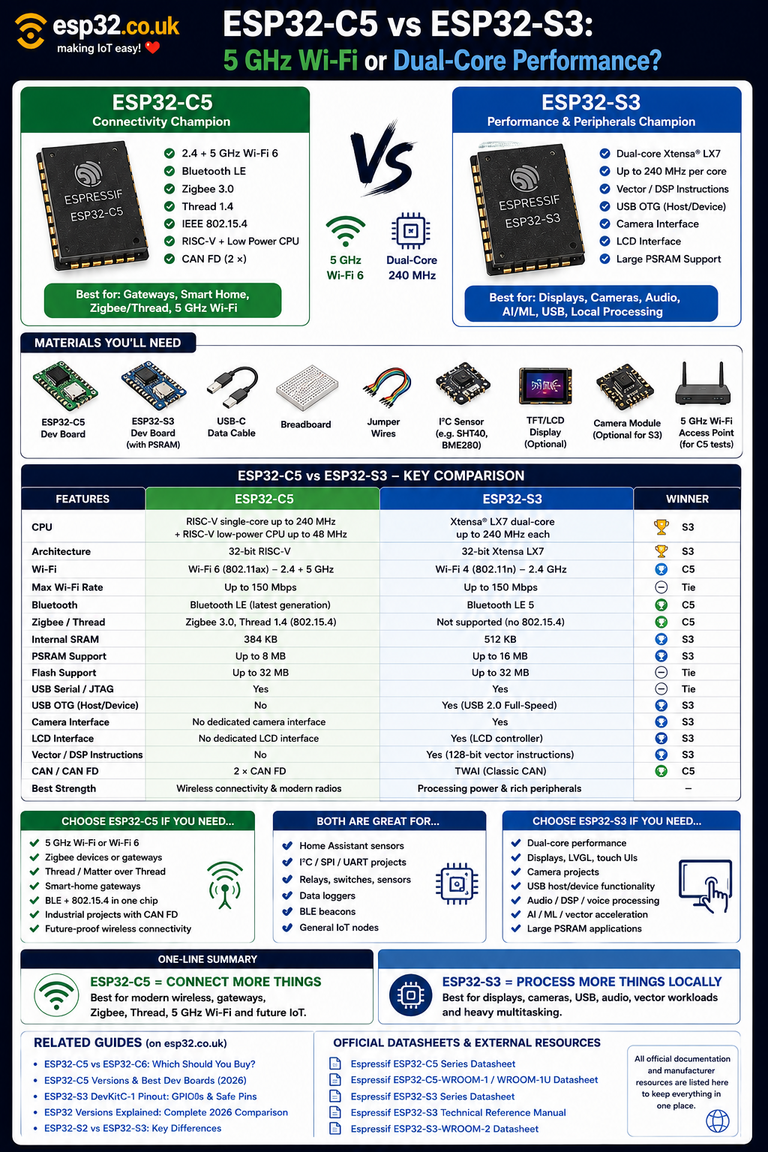
The ESP32-C5AliExpress price is the more capable chip overall: it has a faster 240 MHz RISC-V CPU, dual-band 2.4 GHz + 5 GHz Wi-Fi 6, newer Bluetooth LE features, Thread 1.4, optional PSRAM and module configurations with much larger flash. The ESP32-C6AliExpress price remains an excellent choice for lower-cost smart-home devices, offering 2.4 GHz Wi-Fi 6, Zigbee, Thread and BLE while actually providing more internal SRAM and lower specified deep-sleep current. For a new general-purpose connected project, choose ESP32-C5AliExpress price if the price difference is reasonable. Choose ESP32-C6AliExpress price when 5 GHz Wi-Fi is unnecessary and cost, maturity or minimum sleep consumption matters more. (documentation.espressif.com)
ESP32-C5 vs ESP32-C6 at a glance
The C5 and C6 belong to the same modern RISC-V generation of ESP32AliExpress price chips, and they overlap considerably.
Both provide:
- Wi-Fi 6
- Bluetooth Low Energy
- IEEE 802.15.4
- Zigbee
- Thread
- RISC-V processors
- USB Serial/JTAG
- modern security
- low-power operation
- ADC
- I²C
- SPI
- UART
- I²S
- PWM
But the C5 is not simply a C6 with 5 GHz added.
There are meaningful differences in CPU performance, memory architecture, low-power performance, Bluetooth generation, flash/PSRAM options and peripherals.
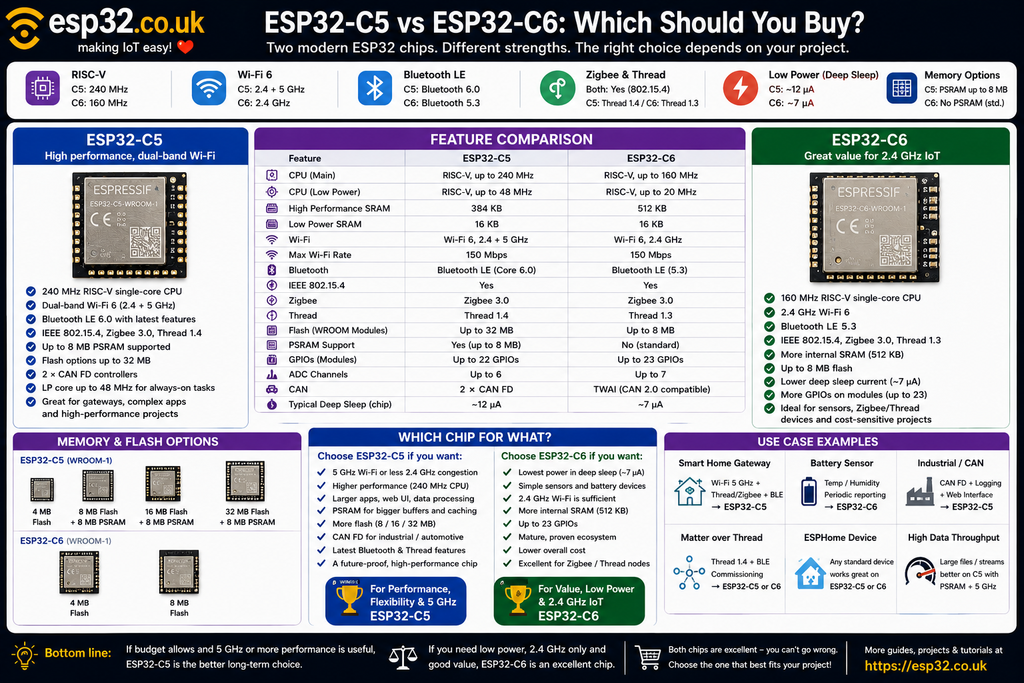
| Feature | ESP32-C5 | ESP32-C6 |
|---|---|---|
| Main CPU | RISC-V @ 240 MHz | RISC-V @ 160 MHz |
| Low-power CPU | RISC-V @ 48 MHz | RISC-V @ 20 MHz |
| HP SRAM | 384 KB | 512 KB |
| LP SRAM | 16 KB | 16 KB |
| Wi-Fi | Wi-Fi 6, 2.4 + 5 GHz | Wi-Fi 6, 2.4 GHz |
| Maximum Wi-Fi rate | 150 Mbps | 150 Mbps |
| Bluetooth certification | Bluetooth Core 6.0 | Bluetooth 5.3 |
| IEEE 802.15.4 | Yes | Yes |
| Zigbee | Zigbee 3.0 | Zigbee 3.0 |
| Thread | Thread 1.4 | Thread 1.3 |
| PSRAM | Up to 8 MB supported | No PSRAM on standard C6-WROOM |
| WROOM flash options | Up to 32 MB | Up to 8 MB |
| WROOM GPIOs | Up to 22 | 23 |
| ADC channels | Up to 6 | 7 |
| CAN | 2 × CAN FD | TWAI / classic CAN-style controller |
| Typical chip deep sleep | 12 µA | 7 µA |
| Best reason to buy | 5 GHz + performance | Value + mature smart-home platform |
The latest Espressif C5 datasheet specifies a 240 MHz high-performance processor and 48 MHz low-power processor, while C6 uses a 160 MHz main core and 20 MHz low-power processor. Interestingly, C6 retains more on-chip high-performance SRAM: 512 KB versus 384 KB on C5. (documentation.espressif.com)
The biggest difference is 5 GHz Wi-Fi
This is the feature that fundamentally separates C5 from C6.
ESP32-C6
Supports:
2.4 GHz Wi-Fi 6
ESP32-C5
Supports:
2.4 GHz + 5 GHz dual-band Wi-Fi 6
The C5 operates across approximately:
2.4 GHz:
2412–2484 MHz

5 GHz:
5180–5885 MHz
and also supports 802.11ac operation in the 5 GHz band in addition to Wi-Fi 6/802.11ax. (documentation.espressif.com)
This is not just about achieving higher speed.
For IoT, the most useful advantage of 5 GHz is often escaping the extremely crowded 2.4 GHz band.
A home may already contain:
- Wi-Fi access points
- Bluetooth devices
- Zigbee
- Thread
- wireless cameras
- wireless speakers
- neighbouring Wi-Fi networks
- cordless peripherals
all competing around 2.4 GHz.
An ESP32-C5 can put its Wi-Fi traffic onto 5 GHz while Zigbee or Thread continues using the 2.4 GHz 802.15.4 radio.
That can be particularly attractive for smart-home hubs and gateways.
Does 5 GHz always make the C5 better?
No.
5 GHz generally offers:
- more available spectrum
- less congestion
- more channels
- potentially lower interference
But 2.4 GHz generally offers:
- longer range
- better penetration through walls
- better coverage at the edge of a property
A sensor at the bottom of a garden or behind several masonry walls may actually work better on 2.4 GHz.
The important advantage is that C5 does not force the choice.
It supports both.
For a nearby high-traffic device:
Use 5 GHzFor a distant sensor:
Use 2.4 GHzC6 only provides the second option.
C5 is considerably faster
The main CPU difference is:
ESP32-C5
240 MHz

ESP32-C6
160 MHz
Both are single-core 32-bit RISC-V processors.
The C5 datasheet specifies a five-stage high-performance pipeline and a published CoreMark score of approximately 820 CoreMark under Espressif’s test configuration. (documentation.espressif.com)
That extra processing power can help with:
- complex networking
- encryption
- large web interfaces
- protocol gateways
- signal processing
- data logging
- larger Arduino applications
- simultaneous wireless workloads
- local data processing
For a simple temperature sensor publishing MQTT every minute, it makes essentially no practical difference.
For a gateway doing:
Wi-Fi
+
BLE
+
Thread/Zigbee
+
local processing
the C5’s extra CPU headroom becomes much more appealing.
The C5 also has a much faster low-power processor
Both chips contain a separate low-power RISC-V processor.
This can monitor selected events while the main processor is unavailable or sleeping.
The difference is substantial:
ESP32-C5 LP CPU
up to 48 MHz

ESP32-C6 LP CPU
up to 20 MHz
Espressif explicitly describes the C5 as allowing the main CPU to power down while the low-power processor continues monitoring peripherals for events or thresholds. (documentation.espressif.com)
This makes C5 interesting for more sophisticated low-power sensor hubs where some processing needs to continue without waking the 240 MHz CPU.
But C6 has more internal SRAM
This is one specification where the supposedly “smaller” C6 actually wins.
ESP32-C5
HP SRAM: 384 KB
LP SRAM: 16 KB
ESP32-C6
HP SRAM: 512 KB
LP SRAM: 16 KB
So the C6 has 128 KB more high-performance internal SRAM. (documentation.espressif.com)
That may sound surprising given the C5’s faster processor.
But C5 compensates with a much more flexible external-memory architecture.
C5 has much better PSRAM and flash options
The standard C6-WROOM family supports flash configurations up to 8 MB.
The current C5-WROOM family goes considerably further.
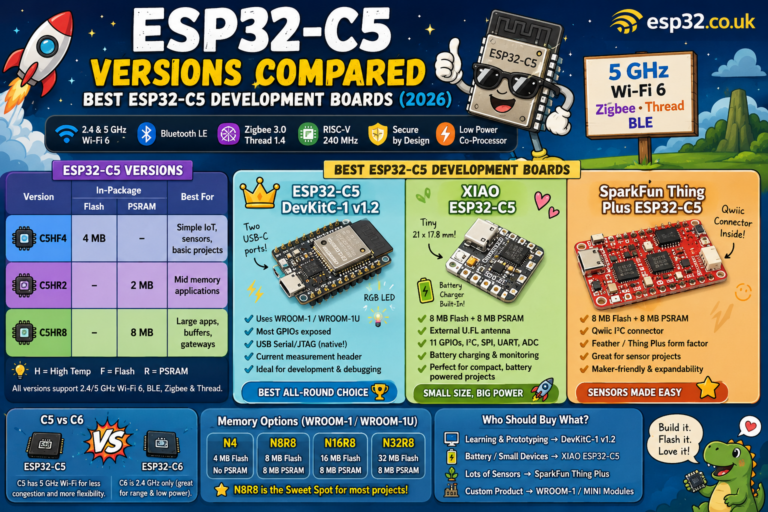
Espressif lists configurations including:
4 MB flash

8 MB flash + 8 MB PSRAM

16 MB flash + 8 MB PSRAM

32 MB flash + 8 MB PSRAM
for the C5-WROOM-1 family. (documentation.espressif.com)
That changes the picture significantly.
For a simple project:
C6
512 KB internal SRAM
is excellent.
For a much larger application:
C5
384 KB internal SRAM
+
8 MB PSRAM
offers far more total working memory.
PSRAM becomes useful for:
- large web pages
- large JSON objects
- buffers
- audio
- networking
- caching
- data processing
- large firmware frameworks
So the memory comparison is really:
C6 has more internal SRAM.
C5 has much greater total memory expansion potential.
Both support Zigbee and Thread
This is important because C5’s 5 GHz support sometimes causes people to assume C6 is still the “Zigbee/Thread ESP32.”
It isn’t.
Both contain an IEEE 802.15.4 radio.
Both support:
Zigbee 3.0
and:
Thread
C6’s current WROOM datasheet lists Thread 1.3, while the C5’s latest documentation lists Thread 1.4. (documentation.espressif.com)
For most DIY users, that version difference is far less important than the fact that both contain the required 802.15.4 hardware.
Which is better for Matter?
Both are excellent candidates.
Matter can operate over:
- Wi-Fi
- Thread
and both C5 and C6 contain the hardware required for either architecture.
For a simple Matter-over-Thread sensor:
C6 is already enough.
For a more ambitious device combining:
Thread
+
BLE commissioning
+
Wi-Fi
+
local processing
C5 has some attractive advantages:
- faster CPU
- faster LP processor
- optional PSRAM
- larger flash
- dual-band Wi-Fi
For a new high-end Matter gateway or bridge, C5 would generally be the more future-proof choice.
For a £10 battery-powered Thread temperature sensor, C6 remains perfectly sensible.
C5 has a particularly interesting smart-home advantage
Consider a smart-home gateway using:
- Thread or Zigbee at 2.4 GHz
- Wi-Fi to communicate with the LAN
- Bluetooth for commissioning
With C6, all three wireless systems operate around the same 2.4 GHz spectrum.
With C5, the Wi-Fi connection can potentially move onto 5 GHz, leaving the 2.4 GHz spectrum primarily for BLE and 802.15.4.
That does not magically eliminate all coexistence issues, but it provides an architectural option that C6 simply cannot offer.
For dense smart-home installations, that may become one of the C5’s most useful real-world advantages.
Bluetooth is newer on C5
The current C5 datasheet lists:
Bluetooth Core 6.0 certified
while C6-WROOM is:
Bluetooth 5.3 certified. (documentation.espressif.com)
C5 includes features such as:
- Direction Finding
- AoA / AoD
- Periodic Advertising with Responses
- LE Connection Subrating
- LE Power Control
- extended advertising
- multiple advertising sets
- BLE Mesh 1.1
For many ordinary Arduino BLE projects, this makes little difference.
A BLE temperature sensor or beacon will work perfectly well on either chip.
But for new commercial BLE designs, C5 clearly provides the newer radio platform.
Neither has Bluetooth Classic
This is worth mentioning for anyone migrating from the original ESP32.
Neither C5 nor C6 provides Bluetooth Classic.
They provide Bluetooth Low Energy only.
If a project specifically requires classic profiles such as older Bluetooth audio or certain serial-profile applications, the original ESP32 may still be required.
For modern IoT, however, BLE is usually the relevant protocol.
C5 has CAN FD
Industrial users get another important difference.
ESP32-C5 includes two CAN FD controllers compatible with ISO 11898-1:2015. (documentation.espressif.com)
CAN FD supports larger payloads and higher data rates than classic CAN.
C6 instead provides Espressif’s TWAI controller, aimed at conventional CAN-compatible communication. (documentation.espressif.com)
For:
- industrial control
- automotive experiments
- robotics
- modern CAN networks
C5 therefore has a meaningful advantage.
A physical CAN/CAN-FD transceiver is still required; neither chip connects directly to a CAN bus from a GPIO.
C6 has one extra ADC channel
C5 provides up to:
6 ADC channels
while C6 exposes up to:
7 ADC channels.
The C5 ADC is a 12-bit SAR ADC, as is the C6’s ADC architecture. (documentation.espressif.com)
For most projects the difference is minor.
If many analog inputs are required, an external ADC such as ADS1115 may be preferable anyway.
GPIO differences are small
At chip level, C5 provides 29 programmable GPIOs according to the current datasheet. (documentation.espressif.com)
The number actually available on a development board depends on:
- package
- module
- flash/PSRAM configuration
- board layout
For example, the current C5-WROOM modules expose up to 22 GPIOs, while C6-WROOM exposes 23 GPIOs. (documentation.espressif.com)
This means C5 is not automatically better if the project simply requires the maximum number of uncomplicated GPIO pins.
Always check the specific development board pinout, not only the chip specification.
Power consumption is more complicated than “newer is lower”
C5 is faster and more capable, but that does not mean it always consumes less power.
Espressif currently specifies typical deep-sleep figures of approximately:
ESP32-C5
12 µA

ESP32-C6
7 µA
with RTC timer and low-power memory retained. (documentation.espressif.com)
C6 therefore has the advantage for a sensor spending almost all its life in deep sleep.
C5’s 5 GHz radio can also consume substantially more current while actively transmitting or receiving than its 2.4 GHz radio. Espressif’s C5 data shows roughly 110 mA 5 GHz receive current under several tested modes, compared with roughly 87–91 mA for its 2.4 GHz Wi-Fi modes. (documentation.espressif.com)
This does not mean C5 has “bad” power consumption.
It means:
Use the extra performance only when it provides a benefit.
Which is better for battery sensors?
For a tiny node that does:
Wake
→ measure sensor
→ connect
→ send result
→ deep sleep
C6 remains very attractive.
Reasons include:
- lower published deep-sleep current
- plenty of CPU performance
- plenty of internal SRAM
- Wi-Fi 6
- BLE
- Thread/Zigbee
If 5 GHz isn’t needed, choosing C5 purely because it is newer may not improve the project.
For a battery device requiring more complex low-power processing, however, C5’s much faster 48 MHz LP processor can make it more interesting.
So:
Simple deep-sleep node → C6
More sophisticated low-power processing → C5 may win
Which is better for Home Assistant?
For ordinary ESPHome Home Assistant devices, either one is more than powerful enough.
Examples:
- BME280 sensor
- SHT40 node
- DS18B20
- relay controller
- mmWave presence sensor
- energy monitor
- BLE proxy
- MQTT sensor
C6 has already become a mature and popular Home Assistant choice.
C5’s advantage becomes meaningful when the Home Assistant device benefits from:
- 5 GHz Wi-Fi
- extra processing power
- more flash
- PSRAM
- more advanced multi-protocol operation
For a simple temperature sensor, C5 is arguably unnecessary.
For a sophisticated room controller combining many sensors, a local web UI and multiple wireless protocols, C5 is much more compelling.
ESPHome supports both
ESPHome’s current ESP32 platform includes both:
variant: esp32c5and:
variant: esp32c6as supported targets. (ESPHome – Smart Home Made Simple)
This is an important change from earlier periods when C6 support was still being introduced and C5 support was unavailable.
In 2026, both are realistic ESPHome platforms.
That removes one of the strongest historical arguments for automatically choosing the older C6.
Arduino supports both as stable targets
Official Arduino-ESP32 documentation now lists both:
ESP32-C5 — Stable
and:
ESP32-C6 — Stable. (Espressif Systems)
Standard Arduino APIs are available for major peripherals across both platforms.
This means a developer no longer needs to choose C6 simply because C5 is “too new for Arduino.”
That may have been a valid concern early in C5’s life.
It is no longer a strong buying argument in 2026.
C6 still has the more established hardware ecosystem
Software support is now strong on both, but C6 has been available much longer.
As a result, the market contains a large number of C6 boards including:
- Espressif DevKitC
- Espressif DevKitM
- XIAO ESP32-C6
- SuperMini boards
- various compact third-party designs
- Zigbee/Thread-oriented boards
C5’s development-board ecosystem is growing, but it is still younger.
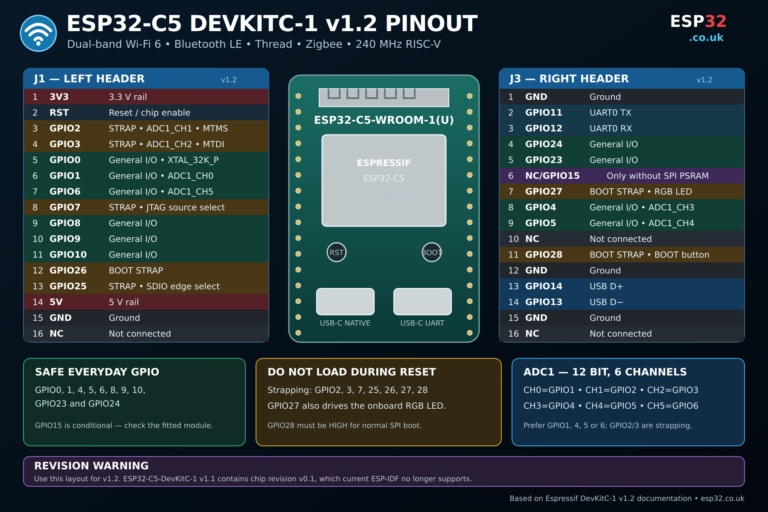
Espressif’s main official reference board is currently the ESP32-C5-DevKitC-1 v1.2, built around the C5-WROOM-1/WROOM-1U module. Espressif states that all available non-flash GPIOs are broken out to the headers. (Espressif Systems)
If the exact board size or form factor matters, C6 currently gives buyers more choice.
Official C5 board to buy
For general experimentation, the obvious official choice is:
ESP32-C5-DevKitC-1 v1.2
It provides:
- C5-WROOM module
- 2.4/5 GHz Wi-Fi
- BLE
- Zigbee
- Thread
- exposed GPIOs
- USB
- current-measurement support
- breadboard-friendly headers
Espressif’s latest documentation identifies v1.2 as the current board revision. (Espressif Systems)
It is the safest choice for learning the C5 before moving to smaller third-party boards.
Official C6 boards
C6 gives more official form-factor choice.
The two important boards are:
and:
DevKitC uses the larger WROOM module and more traditional development-board format.
DevKitM uses the smaller MINI module.
For broad C6 development, DevKitC remains the easiest recommendation.
For compact prototypes or eventual MINI-module designs, DevKitM is attractive.
Which is better for a web server?
The additional CPU speed and availability of modules with:
8 MB PSRAM
+
8 / 16 / 32 MB flash
give C5 substantially more headroom.
For:
- embedded HTML
- larger dashboards
- JSON APIs
- logging
- local databases
- multiple network clients
the C5 architecture is more expandable. (documentation.espressif.com)
For a tiny configuration page, either chip is fine.
Which is better for Zigbee devices?
For a basic Zigbee device:
C6 is enough.
Examples:
- temperature sensor
- relay
- contact sensor
- light controller
The C6 already has Zigbee 3.0 and a mature development ecosystem.
For a more sophisticated gateway or combined:
Zigbee
+
Wi-Fi
+
BLE
device, C5 is more attractive because of its faster CPU and dual-band Wi-Fi.
Which is better for Thread?
Again, both work.
C6 supports Thread 1.3 in the current WROOM documentation.
C5 supports the newer Thread 1.4 specification. (documentation.espressif.com)
For a straightforward Matter-over-Thread endpoint, C6 remains perfectly reasonable.
For a new design intended to remain current for several years, C5 has the advantage.
Which is better for BLE?
For a conventional BLE sensor:
Either.
For newer BLE functionality:
C5.
Its Bluetooth Core 6.0 certification and additional newer BLE features give it more long-term capability. (documentation.espressif.com)
Which is better for industrial projects?
C5
Reasons include:
- faster CPU
- CAN FD
- optional PSRAM
- much larger flash options
- dual-band Wi-Fi
- newer Bluetooth
- faster low-power processor
The two CAN FD controllers in particular distinguish it from C6 for modern industrial and automotive-network applications. (documentation.espressif.com)
Which is better for a simple sensor?
C6
If the project is:
ESP32
+
SHT40
+
ESPHome
+
Home Assistant
there is very little reason to require:
240 MHz
5 GHz
8 MB PSRAM
32 MB flash
C6 already has more than enough performance.
It is an excellent example of choosing the appropriate microcontroller rather than simply choosing the highest specification.
Which is more future-proof?
C5
Not because C6 is obsolete — it isn’t.
But C5 adds several capabilities that cannot be added later in software:
- 5 GHz radio
- 240 MHz CPU
- 48 MHz LP processor
- CAN FD
- newer BLE
- Thread 1.4
- PSRAM support
- larger flash options
If one development board is being bought today simply to experiment with the modern ESP32 ecosystem, C5 gives more room to explore.
Should an existing C6 project be upgraded to C5?
Usually no.
If a C6 project already works reliably, moving to C5 simply because C5 is newer provides little benefit.
Keep C6 if:
- 2.4 GHz coverage is good
- firmware fits comfortably
- CPU usage is low
- GPIOs are sufficient
- Thread/Zigbee works correctly
- power consumption is satisfactory
Consider C5 when there is an actual requirement for:
- 5 GHz
- more CPU performance
- PSRAM
- much larger flash
- CAN FD
- newer wireless features
There is no reason to redesign a successful C6 temperature sensor around C5.
Is C5 the replacement for C6?
Not really.
It is better to think of them as different performance tiers.
ESP32-C6
A highly capable, cost-conscious Wi-Fi 6 + BLE + 802.15.4 IoT chip.
ESP32-C5
A higher-performance, dual-band connected IoT chip with greater memory expansion and newer interfaces.
C6 continues to make sense precisely because many IoT projects do not need what C5 adds.
C5 vs C6 recommendations by project
| Project | Better choice |
|---|---|
| Basic ESPHome sensor | C6 |
| Battery temperature sensor | C6 |
| Zigbee sensor | C6 |
| Thread end device | C6 |
| Matter-over-Thread device | C5 / C6 |
| Home Assistant multipurpose node | C5 |
| 5 GHz Wi-Fi project | C5 |
| Congested 2.4 GHz environment | C5 |
| Smart-home gateway | C5 |
| Large web interface | C5 |
| Large firmware + PSRAM | C5 |
| Industrial CAN FD | C5 |
| Cheapest practical option | C6 |
| Maximum development flexibility | C5 |
| Existing working C6 project | Keep C6 |
The simple buying decision
The decision can be reduced to one question:
Do you need anything C5 adds?
That means:
- 5 GHz Wi-Fi
- 240 MHz processor
- 48 MHz LP processor
- PSRAM
- larger flash
- CAN FD
- newer BLE/Thread capabilities
If the answer is:
Yes
buy the ESP32-C5.
If the answer is:
No
the ESP32-C6 remains an excellent and often more economical choice.
Final recommendation
For someone buying a new board in 2026 without a very specific constraint, ESP32-C5 is now the more interesting general-purpose choice.
Its biggest advantage is not one single specification.
It is the combination of:
240 MHz RISC-V
+
2.4 GHz Wi-Fi 6
+
5 GHz Wi-Fi 6
+
Bluetooth LE
+
Zigbee
+
Thread
+
optional PSRAM
+
large flash options
in one chip. (documentation.espressif.com)
That makes it one of the most flexible connectivity-focused ESP32s.
But C6 should not be dismissed.
It provides:
- more internal SRAM
- lower specified deep-sleep current
- Wi-Fi 6
- Zigbee
- Thread
- BLE
- mature boards
- plenty of processing power
at a level that already exceeds what most simple IoT nodes require. (documentation.espressif.com)
So the final answer is:
Choose ESP32-C5 for performance, dual-band Wi-Fi and maximum future flexibility.
Choose ESP32-C6 for simpler, lower-cost Wi-Fi/Thread/Zigbee devices where 2.4 GHz is enough.
And if the choice is simply between two similarly priced development boards with no other constraints:
buy the C5.