
The ESP32-C5 is Espressif’s first ESP32 with dual-band 2.4 GHz + 5 GHz Wi-Fi 6, while also providing Bluetooth LE and 802.15.4 for Zigbee and Thread. It combines a 240 MHz RISC-V main processor, a 48 MHz low-power RISC-V processor, 384 KB of HP SRAM and support for PSRAM. For most developers, the ESP32-C5-DevKitC-1 v1.2 is the best general-purpose board. The XIAO ESP32-C5 is an excellent compact/battery option, while boards such as the SparkFun Thing Plus ESP32-C5 add convenient expansion connectors and more maker-oriented features.
1. Why ESP32-C5 is important
The ESP32-C5 fills one of the biggest remaining gaps in the ESP32 family: 5 GHz Wi-Fi.
Older ESP32 generations such as the original ESP32, ESP32-S3, ESP32-C3 and ESP32-C6 operate primarily on the crowded 2.4 GHz Wi-Fi band. ESP32-C5 adds dual-band Wi-Fi 6, allowing a project to connect using either 2.4 GHz or 5 GHz depending on range, interference and network conditions.
It also keeps the multi-protocol features that make the C-series interesting for smart-home and IoT applications:
- 2.4 GHz and 5 GHz Wi-Fi 6
- Bluetooth Low Energy
- IEEE 802.15.4
- Zigbee 3.0
- Thread 1.4
- RISC-V architecture
- USB Serial/JTAG
- External flash and PSRAM support
- Modern hardware security features
This makes the C5 particularly attractive for smart-home hubs, gateways, industrial IoT, sensor hubs and devices operating in environments where 2.4 GHz Wi-Fi is heavily congested.
2. ESP32-C5 processor and memory
ESP32-C5 actually contains two RISC-V processors with different jobs.
The main high-performance processor is a:
- 32-bit RISC-V CPU
- Single core
- Up to 240 MHz
There is also a dedicated low-power RISC-V processor running at up to 48 MHz. This can perform limited work while the main processor is sleeping, allowing more sophisticated low-power applications than simply waking the entire chip whenever something happens.
Internal memory consists of:
| Memory | ESP32-C5 |
|---|---|
| ROM | 320 KB |
| High-performance SRAM | 384 KB |
| Low-power SRAM | 16 KB |
| External flash | Supported |
| External/in-package PSRAM | Variant dependent |
The C5 therefore has substantially more flexibility than its internal SRAM figure initially suggests. A board or module with 8 MB PSRAM can handle considerably larger buffers, networking workloads and complex applications.
3. ESP32-C5 wireless specifications
Wireless connectivity is the main reason to choose the C5.
Wi-Fi
ESP32-C5 supports both:
- 2.4 GHz Wi-Fi
- 5 GHz Wi-Fi
The latest datasheet specifies Wi-Fi 6 / IEEE 802.11ax operation and backwards compatibility with older Wi-Fi standards including 802.11a/b/g/n. It supports data rates up to 150 Mbps.
For typical IoT applications, 5 GHz is not simply about higher speed.
It can also provide:
- less interference
- more available channels
- lower congestion
- lower latency in busy environments
The trade-off is that 2.4 GHz generally provides better range and wall penetration, so having both bands is more useful than simply replacing 2.4 GHz with 5 GHz.
Bluetooth
ESP32-C5 supports Bluetooth Low Energy, with the current ESP32-C5 v1.3 datasheet listing Bluetooth Core 6.0 certification and features including extended advertising, direction finding, periodic advertising with responses and LE power control.
There is no Bluetooth Classic. Projects requiring Bluetooth Classic profiles should still consider the original ESP32.
Zigbee and Thread
The integrated IEEE 802.15.4 radio supports:
- Zigbee 3.0
- Thread 1.4
This makes ESP32-C5 suitable for Matter/Thread products and multi-protocol smart-home applications without requiring a separate 802.15.4 radio.
4. ESP32-C5 chip versions explained
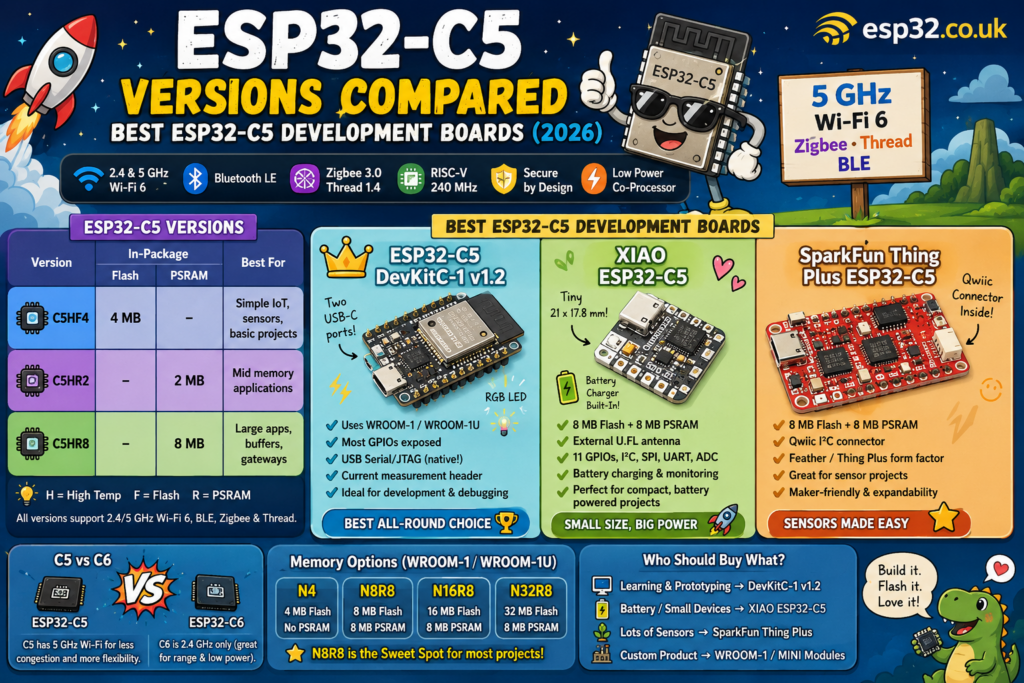
As of the latest June 2026 ESP32-C5 datasheet, Espressif lists three principal C5 silicon variants:
The letters in the part number are useful.
- H = high-temperature grade
- F = in-package flash
- R = in-package PSRAM
- Final number = memory capacity in megabytes
ESP32-C5HF4
The C5HF4 contains:
- 4 MB in-package flash
- No in-package PSRAM
This is the simplest C5 configuration and is well suited to general IoT firmware where very large RAM buffers are unnecessary.
ESP32-C5HR8
The C5HR8 contains:
- 8 MB in-package PSRAM
- No in-package flash
Flash is therefore added separately when this chip is used in a module.
This is the more interesting option for demanding projects because the 8 MB PSRAM dramatically increases the memory available for large buffers and applications.
ESP32-C5HR2
The newer C5HR2 contains:
- 2 MB in-package PSRAM
- No in-package flash
It was added to the datasheet in May 2026. Espressif’s June 2026 v1.3 datasheet states that this particular variant was not yet in mass production at the time of publication.
For most buyers in 2026, the HF4 and HR8 variants are therefore the ones most likely to appear in actual boards and modules.
5. ESP32-C5 versions comparison
| Version | In-package Flash | In-package PSRAM | Best suited for |
|---|---|---|---|
| ESP32-C5HF4 | 4 MB | None | Basic IoT, sensors, simple network devices |
| ESP32-C5HR2 | None | 2 MB | Intermediate-memory designs |
| ESP32-C5HR8 | None | 8 MB | Larger applications, buffers, gateways |
All three share the same basic C5 wireless and processing architecture. The important difference is where the memory is located and how much PSRAM is available.
6. ESP32-C5-WROOM-1 module versions
Most projects will not use the bare C5 chip. They will use a certified module.
The main general-purpose module is:
ESP32-C5-WROOM-1
There is also:
ESP32-C5-WROOM-1U
The difference is the antenna.
- WROOM-1 → integrated PCB antenna
- WROOM-1U → IPEX external antenna connector
The external-antenna version is useful when the device will be placed inside an enclosure, near metal, or where antenna position needs to be controlled.
Main WROOM memory configurations
Espressif currently lists:
| Module | Flash | PSRAM |
|---|---|---|
| N4 | 4 MB | None |
| N8R8 | 8 MB | 8 MB |
| N16R8 | 16 MB | 8 MB |
| N32R8 | 32 MB | 8 MB |
Both PCB-antenna and external-antenna WROOM versions are available with these general memory configurations.
Which module version is best?
For a simple sensor or relay:
N4 is enough.
For Home Assistant gateways, web interfaces, larger firmware or more ambitious projects:
N8R8 is probably the sweet spot.
For applications requiring large filesystems, substantial web assets or extensive OTA space:
N16R8 or N32R8 provides far more flash storage.
7. ESP32-C5-MINI-1 and MINI-1U
Espressif also now lists compact:
- ESP32-C5-MINI-1
- ESP32-C5-MINI-1U
The MINI-1 uses a PCB antenna, while MINI-1U uses an IPEX external antenna connector. Current Espressif listings show 4 MB flash and no PSRAM for the standard MINI versions, with 22 GPIOs exposed through the module compared with 29 on the WROOM family.
These modules make more sense for custom compact products than for developers who simply want a breadboard board.
At present, Espressif’s generic C5 development-board documentation centers on the DevKitC-1 rather than a C5 DevKitM, so the MINI modules are currently more relevant to custom PCB designers.
8. ESP32-C5-DevKitC-1 v1.2
For most developers, the ESP32-C5-DevKitC-1 v1.2 is the board to buy first.
It is Espressif’s official general-purpose development board and uses an ESP32-C5-WROOM-1 or WROOM-1U module. Most available GPIOs are brought out to standard headers.
The board includes:
- ESP32-C5-WROOM module
- 5 V to 3.3 V DC/DC converter
- Boot button
- Reset button
- Addressable RGB LED on GPIO27
- USB-to-UART interface
- Native ESP32-C5 USB Serial/JTAG port
- Current-measurement jumper
- Breadboard-friendly GPIO headers
Two USB-C ports
One particularly useful feature is the presence of two USB-C connections.
The first uses the on-board USB-to-UART bridge.
The second connects to the ESP32-C5’s own USB Serial/JTAG controller and supports USB 2.0 full-speed operation up to 12 Mbps for programming, communication and JTAG debugging.
This makes the DevKitC-1 especially useful for debugging and development.
Current measurement
The board also includes the J5 current-measurement header.
Removing its jumper isolates the module so an ammeter can be inserted in series, making it much easier to measure real ESP32-C5 power consumption during sleep and active operation.
That is a particularly useful feature for battery and low-power development.
9. DevKitC-1 v1.1 vs v1.2
There are currently two revisions likely to appear in stores:
- v1.1
- v1.2
Version 1.1 was the initial board.
Version 1.2 revised the J1 and J3 header functions on newer production boards. Espressif therefore recommends checking the correct board revision when using a pinout or schematic.
For a new purchase, v1.2 is the version to prefer.
10. Seeed Studio XIAO ESP32-C5
The XIAO ESP32-C5 takes a very different approach.
Instead of exposing almost every pin on a large development board, it compresses the C5 into a board measuring approximately 21 × 17.8 mm.
Its key specifications include:
- ESP32-C5 at up to 240 MHz
- 8 MB flash
- 8 MB PSRAM
- USB-C
- External U.FL antenna
- 11 GPIOs
- 5 ADC-capable pins
- I²C, SPI and UART
- User LED
- Battery charging circuitry
- Battery-voltage measurement circuitry
Seeed uses an SGM40567 battery charging IC, and the board can operate from a 3.7 V lithium battery.
Who should buy the XIAO C5?
It is arguably the best C5 board for:
- small battery-powered sensors
- wearable projects
- compact Home Assistant nodes
- custom enclosures
- embedded projects where DevKitC is physically too large
The trade-off is obvious: only a fraction of the C5’s GPIOs are accessible.
11. SparkFun Thing Plus ESP32-C5
Another interesting option is the SparkFun Thing Plus ESP32-C5.
SparkFun’s current board listing specifies:
- ESP32-C5
- 2.4 + 5 GHz Wi-Fi 6
- Bluetooth LE
- Zigbee/Thread-capable C5 radio
- 8 MB flash
- 8 MB PSRAM
- USB-C
- Qwiic connector
- Thing Plus / Feather-style form factor
The integrated Qwiic connector is particularly useful for sensor projects because compatible I²C devices can be connected without breadboard wiring.
This board is a good choice for:
- environmental sensors
- data loggers
- sensor-heavy prototypes
- projects already using Qwiic hardware
- Feather/Thing Plus style enclosures and accessories
12. Best ESP32-C5 development boards compared
| Board | Flash / PSRAM | Main advantage | Best for |
|---|---|---|---|
| ESP32-C5-DevKitC-1 v1.2 | Depends on WROOM module | Maximum GPIO access, official reference board | General development |
| XIAO ESP32-C5 | 8 MB / 8 MB | Extremely compact, battery charger | Battery and small projects |
| SparkFun Thing Plus ESP32-C5 | 8 MB / 8 MB | Qwiic + maker-friendly layout | Sensors and prototyping |
The DevKitC-1 remains the safest first C5 purchase because Espressif’s official schematics, pinouts and documentation use it as the main C5 reference platform.
The XIAO becomes more attractive once physical size or battery integration matters.
13. ESP32-C5 vs ESP32-C6
The most common decision will probably be C5 vs C6.
Both provide:
- Wi-Fi 6
- BLE
- Zigbee/Thread via 802.15.4
- RISC-V processors
The major advantage of the C5 is 5 GHz Wi-Fi.
C6 remains a very good choice when only 2.4 GHz Wi-Fi is required, but C5 provides far greater networking flexibility in environments containing large numbers of Wi-Fi devices.
For a brand-new mains-powered smart-home hub, gateway or networking-heavy design, C5 is therefore particularly attractive.
For a simple battery temperature sensor that wakes every five minutes, 5 GHz may offer little practical benefit.
14. Arduino support in 2026
ESP32-C5 now has full stable support in Arduino-ESP32, alongside ESP32, C3, C6, S2 and S3.
Arduino support currently covers common functions such as:
- ADC
- UART
- USB Serial
- Wi-Fi
- Zigbee
More advanced Matter-over-Thread configurations can still require Arduino to be built as an ESP-IDF component rather than relying only on the precompiled Arduino libraries.
For normal Wi-Fi, sensors, BLE and GPIO projects, however, C5 is no longer an ESP-IDF-only device.
15. Which ESP32-C5 should you buy?
For general learning and prototyping
Choose:
ESP32-C5-DevKitC-1 v1.2
It exposes the most hardware and has the strongest official documentation.
For Home Assistant sensors
Choose:
XIAO ESP32-C5 if size and battery support matter.
Choose:
DevKitC-1 if maximum GPIO flexibility matters.
For lots of I²C sensors
Choose:
SparkFun Thing Plus ESP32-C5
The Qwiic connector simplifies wiring significantly.
For a custom PCB with no need for PSRAM
Choose:
ESP32-C5-WROOM-1-N4
For a larger application needing PSRAM
Choose:
ESP32-C5-WROOM-1-N8R8
This provides an excellent balance of 8 MB flash + 8 MB PSRAM.
For an enclosed device requiring an external antenna
Choose the equivalent:
ESP32-C5-WROOM-1U
16. Final recommendation
For most readers beginning with ESP32-C5 in 2026, the best combination is:
ESP32-C5-DevKitC-1 v1.2 with an N8R8 WROOM module
It provides the C5’s biggest advantages:
- dual-band 2.4/5 GHz Wi-Fi 6
- Bluetooth LE
- Zigbee and Thread
- 240 MHz RISC-V CPU
- low-power secondary processor
- plenty of flash
- 8 MB PSRAM
- full GPIO access
- native USB Serial/JTAG
- official Espressif documentation
For a finished compact project rather than a development bench, the XIAO ESP32-C5 is arguably the more attractive board because it combines 8 MB flash, 8 MB PSRAM, battery charging and an external antenna in a very small package.