The ESP32-C6AliExpress price is the better choice for most new projects because it keeps the C3’s 160 MHz RISC-V architecture while adding Wi-Fi 6, Bluetooth 5.3, Zigbee, Thread, a separate low-power RISC-V core, more internal SRAM and a larger peripheral set. The older ESP32-C3AliExpress price remains an excellent low-cost choice for straightforward Wi-Fi/BLE devices, and its specified deep-sleep current is actually slightly lower at around 5 µA versus 7 µA for the C6. If a project only needs Wi-Fi, BLE, GPIO and a few sensors, the C3 can save money without sacrificing useful performance. If starting a new smart-home, Matter, Thread or Zigbee project, choose the ESP32-C6AliExpress price. (Espressif Documentation)
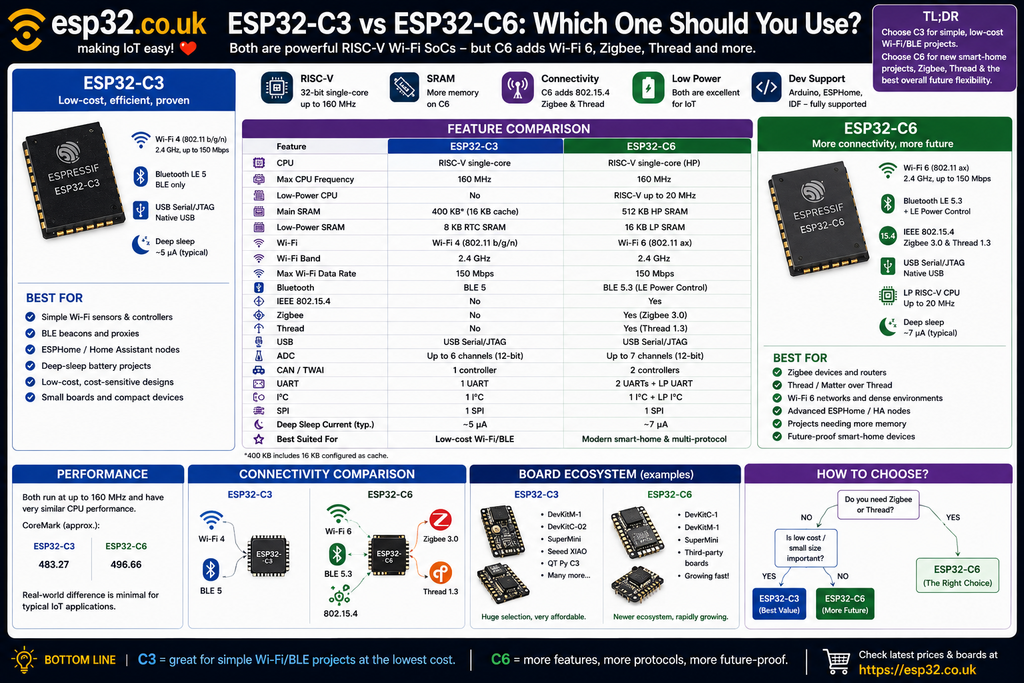
ESP32-C3 vs ESP32-C6 at a glance
At first glance, the C3 and C6 look surprisingly similar.
Both are:
- single-core 32-bit RISC-V ESP32AliExpress price chips
- capable of running at up to 160 MHz
- 2.4 GHz Wi-Fi devices
- Bluetooth Low Energy capable
- designed for low-power IoT
- equipped with native USB Serial/JTAG
- supported by Arduino
- supported by ESPHome
- available on inexpensive development boards
But the C6 belongs to a newer connectivity generation.
The major addition is an integrated IEEE 802.15.4 radio, giving it native support for Zigbee and Thread, while Wi-Fi moves from Wi-Fi 4 on the C3 to Wi-Fi 6 on the C6.
| Feature | ESP32-C3AliExpress price | ESP32-C6 |
|---|---|---|
| CPU | RISC-V single-core | RISC-V HP core |
| Maximum CPU speed | 160 MHz | 160 MHz |
| Low-power CPU | No separate LP CPU | RISC-V up to 20 MHz |
| Main SRAM | 400 KB* | 512 KB HP SRAM |
| Low-power SRAM | 8 KB RTC SRAM | 16 KB LP SRAM |
| Wi-Fi | Wi-Fi 4 | Wi-Fi 6 |
| Wi-Fi band | 2.4 GHz | 2.4 GHz |
| Maximum Wi-Fi data rate | 150 Mbps | 150 Mbps |
| Bluetooth | BLE 5 | BLE 5.3 |
| IEEE 802.15.4 | No | Yes |
| Zigbee | No | Yes |
| Thread | No | Yes, Thread 1.3 |
| ADC channels | Up to 6 | Up to 7 |
| USB | USB Serial/JTAG | USB Serial/JTAG |
| CAN/TWAI | 1 controller | 2 controllers |
| Typical deep sleep | ~5 µA | ~7 µA |
| Best for | Low-cost Wi-Fi/BLE | Modern smart-home IoT |
*The ESP32-C3’s 400 KB SRAM includes 16 KB configured as cache.
Both have a 160 MHz RISC-V processor
One thing that does not change when moving from C3 to C6 is the maximum main CPU frequency.
Both run at:
160 MHz
and both use a 32-bit RISC-V architecture.
The published CoreMark results are also remarkably close:
ESP32-C3
483.27 CoreMark

ESP32-C6
496.66 CoreMark
So for ordinary Arduino code, the C6 is not dramatically faster.
A loop processing sensor data, controlling relays or publishing MQTT messages will normally perform very similarly on both.
This means the reason to buy a C6 is connectivity, memory and peripherals, not raw main-CPU speed.
C6 adds a separate low-power processor
The C6 does have one major CPU architecture advantage.
In addition to the normal 160 MHz high-performance core, it contains a second:
32-bit low-power RISC-V CPU running at up to 20 MHz. (Espressif Documentation)
This low-power processor can continue performing selected tasks while the main system is in a reduced-power state.
Conceptually:
Main 160 MHz CPU
↓
goes to sleep

20 MHz LP CPU
↓
monitors selected events
↓
wakes main system when needed
This can be useful for:
- sensor monitoring
- low-power event detection
- periodic housekeeping
- battery nodes
- always-on low-complexity logic
The C3 instead uses RTC memory and its normal power-management system without a separate programmable LP RISC-V processor.
For a simple deep-sleep temperature sensor, that distinction may not matter.
For more sophisticated low-power designs, the C6 architecture is considerably more flexible.
C6 has more internal memory
Memory is another clear improvement.
ESP32-C3
Provides:
384 KB ROM
400 KB SRAM
8 KB RTC SRAM
with 16 KB of its SRAM configured as cache.
ESP32-C6
Provides:
320 KB ROM
512 KB HP SRAM
16 KB LP SRAM
32 KB L1 cache
The difference is especially useful with:
- ESPHome
- larger networking stacks
- TLS
- JSON
- web servers
- BLE
- Zigbee
- Thread
- Matter
- several sensors simultaneously
For small Arduino sketches, both have plenty.
For more complicated connected applications, the C6’s memory architecture gives substantially more breathing room.
C3 uses Wi-Fi 4
The ESP32-C3 supports:
IEEE 802.11b/g/n
which is commonly described as:
Wi-Fi 4
in the ESP32 context.
It operates exclusively in the:
2.4 GHz band
and supports a maximum PHY data rate of approximately:
150 Mbps.
For normal IoT devices, Wi-Fi 4 remains entirely adequate.
A sensor transmitting:
Temperature: 22.4°C
Humidity: 47%
once every 30 seconds needs almost no bandwidth.
So Wi-Fi 6 alone is not a reason to replace every C3 with a C6.
C6 adds Wi-Fi 6
The ESP32-C6 supports:
IEEE 802.11ax Wi-Fi 6
while remaining backwards compatible with:
- 802.11b
- 802.11g
- 802.11n
networks.
Like the C3, it remains 2.4 GHz only.
This is important:
ESP32-C6
≠
5 GHz Wi-Fi
For dual-band 2.4 + 5 GHz Wi-Fi, the relevant C-series chip is the ESP32-C5.
Why Wi-Fi 6 matters for IoT
The main advantage of Wi-Fi 6 on an ESP32 is not necessarily faster downloads.
C6’s maximum Wi-Fi data rate is still around:
150 Mbps
just like C3.
The useful improvements include technologies such as:
- OFDMA
- Target Wake Time
- spatial reuse
- improved operation in dense wireless environments
- downlink MU-MIMO support
- improved efficiency with many connected devices
Espressif specifically highlights Wi-Fi 6’s suitability for high-density environments.
That is exactly the sort of environment found in a modern smart home containing:
30 Wi-Fi devices
+
20 Zigbee devices
+
Bluetooth
+
phones
+
TVs
+
cameras
The benefit is more about network efficiency than headline bandwidth.
The biggest C6 advantage is IEEE 802.15.4
This is probably the most important section in the entire comparison.
The C3 supports:
Wi-Fi
+
Bluetooth LE
The C6 supports:
Wi-Fi
+
Bluetooth LE
+
IEEE 802.15.4
That third radio technology enables:
- Zigbee
- Thread
- Matter-over-Thread
on the same ESP32.
This transforms the C6 from simply another Wi-Fi ESP32 into a genuine multiprotocol smart-home chip.
C6 supports Zigbee 3.0
Espressif specifies:
Zigbee 3.0
support for ESP32-C6.
That makes it suitable for projects such as:
- Zigbee temperature sensors
- Zigbee relays
- smart switches
- door/window sensors
- motion sensors
- environmental monitors
- Zigbee routers
- coordinators and gateways depending on software architecture
The C3 does not contain an 802.15.4 radio.
It therefore cannot become a native Zigbee device simply through a firmware update.
An external Zigbee radio would be required.
C6 supports Thread
The C6’s integrated 802.15.4 radio also supports:
Thread 1.3 in Espressif’s current C6 documentation.
Thread is increasingly important because it provides the low-power IP-based mesh networking foundation used by many Matter devices.
That makes C6 a much stronger choice for anyone learning:
- OpenThread
- Matter
- Thread end devices
- Thread routers
- smart-home interoperability
C3 cannot directly participate in a Thread network because it lacks the required 802.15.4 radio.
Which one is better for Matter?
For a simple Matter-over-Wi-Fi device, both C3 and C6 can potentially be useful depending on framework support and application requirements.
But if the goal is:
Matter over Thread
the choice is easy:
because the C6 contains IEEE 802.15.4 hardware and the C3 does not.
For anyone specifically buying a board to learn modern smart-home standards, C6 is therefore the more future-proof platform.
Bluetooth is newer on the C6
The C3 supports:
Bluetooth LE 5
with features including:
- 1 Mbps
- 2 Mbps
- 125 kbps
- 500 kbps
- extended advertising
- multiple advertising sets
- Bluetooth Mesh
The C6 moves to:
Bluetooth 5.3 certification
and adds newer features such as LE Power Control.
For a basic BLE sensor, beacon or proxy, both are highly capable.
For new BLE designs, the C6 provides the newer radio platform.
Neither supports Bluetooth Classic
This matters when moving from the original ESP32.
The original ESP32 supports:
- Bluetooth Classic
- BLE
C3 and C6 support:
BLE only.
So neither is a direct replacement for projects requiring Bluetooth Classic features.
This can matter for:
- older Bluetooth serial applications
- some audio applications
- legacy Bluetooth equipment
For modern IoT applications, BLE is usually sufficient.
C3 actually wins on specified deep-sleep current
It would be easy to assume that C6 must use less power because it is newer.
According to Espressif’s current chip datasheets:
ESP32-C3 deep sleep
~5 µA

ESP32-C6 deep sleep
~7 µA
So at the chip level, C3 has the lower headline deep-sleep figure.
For a very simple battery sensor that:
sleeps 99.9% of the timethis can favour the C3.
But development board sleep current is a different matter
Do not assume a development board will actually sleep at:
5 µAjust because the chip can.
Development boards may also contain:
- USB-UART converters
- power LEDs
- regulators
- addressable LEDs
- voltage dividers
- other peripheral circuitry
These can consume far more power than the ESP32 itself.
A poorly chosen board can use:
hundreds of µAor even:
several mAwhile the C3/C6 itself is sleeping.
For serious battery designs, board-level implementation matters at least as much as choosing C3 or C6.
C6 has the more sophisticated low-power architecture
Although C3 wins on the headline 5 µA deep-sleep figure, C6 provides:
- 16 KB low-power SRAM
- 20 MHz LP RISC-V CPU
- low-power UART
- low-power I²C
in addition to its main processor.
So the comparison is more nuanced:
Simplest possible sleeping sensor
C3 has an advantage.
Device that needs useful processing while the main CPU sleeps
C6 has the more capable architecture.
ADC capability
Both include 12-bit SAR ADC hardware.
The C3 provides:
up to 6 ADC channels
while the C6 provides:
up to 7 channels.
For typical sensors this difference is small.
Most modern environmental sensors use digital buses such as:
- I²C
- SPI
- UART
rather than analog ADC inputs.
If a project needs many high-quality analog channels, an external ADC such as ADS1115 may be a better solution regardless of which ESP32 is chosen.
C6 has more peripherals
C6’s newer architecture adds several hardware peripherals absent or more limited on C3.
The C6 includes:
- two UART controllers
- LP UART
- SPI
- I²C
- LP I²C
- I²S
- pulse counter
- two TWAI controllers
- SDIO slave
- LED PWM
- MCPWM
- RMT
- PARLIO
- ETM
C3 includes a simpler selection:
- UART
- SPI
- I²C
- I²S
- USB Serial/JTAG
- one TWAI controller
- LED PWM
- RMT
- ADC
For basic sensors, there is little practical difference.
For motor control, industrial interfaces or more complex embedded systems, C6 has considerably more flexibility.
C6 has two TWAI controllers
ESP32-C3 contains:
one TWAI controller
compatible with classic CAN 2.0-style networks through an external transceiver.
ESP32-C6 provides:
two TWAI controllers.
This can be useful for:
- automotive experiments
- industrial automation
- robotics
- CAN gateways
A physical CAN transceiver is still required.
The ESP32 GPIO cannot connect directly to a CAN bus.
Both have native USB Serial/JTAG
Both C3 and C6 include an integrated:
USB Serial/JTAG controller.
This can eliminate the need for a separate USB-to-UART chip on very small boards.
It supports:
- programming
- serial console
- JTAG debugging
This is one reason tiny boards such as C3 and C6 SuperMini designs can be so compact.
However, this is USB Serial/JTAG, not the full general-purpose USB OTG capability found on chips such as the ESP32-S3.
GPIO count depends heavily on the module and board
Comparing the raw chip GPIO count can be misleading because flash packaging and board design affect what actually reaches the headers.
The C3 chip family can provide up to 22 programmable GPIOs, although some versions reserve pins for in-package flash.
For example, the ESP32-C3-WROOM-02 exposes up to:
15 GPIOs
at module level.
C6 is available in packages with:
- up to 30 GPIOs on QFN40
- 22 GPIOs on QFN32
with some required for external flash.
The practical rule is:
compare the actual development boards, not just C3 vs C6 chip specifications.
A tiny C6 SuperMini may expose fewer convenient pins than a larger C3 development board.
C3 has an enormous board ecosystem
One of C3’s strongest advantages in 2026 is simple:
there are C3 boards everywhere.
Common formats include:
- ESP32-C3-DevKitM-1
- ESP32-C3-DevKitC-02
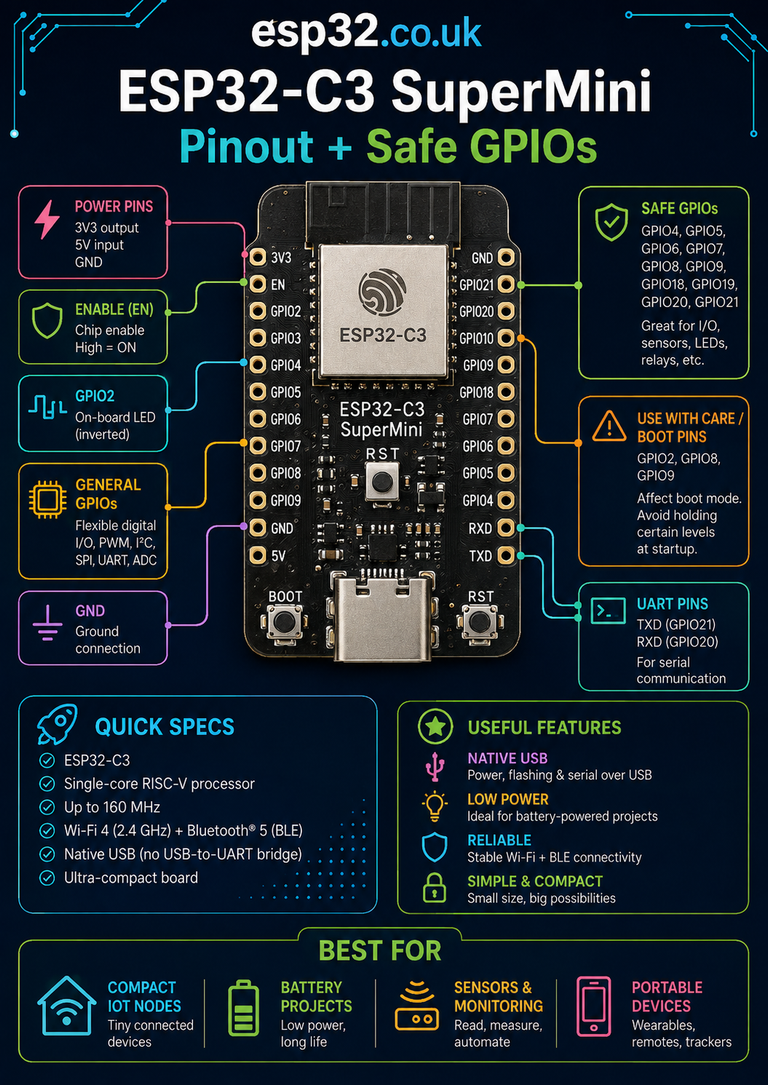
- ESP32-C3 SuperMini
- Seeed Studio XIAO ESP32C3
- Adafruit QT Py ESP32-C3
- compact third-party boards
- D1 Mini-style boards
Espressif still documents both official C3 DevKitM and DevKitC development platforms.
The C3 has become one of the standard low-cost ESP32 platforms.
ESP32-C3 SuperMini is particularly popular
For small DIY projects, the C3 SuperMini format is attractive because it combines:
- ESP32-C3
- USB-C
- tiny PCB
- Wi-Fi
- BLE
- low price
into a board little larger than the ESP32 module itself.
That makes C3 especially useful for:
- 3D-printed devices
- hidden sensors
- retrofit projects
- LED controllers
- compact Home Assistant nodes
C6 SuperMini boards now exist too, but C3 hardware has had more time to mature and is available from a wider range of sellers.
Official C3 development board
The ESP32-C3-DevKitM-1 is Espressif’s compact official C3 development board.
It uses the:
ESP32-C3-MINI-1 / MINI-1U
module with 4 MB flash integrated inside the chip package.
It provides:
- Wi-Fi
- Bluetooth LE
- USB programming
- GPIO headers
- breadboard-friendly layout
For learning the C3 without dealing with questionable clone-board pinouts, it remains an excellent choice.
Official C6 development boards
Espressif offers two major C6 boards:
The current DevKitC-1 uses an ESP32-C6-WROOM-1(U) module with:
8 MB SPI flash
and provides:
- Wi-Fi 6
- Bluetooth LE
- Zigbee
- Thread
- two USB-C connections
- native USB Serial/JTAG
- onboard USB-UART
- RGB LED
- current-measurement jumper
For general-purpose C6 development, the DevKitC-1 is the easiest official recommendation.
Arduino supports both as stable chips
This is no longer a comparison where the newer chip requires experimental Arduino support.
Espressif’s current Arduino-ESP32 documentation marks both:
ESP32-C3
Stable: Yes

ESP32-C6
Stable: Yes
So both are practical choices for:
- Arduino IDE
- PlatformIO
- common Arduino libraries
- GPIO
- ADC
- I²C
- SPI
- UART
- networking
The C6 being newer should not by itself be a reason to avoid it.
ESPHome supports both
ESPHome currently supports both:
variant: esp32c3and:
variant: esp32c6as normal ESP32 platform targets.
ESPHome itself describes the C3 as a strong option for simpler, lower-cost projects, while describing C6 as similar to C3 but with extra connectivity including Thread and as a good choice for new projects.
That is a good summary of the practical buying decision.
Which is better for Home Assistant?
For a conventional Home Assistant ESPHome node:
both are excellent.
Example:
ESP32
+
SHT40
+
Wi-Fi
+
Home Assistant
does not require:
- Wi-Fi 6
- Thread
- Zigbee
- 512 KB RAM
- LP CPU
A C3 can run that job perfectly.
So if C3 is:
- cheaper
- smaller
- already available
there may be no reason to spend more.
When C6 makes more sense for Home Assistant
C6 becomes particularly attractive when the project may eventually use:
- Thread
- Zigbee
- Matter
- Wi-Fi 6
- multiprotocol operation
- larger ESPHome configurations
For a completely new Home Assistant board purchase where the price difference is small, the C6 provides more future options.
That is why it gets the overall recommendation.
Which is better for a BLE proxy?
For a straightforward ESPHome Bluetooth proxy:
C3 is already very capable.
Its BLE 5 radio and low cost make it an attractive choice.
C6’s BLE 5.3 hardware is newer, but for ordinary BLE advertisements and proxy duties the difference is unlikely to be dramatic.
If BLE is the only reason for buying the board:
C3 remains excellent value.
Which is better for Zigbee?
ESP32-C6.
There is no close comparison.
C3:
No IEEE 802.15.4 radioC6:
IEEE 802.15.4
Zigbee 3.0
A C3 would need an external Zigbee radio.
C6 has the required radio integrated.
Which is better for Thread?
Again:
ESP32-C6.
Thread uses IEEE 802.15.4.
The C6 supports Thread 1.3 in current Espressif documentation.
C3 cannot join a Thread mesh directly.
Which is better for Matter?
For modern smart-home experimentation:
C6
is the more interesting platform because it can support both:
Matter over Wi-Fiand architectures involving:
Matter over Threaddepending on the software stack.
C3 remains useful for Wi-Fi-based Matter applications, but lacks the radio needed for native Thread.
Which is better for a simple sensor?
C3
Consider:
ESP32
+
DS18B20
+
Wi-Fi
+
MQTT
The device spends most of its time doing virtually nothing.
The C3 already provides:
- 160 MHz CPU
- 400 KB SRAM
- Wi-Fi
- BLE
- USB
- deep sleep
Adding Zigbee and Wi-Fi 6 does not make that DS18B20 measurement any better.
If a C3 board costs less, use the C3.
Which is better for a battery sensor?
For the simplest sleep-heavy device:
C3 has a slight theoretical advantage because Espressif specifies approximately 5 µA chip deep-sleep consumption versus 7 µA for the C6.
But real battery life is likely to depend more heavily on:
- development-board regulator
- power LED
- USB bridge
- sensor current
- Wi-Fi connection time
- transmission power
- wake interval
than that 2 µA difference.
So do not choose the microcontroller from the deep-sleep number alone.
Which is better for an advanced battery device?
Potentially C6.
Its 20 MHz LP RISC-V processor and low-power peripheral domain allow more sophisticated logic to continue without waking the main processor.
That means C6 can be more capable even though its basic deep-sleep figure is slightly higher.
Which is better for industrial use?
C6, generally.
Reasons include:
- two TWAI controllers
- pulse counter
- MCPWM
- PARLIO
- ETM
- LP UART/I²C
- larger memory
- newer wireless connectivity
C3 remains perfectly useful for simple industrial telemetry and controls, especially where cost matters.
Which is better for a web server?
C6, slightly.
The main CPU runs at the same speed, but C6’s additional SRAM gives more room for:
- connections
- buffers
- JSON
- TLS
- web content
- application state
Neither chip is designed as a high-performance web application processor, but C6 offers the more comfortable memory environment.
Which is better for beginners?
This is close.
C3 advantages for beginners
- inexpensive
- huge board selection
- many tutorials
- simple Wi-Fi/BLE feature set
- small SuperMini boards
- mature community support
C6 advantages for beginners
- still Arduino-friendly
- still ESPHome-friendly
- Wi-Fi 6
- Zigbee
- Thread
- newer platform
- more future experimentation
If the goal is simply:
learn Arduino and ESP32
C3 is excellent.
If the goal is:
learn modern smart-home technology
C6 is the better board.
Do you need Wi-Fi 6 for ESPHome?
Usually, no.
ESPHome sensors transmit tiny amounts of data.
A temperature sensor does not care whether the network offers:
Wi-Fi 4or:
Wi-Fi 6from a raw throughput perspective.
Wi-Fi 6 becomes useful mainly for:
- improved efficiency
- dense Wi-Fi environments
- newer access points
- future-proofing
So do not buy C6 simply because “6 is better than 4.”
The stronger reason is the whole C6 feature set, especially 802.15.4.
Does C6 replace C3?
No.
They occupy overlapping but different positions.
Think of C3 as:
modern low-cost Wi-Fi + BLE ESP32
and C6 as:
modern Wi-Fi 6 + BLE + Zigbee/Thread ESP32
C3 is therefore still the better economic choice for huge numbers of simple connected devices.
There is little reason to pay for an 802.15.4 radio that will never be used in a basic Wi-Fi relay.
Should an existing C3 project be upgraded to C6?
Usually no.
Keep C3 if:
- Wi-Fi works reliably
- BLE is sufficient
- firmware fits
- GPIO count is enough
- power consumption is acceptable
- Zigbee/Thread are not required
Changing the board adds:
- firmware work
- pinout changes
- testing
- hardware changes
with little benefit if the existing system already does its job.
Upgrade when there is a real requirement for:
- Thread
- Zigbee
- Matter-over-Thread
- Wi-Fi 6
- additional memory
- C6-specific peripherals
C3 vs C6 by project
| Project | Better choice |
|---|---|
| Basic ESPHome temperature sensor | C3 |
| Wi-Fi relay | C3 |
| MQTT sensor | C3 |
| BLE beacon | C3 |
| BLE proxy | C3 / C6 |
| Deep-sleep Wi-Fi sensor | C3 |
| New general Home Assistant node | C6 |
| Wi-Fi 6 project | C6 |
| Zigbee device | C6 |
| Thread device | C6 |
| Matter-over-Thread | C6 |
| Smart-home multiprotocol node | C6 |
| Larger ESPHome configuration | C6 |
| Industrial controller | C6 |
| Cheapest small board | C3 |
| Maximum future flexibility | C6 |
The simplest buying decision
The easiest question is:
Will the project ever need Zigbee or Thread?
If:
Yes → buy ESP32-C6.
If:
No → either board works.
Then ask:
Is the C3 meaningfully cheaper or smaller?
If:
Yes → C3 may be the better value.
If the prices are almost identical:
buy the C6.
The additional RAM, Wi-Fi 6, newer Bluetooth and 802.15.4 radio make it the more flexible platform.
C3 strengths
The ESP32-C3 still has several genuine advantages:
- low price
- huge board ecosystem
- 160 MHz RISC-V CPU
- Wi-Fi
- BLE
- native USB Serial/JTAG
- very low specified deep-sleep current
- mature Arduino support
- mature ESPHome support
- excellent compact boards
It remains one of the best chips in the ESP32 family for straightforward connected sensors.
C6 strengths
The ESP32-C6 adds:
- Wi-Fi 6
- Bluetooth 5.3
- Zigbee
- Thread
- 802.15.4
- 512 KB HP SRAM
- 16 KB LP SRAM
- 20 MHz LP RISC-V processor
- additional peripheral hardware
- two TWAI controllers
- more modern smart-home capabilities
That is a substantial feature upgrade despite the main CPU remaining at 160 MHz.
Final recommendation
The ESP32-C3 remains one of the best value ESP32 chips.
For:
Wi-Fi
+
BLE
+
sensor
projects, it already provides almost everything required.
There is little reason to stop using a C3 simply because C6 exists.
But for a new project in 2026, the ESP32-C6 is generally the more attractive platform if the price difference is small.
It keeps the same basic:
160 MHz RISC-Vperformance class while adding:
Wi-Fi 6
+
BLE 5.3
+
Zigbee
+
Thread
+
low-power RISC-V CPU
+
more SRAM
The final recommendation is therefore:
ESP32-C3 = best for inexpensive, straightforward Wi-Fi/BLE projects.
ESP32-C6 = best for new smart-home and multiprotocol projects.
If the project only needs a cheap ESPHome temperature sensor, buy the C3.
If buying one board today to experiment with the future of Home Assistant, Matter, Zigbee and Thread, buy the C6.