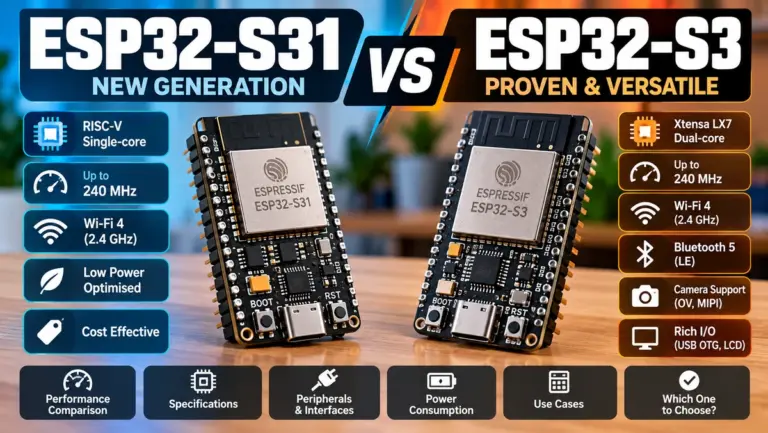
Quick summary: Espressif announced ESP-Mosaico on 20 October 2026, a modular development kit built around the ESP32-S31PriceAliExpress price. The US$59 Vision Combo Kit combines a 2.16-inch 480 × 480 AMOLED touchscreen core unit with camera and interaction modules. The official store is accepting pre-orders and currently quotes a 15-day dispatch estimate; this is not an in-stock shipping claim.
ESP-Mosaico is a development kit, not a new chip or module. Its controller is the existing ESP32PriceAliExpress price-S31NRV16 SoC, and the store identifies the core unit as hardware revision V1.2. That distinction matters because Espressif also documents an earlier V1.0 board and separate camera-module revisions.
What the ESP-Mosaico hardware includes
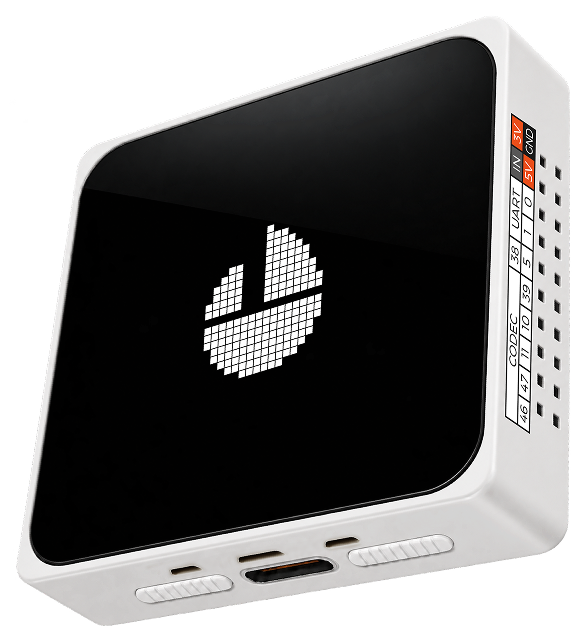
| Area | Verified ESP-Mosaico V1.2 specification |
|---|---|
| Controller | ESP32AliExpress price-S31NRV16, dual-core 32-bit RISC-V at up to 320 MHz |
| Memory and storage | 16 MB in-package PSRAM, 16 MB SPI NOR flash and 1 Gbit (128 MB) SPI NAND |
| Display | 2.16-inch, 480 × 480 QSPI AMOLED touchscreen |
| Wireless | 2.4 GHz Wi-Fi 6, Bluetooth 5.4 LE plus BR/EDR, and IEEE 802.15.4 for Thread or Zigbee |
| Onboard hardware | Microphone, speaker, audio codec and amplifier, six-axis IMU, two magnetometers, vibration motor and buttons |
| Expansion and power | Two 20-pin, 2.54 mm module interfaces, USB-C with USB 2.0 High-Speed OTG, and a 65 mAh Li-ion battery |
The Vision Combo Kit listed by Espressif contains the V1.2 core unit, a camera module and a multi-function interaction module. The interaction board adds ambient-light sensing, PIR motion detection, infrared transmission, six addressable RGB LEDs, buttons and capacitive-touch inputs.
The camera is less interchangeable than the magnetic presentation might suggest: Espressif says it works only in the left expansion slot. Camera modules also exist in V1.2 and V1.4 forms with different sensors, so buyers should check the module’s silkscreen instead of assuming a sensor from the core-unit revision. Five pins on the right expansion header are shared with the onboard audio codec, which also limits simultaneous use when microphone or speaker audio is required.
Where the “AI coding” fits
Espressif presents two workflows. Chat Coding uses the ESP-Claw agent to turn a natural-language request into an application without a locally configured toolchain. Vibe Coding is intended for a desktop coding agent that can work through implementation, simulation, flashing, physical-device feedback and iteration. The supporting stack includes ESP-IDF, a board support package and ESP-GSP, which compiles structured JSON interfaces into embedded bundles.
That does not mean every AI operation runs on the ESP32-S31. Espressif says interfaces, application logic and peripheral control that do not depend on online services can run locally after deployment. The store says the open-source factory firmware can use several hosted or custom LLM providers. Developers should therefore evaluate the chosen provider, connectivity and data handling separately from the board itself.
For conventional development, Espressif’s guide uses the esp32s31 ESP-IDF target and provides a BSP for the display, touch, audio, sensors, battery, NAND storage and expansion modules. The documentation does not establish ESPHome support, so the ESP32-S31 radio feature set should not be treated as proof that an ESPHome configuration exists. For broader context, see our ESP32-S31 development-board comparison, ESP32-S31 versus ESP32-S3 guide and ESP-IDF 6.0 overview.
Price and availability
Espressif’s own store lists the black Vision Combo Kit at US$59. Although the announcement says the kit is available to purchase, the product page labels it as a pre-order and shows an estimated 15-day shipping lead time. Shipping charges, taxes and destination availability are not included in that headline price.
One further hardware distinction is worth noting: the ESP32-S31 SoC supports a Gigabit Ethernet interface, but the Mosaico V1.2 board documentation does not list an Ethernet PHY or RJ45 socket. It should not be described as an Ethernet-equipped development board merely because the underlying silicon has that capability.