Quick Summary (TL;DR):
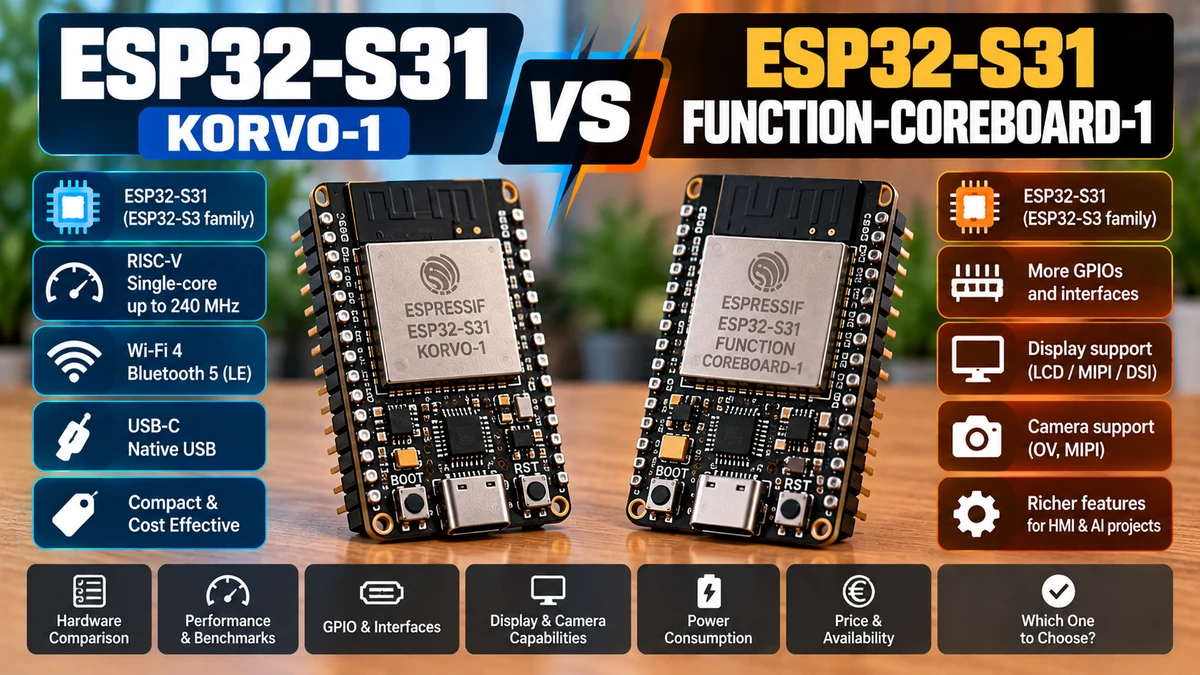
The ESP32-S31AliExpress price-Function-CoreBoard-1 and ESP32-S31AliExpress price-Korvo-1 use the same new ESP32-S31AliExpress price platform but target very different kinds of development. The Function-CoreBoard-1 is the better general-purpose S31 development board: it is built around ESP32-S31AliExpress price-WROOM-3, exposes most useful GPIOs on a 40-pin header, includes 10/100/1000 Mbps Ethernet, USB 2.0 High-Speed host, native USB Serial/JTAG, a second USB-to-UART port, an onboard microphone, mono audio codec, 3 W speaker output and a current-measurement jumper. It is ideal when you want to learn the S31, build a custom peripheral prototype, test Ethernet/Thread/Zigbee/Wi-Fi 6 or use your own display/camera hardware. The Korvo-1 is the better multimedia/voice/HMI board: V1.1 uses an ESP32-S31AliExpress price-WROOM-3 configuration with 16 MB flash and 16 MB PSRAM, dual microphones, stereo ES8389 audio, two 3 W speaker channels, microSD, a DVP camera connector, four hardware function buttons and support for the 4.3-inch ESP32-S3-LCD-EV-Board-SUB3 display. Korvo-1 is designed for speech recognition, near/far-field wake word, smart speakers, audio/video streaming and graphical HMI. The trade-off is expansion flexibility: many S31 pins are already committed to audio, SD, camera and LCD functions, and Korvo-1 does not provide the Function-CoreBoard-1’s onboard Gigabit RJ45 interface. For your first S31 board, I would buy Function-CoreBoard-1. For voice, audio, camera or ready-made HMI experiments, Korvo-1 is much more useful.
Materials You’ll Need
| Item | Why it helps |
|---|---|
| ESP32-S31-Function-CoreBoard-1 | Best general-purpose reference board for S31 connectivity and GPIO expansion |
| ESP32-S31-Korvo-1 V1.1 | Ready-made audio, camera and HMI S31 platform |
| 4.3-inch LCD subboard | Turns Korvo-1 into a complete smart-display/HMI test platform |
| OV3660 camera | Officially documented camera accessory for Korvo-1 |
| 4 Ω speakers | Audio tests; Korvo supports two channels, Function-CoreBoard one |
| microSD card | Audio/assets/storage on Korvo-1 |
| USB data cables | Power, programming, UART, JTAG and USB-host tests |
| Ethernet cable | Function-CoreBoard-1 Gigabit Ethernet testing |
| ESP-IDF | Reference development framework for S31 |
| ESP Board Manager / ESP-GMF / ESP-Brookesia | Useful Espressif board and multimedia frameworks |
These Boards Are Not Two Sizes of the Same DevKit
The easiest mistake is to treat Korvo-1 as simply a more expensive Function-CoreBoard-1. It is not. They are different reference architectures built around the same S31 module family.
Function-CoreBoard-1
→ generic connected AIoT / peripheral development
→ maximum GPIO exposure
→ Ethernet + USB + basic audio

Korvo-1
→ multimedia / voice / HMI development
→ dual microphones + stereo audio
→ LCD + camera + SD already architected
Board Comparison at a Glance
| Feature | Function-CoreBoard-1 | Korvo-1 V1.1 |
|---|---|---|
| Module | ESP32-S31-WROOM-3 | ESP32-S31-WROOM-3 |
| CPU/radio | Same S31 platform | Same S31 platform |
| Wi-Fi | 2.4 GHz Wi-Fi 6 | 2.4 GHz Wi-Fi 6 |
| Bluetooth | 5.4 LE + BR/EDR | 5.4 LE + BR/EDR |
| 802.15.4 | Thread / Zigbee / Matter | Thread / Zigbee / Matter |
| Flash / PSRAM | Depends on fitted WROOM-3 variant | 16 MB flash + 16 MB PSRAM documented |
| Ethernet RJ45 | 10/100/1000 Mbps | No onboard RJ45 |
| USB Host | USB 2.0 Type-A HS | USB 2.0 Type-A HS |
| Native USB Serial/JTAG | Dedicated Type-C | Programming mainly via USB-UART in board guide |
| USB-to-UART | Yes | Yes |
| Microphones | 1 | 2 |
| Audio codec | ES8311 mono | ES8389 stereo |
| Speaker outputs | 1 × 3 W | 2 × 3 W |
| microSD | No onboard slot | 4-bit SDIO slot |
| Camera connector | No dedicated camera connector | DVP camera connector |
| LCD connector | No dedicated LCD subboard connector | 4.3-inch LCD subboard support |
| Function buttons | Boot + Reset | PLAY / SET / VOL- / VOL+ + Boot/Reset |
| GPIO expansion | Excellent — most key GPIOs exposed | More constrained by onboard multimedia peripherals |
| Current-measurement header | Yes | Not a headline board feature |
| Best use | General S31 development | Voice/audio/HMI/camera development |
What Both Boards Have in Common
Both boards are built around the same ESP32-S31 architecture, so the core compute and wireless capabilities are fundamentally the same.
- dual-core 32-bit RISC-V up to 320 MHz
- 2.4 GHz Wi-Fi 6
- Bluetooth 5.4 LE
- Bluetooth Classic BR/EDR
- IEEE 802.15.4
- Thread 1.4
- Zigbee 3.0
- Matter-capable platform
- USB 2.0 High-Speed OTG
- JPEG / PPA / modern multimedia acceleration
- high-speed PSRAM-capable S31 memory architecture
The choice is therefore not about CPU speed or radio performance. It is about what Espressif has already wired around the S31 module for you.
Function-CoreBoard-1: The General-Purpose S31 Board
Espressif describes Function-CoreBoard-1 as a board for connected AIoT prototyping. That description is accurate: the board gives you just enough built-in hardware to exercise S31 features without turning the board into one specific product.
- most available module GPIOs routed to header J2
- 10/100/1000 Mbps auto-negotiating RJ45 Ethernet
- USB 2.0 High-Speed Type-A host port
- native USB Serial/JTAG Type-C port
- separate USB-to-UART Type-C port
- onboard microphone
- ES8311 mono audio codec
- NS4150B 3 W mono amplifier
- speaker connector
- addressable RGB LED
- current-measurement jumper/header
Why the 40-Pin Header Matters
The Function-CoreBoard routes most available WROOM-3 signals to a 40-position header. That is a much more valuable feature than it sounds because S31 has enough peripherals to make custom prototyping otherwise awkward.
The header includes UART0, general GPIOs, SDIO signals, 3.3 V, 5 V and grounds. This makes the board suitable for external displays, ADCs, CAN/TWAI interfaces, sensors, custom daughterboards and radio/peripheral experiments.
Function-CoreBoard-1 philosophy:
S31 module
  ├─ Ethernet
  ├─ USB
  ├─ basic audio
  └─ GPIO header → your hardware
Function-CoreBoard-1 Ethernet Is a Major Advantage
The onboard RJ45 interface is not a basic 10/100 add-on. Espressif documents 10/100/1000 Mbps auto-negotiation using an Ethernet PHY connected to the S31 RGMII interface.
- wired AIoT gateways
- industrial controllers
- networked HMI
- high-throughput data acquisition
- Ethernet + Wi-Fi failover experiments
- Thread/Zigbee-to-Ethernet gateways
- USB-to-network appliances
Korvo-1 can still participate in network applications through Wi-Fi, but it does not give you this ready-made RJ45 interface.
Function-CoreBoard-1 USB Layout
| Port | Purpose |
|---|---|
| USB 2.0 Type-A | High-Speed OTG host; S31 can supply up to 500 mA downstream |
| USB Serial/JTAG Type-C | Power, native USB communication, flashing and JTAG |
| USB-to-UART Type-C | Power, firmware flashing and serial console through onboard bridge |
For firmware development, having both native USB Serial/JTAG and a conventional USB-UART bridge is excellent because you can debug one interface while experimenting with another.
Function-CoreBoard-1 Audio Is Useful but Intentionally Simple
The board includes a single microphone, ES8311 mono codec and one NS4150B amplifier capable of driving a 4 Ω, 3 W speaker.
- wake-word demos
- simple voice commands
- audio playback
- Bluetooth audio experiments
- proof-of-concept speech interaction
It is not intended to be a full acoustic front end. For dual-microphone beamforming, far-field wake word and stereo playback, Korvo-1 is much better.
Current Measurement on Function-CoreBoard-1
A particularly useful engineering feature is the J5 current-measurement header. Removing the jumper separates the module supply path so an ammeter can be inserted in series to measure ESP32-S31-WROOM-3 current.
That makes Function-CoreBoard-1 a better board for power profiling than many multimedia-heavy dev kits where onboard peripherals make current numbers difficult to interpret.
Korvo-1: The Multimedia S31 Board
Korvo-1 is almost the opposite design philosophy. Rather than asking “what will you connect?”, it asks “what if the board already looked like a smart speaker/display/camera product?”
- ESP32-S31-WROOM-3 with 16 MB SPI flash + 16 MB PSRAM
- two analog microphones
- ES8389 stereo audio codec
- two NS4150B 3 W speaker amplifiers
- left + right speaker connectors
- 4.3-inch LCD daughterboard connector
- DVP camera connector
- microSD slot with 4-bit SDIO
- four application buttons
- addressable RGB LED
- USB 2.0 High-Speed host
- USB-to-UART programming interface
16 MB Flash + 16 MB PSRAM Is Exactly What Multimedia Needs
Korvo-1’s documented WROOM-3 configuration gives it 16 MB flash and 16 MB PSRAM. That is a very sensible balance for graphics, audio and camera development.
Flash
→ firmware
→ UI assets
→ fonts
→ models / resources

PSRAM
→ framebuffers
→ camera buffers
→ audio buffers
→ ML tensors
This is why a Korvo project can start from a known memory configuration instead of requiring you to first select a WROOM-3 flash/PSRAM variant.
Korvo-1 Audio Is in a Different Class
Korvo-1 uses an ES8389 stereo codec rather than Function-CoreBoard-1’s mono ES8311. The codec provides dual ADC/DAC capability, and the board routes two analog microphones plus two amplified speaker channels.
| Audio | Function-CoreBoard-1 | Korvo-1 |
|---|---|---|
| Microphones | 1 | 2 |
| Codec | ES8311 mono | ES8389 stereo |
| Speaker amps | 1 × NS4150B | 2 × NS4150B |
| Max speaker outputs | 1 × 3 W | 2 × 3 W |
| Near/far-field voice | Basic evaluation | Target use case |
| Stereo audio | No native stereo output path | Yes |
If your project involves speech recognition, acoustic directionality, near/far-field wake word or richer playback, Korvo-1 is the obvious choice.
The Dual-Microphone Array
Two microphones let voice algorithms use spatial information that one microphone cannot provide.
- better far-field wake word testing
- noise handling
- basic direction/beamforming experiments
- voice activity processing
- more realistic smart-speaker development
The board is specifically positioned by Espressif for speech recognition and near/far-field wake-up.
Korvo-1 Display Support
Korvo-1 V1.1 is designed to pair with the ESP32-S3-LCD-EV-Board-SUB3, a 4.3-inch LCD expansion board.
This makes it very different from a generic S31 board where you first need to choose a display, map the data bus, design power/backlight and resolve connector pinout.
Korvo-1 main board
       ↓ dedicated LCD connector
4.3-inch LCD subboard
       ↓
LVGL / ESP-Brookesia / HMI application
The display is an optional subboard, not necessarily soldered to every bare Korvo-1 package. Check exactly what the seller includes.
Korvo-1 Camera Support
Korvo-1 provides a dedicated camera connector plus the required 2.8 V and 1.5 V regulator rails for an external camera module. Espressif documents the OV3660 as an optional accessory.
- video streaming
- face/image detection experiments
- camera preview on LCD
- JPEG camera applications
- doorbell/intercom prototypes
- visual AI demos
Korvo-1 microSD Is More Important Than It Looks
The onboard microSD slot uses a 4-bit SDIO interface and is suitable for audio files, UI assets, captured images and logs.
The SDIO pins are shared with an optional SPI NAND flash footprint that is not populated by default. Switching from microSD to NAND is therefore a hardware configuration choice, not something you turn on simultaneously in software.
Korvo-1 Function Buttons
Korvo-1 includes PLAY, SET, VOL- and VOL+ buttons. Rather than each button consuming a separate GPIO, they are decoded through an ADC resistor-divider arrangement.
That is a good example of the board being designed as a product-like reference platform rather than a pure breakout board.
GPIO Flexibility: Function-CoreBoard Wins
If you want to connect arbitrary hardware, Function-CoreBoard-1 is much easier.
- I²S audio
- I²C codec control
- speaker amplifier enable
- microSD
- camera
- LCD
- RGB LED
- buttons
- UART
Korvo-1 consumes GPIOs for all of those functions. That does not mean Korvo has no expansion capability, but the useful pin budget is more constrained and you need to consult its assignment table before adding peripherals.
Which Board Is Better for Ethernet?
Function-CoreBoard-1 — decisively. Its RJ45 jack, transformer and Ethernet PHY are already onboard and support 10/100/1000 Mbps auto-negotiation. Korvo-1 is designed around wireless multimedia and does not include an RJ45 Ethernet subsystem.
Which Board Is Better for USB?
Both expose the S31 USB 2.0 High-Speed host through a Type-A connector and can supply up to around 500 mA to downstream USB devices under the board’s documented power design.
Function-CoreBoard-1 is the better USB development/debug board because it also gives you a dedicated native USB Serial/JTAG Type-C port in addition to USB-UART. Korvo-1 is the better USB + multimedia product prototype.
Korvo Power Requirements Matter
Korvo-1 can become a relatively high-power development board when you use both speakers and also power a USB device. Espressif specifically notes that simultaneous high-power dual-speaker operation (2 × 3 W) plus USB Type-A output requires a stable 5 V supply capable of more than 3 A.
That is not the operating current of the S31 chip itself. It is the system-level power requirement for a multimedia board driving speakers and downstream USB loads.
Audio Power Isolation on Korvo
Korvo-1 uses an independent 5 V-to-3.3 V LDO for the audio circuitry, physically separating the analog-audio supply from the main digital rail to reduce noise pickup and playback interference.
Which Board Is Better for Voice Assistants?
Korvo-1. It already gives you the full hardware chain:
dual microphones
      ↓
ES8389 codec
      ↓ I2S
ESP32-S31
      ↓
wake word / speech recognition / network service
      ↓
stereo codec + 2 × 3 W speaker outputs
Function-CoreBoard-1 can test AI voice interaction, but it is a one-microphone/mono-speaker reference rather than a serious far-field audio platform.
Which Board Is Better for a Smart Display?
Korvo-1 if you want a working display system quickly. Its LCD subboard path, audio, camera, microSD and buttons give you a product-like HMI platform without first designing the peripheral architecture.
Function-CoreBoard-1 if you want to use your own display. The broad GPIO exposure is more useful for experimenting with custom RGB/I8080/SPI display boards or a future product-specific PCB.
Which Board Is Better for Camera / Vision?
Korvo-1. The board includes the dedicated DVP camera connector and camera supply rails, and Espressif documents camera/video components and JPEG streaming use cases around the platform.
Function-CoreBoard-1 is better when your goal is to study the S31 camera interface itself or wire your own sensor/bridge hardware.
Which Board Is Better for Thread, Zigbee and Matter?
Function-CoreBoard-1 for protocol development. Both boards have the same 802.15.4 radio capability, but Function-CoreBoard’s accessible GPIOs and Ethernet make it the more natural platform for gateway, border-router and protocol-bridge experimentation.
Korvo makes more sense when Thread/Zigbee is one feature inside a multimedia endpoint, such as a smart control panel or appliance interface.
Which Board Is Better for Ethernet + Thread/Zigbee Gateway Work?
Function-CoreBoard-1. The combination of integrated Gigabit Ethernet, Wi-Fi 6, Bluetooth and 802.15.4 is almost tailor-made for advanced gateway experiments.
Ethernet / Wi-Fi 6
       ↕
ESP32-S31
       ↕
Thread / Zigbee / BLE
Which Board Is Better for LVGL?
For immediate LVGL/HMI development, Korvo-1 is easier because the supported 4.3-inch display path is already defined. For evaluating S31 with several panel types, Function-CoreBoard-1 is more flexible.
Which Board Is Better for Learning the S31?
Function-CoreBoard-1. The board exposes the S31 rather than hiding it behind a prebuilt application.
- GPIO matrix
- USB host/device
- native USB debugging
- Gigabit Ethernet
- Wi-Fi 6
- BLE/Classic Bluetooth
- Thread/Zigbee
- audio I²S
- SDIO
- current consumption
- custom expansion boards
Korvo is better for learning Espressif multimedia frameworks; Function-CoreBoard is better for learning the chip itself.
Which Board Is Better for Product Prototyping?
| Product prototype | Recommended board |
|---|---|
| Industrial/network gateway | Function-CoreBoard-1 |
| Thread/Zigbee control hub | Function-CoreBoard-1 |
| Smart speaker | Korvo-1 |
| Voice assistant display | Korvo-1 |
| Video intercom | Korvo-1 |
| Smart appliance HMI | Korvo-1 |
| Custom peripheral product | Function-CoreBoard-1 |
| Ethernet HMI with custom screen | Function-CoreBoard-1 |
Neither Development Board Is a Production Module
Espressif explicitly positions these boards for R&D, engineering verification and early product development, not as certified final products. For production you would normally move to an ESP32-S31-WROOM-3 or WROOM-1 module on your own PCB, preserving the relevant parts of the reference design.
ESP32-S31-WROOM-3 Memory Variants
The underlying WROOM-3 module family is available with different flash capacities, while the current module datasheet documents 16 MB PSRAM for the listed variants and flash options including 8, 16 and 32 MB.
Korvo-1 V1.1 explicitly documents a 16 MB flash + 16 MB PSRAM configuration. For Function-CoreBoard-1, check the exact module suffix fitted to the board before assuming a flash capacity.
Why the Module Variant Matters
- large fonts
- UI images
- audio prompts
- AI models
- web resources
- OTA partitions
PSRAM capacity is equally important for framebuffers and camera/audio buffers. Always identify the exact WROOM-3 module marking when comparing boards from different sellers or revisions.
Software Development: ESP-IDF First
Both are very new S31 platforms. The reference development route is ESP-IDF, where Espressif exposes the chip’s new networking, multimedia and peripheral features first.
For board-specific peripherals, Espressif provides esp_board_manager support to simplify initialization of things such as LCDs, codecs, buttons and LEDs.
Korvo Software Ecosystem
- ESP-Brookesia for graphical HMI / smart-display applications
- ESP-GMF for multimedia pipelines
- Bluetooth audio APIs
- ESP Video Components
- ESP-Matter / Thread development
This is one of Korvo’s biggest advantages: the hardware and software examples are designed together around a multimedia product architecture.
Function-CoreBoard Software Ecosystem
Function-CoreBoard also supports ESP-IDF, board-manager helpers, Bluetooth software stacks, ESP-GMF and ESP-Matter. Its strength is that these frameworks are not tied to a fixed LCD/camera/audio topology.
Arduino and ESPHome
S31 is still newer than S3/P4 in mainstream high-level framework support. For advanced S31 board features in 2026, assume ESP-IDF-first development rather than expecting every Arduino or ESPHome component to be equally mature.
Neither official S31 board should be bought primarily as a cheap ESPHome sensor node. C3/C6/S3 boards remain far more sensible for that role.
Korvo-1 Pin Reservations
| Function | GPIOs / group |
|---|---|
| Audio I²S | GPIO2–GPIO6 |
| Audio codec I²C | GPIO0 / GPIO1 |
| Audio amp enable | GPIO7 |
| RGB LED | GPIO37 |
| Button ADC | GPIO42 |
| UART0 | GPIO58 / GPIO59 |
| microSD / optional NAND | GPIO20–GPIO25 |
LCD and camera signals add further assignments. This is exactly why Korvo is convenient when you want its reference architecture but less convenient as a generic breakout.
microSD vs Optional SPI NAND on Korvo
Korvo includes footprints for an optional 1.8 V SPI NAND device, but it is not populated by default. The NAND shares signals with the microSD interface and requires resistor changes on the back of the board to switch the hardware configuration.
Camera and LCD Accessories Are Not Always Included
Espressif lists the 4.3-inch LCD subboard and OV3660 camera as optional Korvo accessories. Retail listings may bundle them or sell only the main board.
- Korvo-1 main board
- LCD subboard
- camera
- speakers
- USB cables
Function-CoreBoard-1 Pros
- Best general S31 development board
- excellent GPIO breakout
- Gigabit RJ45 Ethernet
- native USB Serial/JTAG + USB-UART
- USB 2.0 HS host
- basic microphone/speaker audio already onboard
- current-measurement header
- great for custom daughterboards
- good gateway/protocol test platform
Function-CoreBoard-1 Cons
- no integrated display
- no dedicated camera connector
- only mono audio chain
- no onboard microSD
- you must build more of the HMI/camera system yourself
Korvo-1 Pros
- Best S31 multimedia development board
- 16 MB flash + 16 MB PSRAM known configuration
- dual microphones
- stereo codec
- two 3 W speaker channels
- 4.3-inch LCD expansion support
- DVP camera connector
- microSD
- application buttons
- excellent voice/HMI reference design
Korvo-1 Cons
- less generic GPIO flexibility
- no onboard RJ45 Ethernet
- more complex power requirements under full multimedia load
- many GPIOs already assigned
- LCD/camera may be optional extras rather than included
- overkill for simple S31 experiments
Which One Is Better Value?
Value depends on what you would otherwise have to add. Buying the cheaper board and then adding five external modules can easily cost more in time and integration effort than starting with the board built for that application.
If You Can Buy Only One
Buy Function-CoreBoard-1 first. It shows you more of what the ESP32-S31 itself can do and does not commit you to one HMI/audio layout. You get Ethernet, USB, audio and a large GPIO breakout in one board.
Buy Korvo-1 as the first board only if your actual goal is already clear: voice, smart speaker, graphical HMI, camera or multimedia.
Korvo vs Function-CoreBoard for AI
| AI workload | Recommended board |
|---|---|
| Generic model benchmarking / custom sensors | Function-CoreBoard-1 |
| Wake word / speech recognition | Korvo-1 |
| Far-field voice | Korvo-1 |
| Camera inference | Korvo-1 |
| Network AI gateway | Function-CoreBoard-1 |
| Multimedia AI assistant | Korvo-1 |
Korvo vs Function-CoreBoard for HMI
| HMI goal | Recommended board |
|---|---|
| Use official 4.3-inch display quickly | Korvo-1 |
| Build custom display carrier | Function-CoreBoard-1 |
| Voice + screen UI | Korvo-1 |
| Ethernet control panel | Function-CoreBoard-1 |
| Camera + display UI | Korvo-1 |
| Evaluate several LCD interfaces | Function-CoreBoard-1 |
Korvo vs Function-CoreBoard for Smart Home
Function-CoreBoard-1 is a better smart-home protocol development platform because of Ethernet and expansion. Korvo-1 is a better smart-home user-interface platform: voice assistant, touchscreen control panel, camera intercom and multimedia appliance controller.
Decision Flow
Need onboard Gigabit Ethernet?
 └─ YES → Function-CoreBoard-1
 └─ NO
     Need dual microphones / stereo audio / voice work?
      └─ YES → Korvo-1
      └─ NO
          Need official LCD + camera + microSD platform?
           └─ YES → Korvo-1
           └─ NO
               Need maximum GPIO flexibility?
                └─ YES → Function-CoreBoard-1
                └─ NO → Function-CoreBoard-1 as the safer first board
My 2026 Verdict
| Category | Winner |
|---|---|
| Best first S31 board | Function-CoreBoard-1 |
| GPIO expansion | Function-CoreBoard-1 |
| Ethernet | Function-CoreBoard-1 |
| USB/debug flexibility | Function-CoreBoard-1 |
| Power profiling | Function-CoreBoard-1 |
| Voice / far-field audio | Korvo-1 |
| Stereo audio | Korvo-1 |
| Display HMI | Korvo-1 |
| Camera / video | Korvo-1 |
| Local media storage | Korvo-1 |
| Gateway development | Function-CoreBoard-1 |
| Smart speaker / intercom prototype | Korvo-1 |
Final Recommendation
The two official ESP32-S31 boards complement each other rather than compete directly.
Function-CoreBoard-1
= ESP32-S31 evaluation / networking / expansion board

Korvo-1
= ESP32-S31 multimedia / voice / HMI reference board
Choose Function-CoreBoard-1 if you want to explore the S31 itself: Wi-Fi 6, Bluetooth, Thread/Zigbee, Gigabit Ethernet, USB, custom peripherals and power profiling. Its broad GPIO header and wired networking make it the board I would recommend to most developers buying their first S31 hardware.
Choose Korvo-1 if your project is already multimedia-focused. The dual microphones, stereo audio codec, two speaker amplifiers, 16 MB flash + 16 MB PSRAM, microSD, LCD expansion and DVP camera connector save a huge amount of hardware integration work.
If you are developing a serious S31 product family, owning both actually makes sense: Function-CoreBoard for chip/protocol/peripheral experiments and Korvo-1 for validating Espressif’s multimedia and voice stack.
Related ESP32 Guides
- ESP32-S31 vs ESP32-S3: Is the S31 the New S3?
- ESP32-S31 vs ESP32-P4: Which Is Better for HMI, AI & Displays?
- ESP32-P4 Function-EV-Board Pinout + Complete Guide
- ESP32 Versions Explained: Which Board Should You Buy?
Datasheets & External Resources
All manufacturer/framework references are collected here so the main article keeps readers inside esp32.co.uk.
- ESP32-S31-Function-CoreBoard-1 User Guide — official Ethernet, USB, GPIO header, audio and current-measurement documentation.
- ESP32-S31-Korvo-1 V1.1 User Guide — official microphone, stereo audio, LCD, camera, microSD and power documentation.
- ESP32-S31 Developer Platform — current S31 boards, demos and developer resources.
- ESP32-S31-WROOM-3 Datasheet — module variants, flash/PSRAM options, radios and peripherals.
- ESP-IDF ESP32-S31 Getting Started — reference S31 framework setup.