Quick Summary (TL;DR):
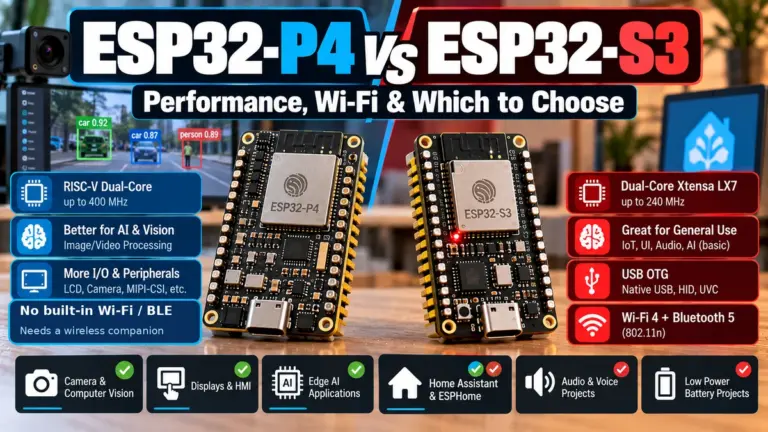
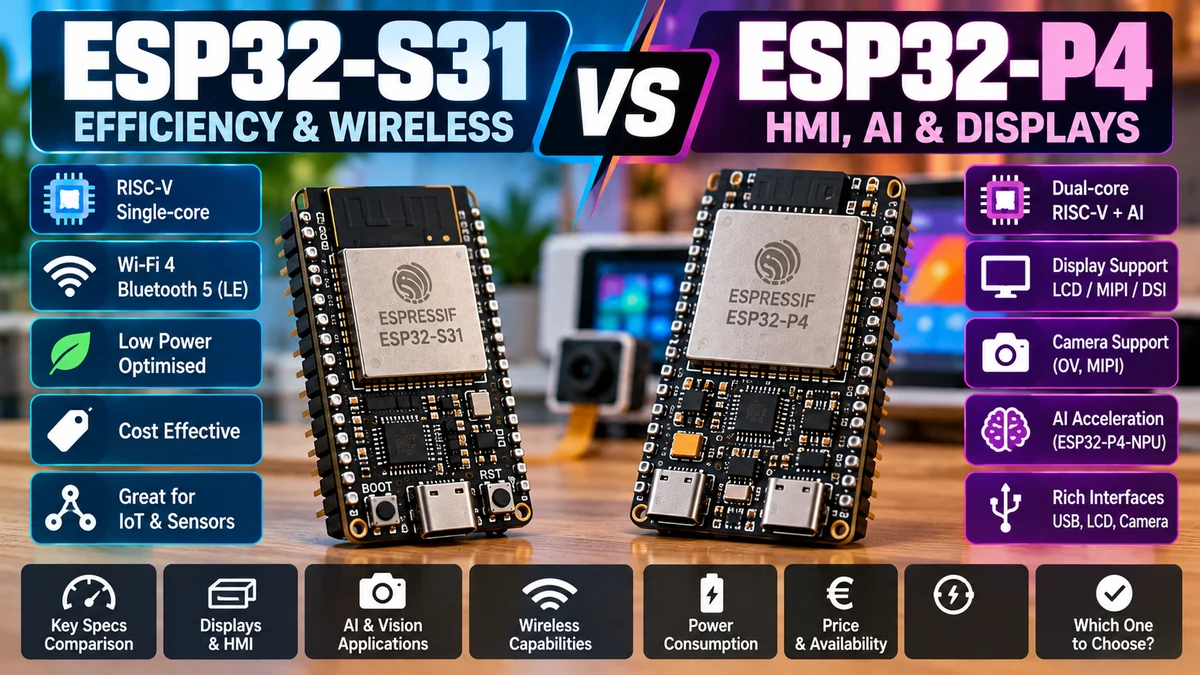
The ESP32-S31AliExpress price and ESP32-P4AliExpress price overlap in HMI, AI, display and camera projects, but they are not really the same class of chip. The S31 is a high-performance connected MCU: dual-core RISC-V up to 320 MHz, 2.4 GHz Wi-Fi 6, Bluetooth 5.4 + Classic, IEEE 802.15.4 for Thread/Zigbee, Gigabit Ethernet MAC, DVP camera, parallel RGB/I8080/MOTO6800 LCD, JPEG codec, PPA, 2D-DMA and 250 MHz 8-bit DDR PSRAM connectivity. The P4 is a multimedia/application processor-style MCU: dual-core RISC-V up to 400 MHz plus a 40 MHz LP core, 768 KB HP SRAM, AI/DSP vector extensions, MIPI-CSI camera, MIPI-DSI display, integrated ISP, H.264 encoder up to 1080p30, JPEG, PPA, 2D-DMA, USB 2.0 High-Speed OTG, Ethernet and SDIO 3.0. The trade-off is decisive: P4 has no integrated Wi-Fi, Bluetooth or 802.15.4, so wireless designs need a companion ESP32AliExpress price-C/S chip. For a large touchscreen, MIPI camera, video encoder, high-end LVGL/HMI or vision product, P4 is the stronger platform. For a connected smart display, AI voice panel, video doorbell, Matter/Thread appliance or product where one chip should handle both rich UI and wireless networking, S31 is usually the better system-level choice. The best architecture can also be P4 + S31/C6: P4 handles graphics/vision while the companion handles wireless.
Materials You’ll Need
| Item | Why it helps |
|---|---|
| ESP32-S31AliExpress price-Function-CoreBoard-1 | Broad S31 AIoT/connectivity development platform |
| ESP32-S31AliExpress price-Korvo-1 | S31 multimedia/audio/HMI reference board with LCD, camera and microphones |
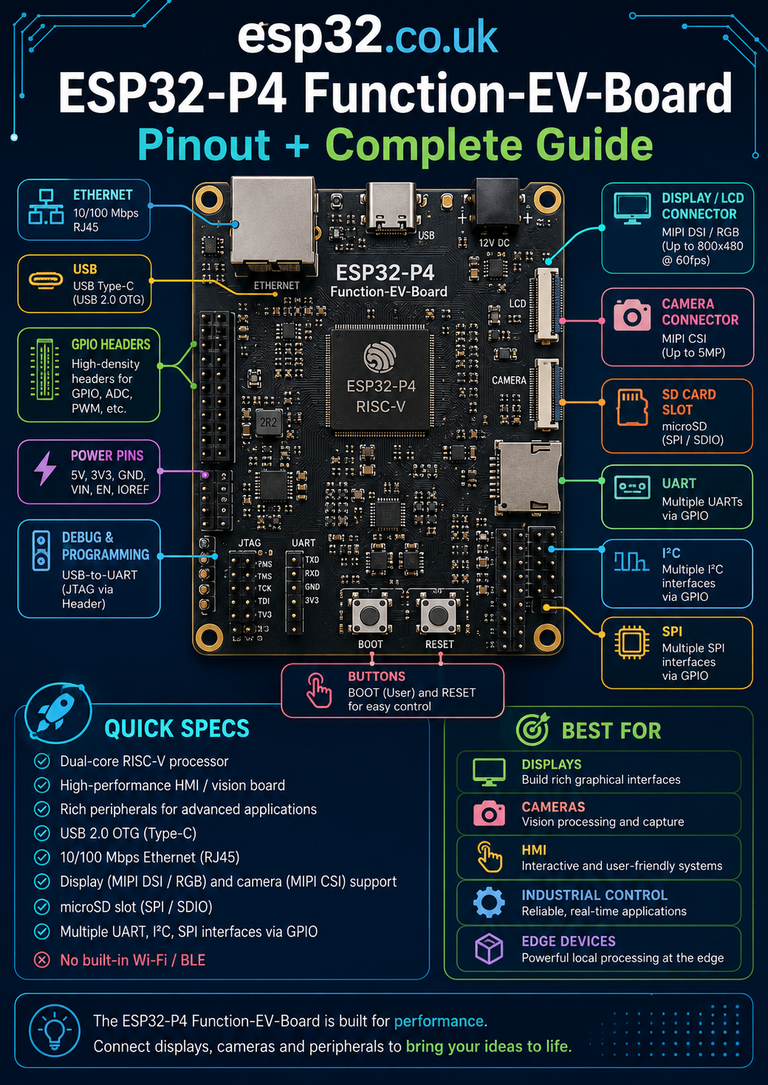
| ESP32-P4 Function-EV-Board | Reference P4 HMI/camera/Ethernet development platform |
| RGB or MIPI-DSI display | Shows the major interface difference between S31 and P4 |
| DVP or MIPI-CSI camera | Useful for comparing camera pipelines |
| PSRAM-equipped board/module | Framebuffers, camera buffers, tensors and media assets |
| Ethernet connection | Both families support wired-network designs |
| Wi-Fi 6 access point | Lets S31 operate as a standalone connected device |
| ESP-IDF | Reference framework for both chips and new S31 capabilities |
| Arduino-ESP32 | Currently a particularly mature route for P4; S31 support is still developing in 2026 |
The Most Important Difference: Connected MCU vs Multimedia Processor
If you remember only one thing from this comparison, remember this: S31 is designed to be the whole connected device; P4 is designed to be the high-performance application processor inside a device.
ESP32-S31
CPU + AI + HMI + Wi-Fi 6 + BLE + 802.15.4 + Ethernet

ESP32-P4
faster CPU + advanced HMI/video/camera + Ethernet
NO Wi-Fi / BLE / 802.15.4
→ add companion ESP32 if wireless is needed
This distinction explains almost every recommendation that follows. P4 is more capable for pure multimedia, but S31 can produce a much simpler bill of materials for a connected product.
ESP32-S31 vs ESP32-P4 Specifications
| Feature | ESP32-S31 | ESP32-P4 |
|---|---|---|
| Main CPU | Dual-core 32-bit RISC-V | Dual-core 32-bit RISC-V |
| Maximum clock | 320 MHz | 400 MHz |
| Low-power core | Modern power domains / platform-specific | 40 MHz LP RISC-V core |
| Internal HP SRAM | 512 KB | 768 KB + TCM |
| AI/DSP | 128-bit SIMD data path | 128-bit AI/DSP vector extensions |
| External PSRAM | 250 MHz 8-bit DDR PSRAM interface | High-bandwidth external PSRAM; 32 MB on Function-EV-Board |
| Wi-Fi | 2.4 GHz Wi-Fi 6 | None |
| Bluetooth | BLE 5.4 + Classic | None |
| IEEE 802.15.4 | Thread / Zigbee | None |
| Ethernet MAC | 1000 Mbps-class | Ethernet MAC / RMII |
| Camera | DVP 8/16-bit | DVP + MIPI-CSI |
| Display | Parallel RGB 8–24 bit, I8080, MOTO6800 | Parallel + MIPI-DSI |
| Image Signal Processor | No comparable MIPI ISP pipeline | Integrated ISP |
| JPEG | Hardware codec | Hardware acceleration |
| H.264 | No dedicated H.264 encoder highlighted | Hardware encoder up to 1080p30 |
| PPA | Yes | Yes |
| 2D-DMA | Yes | Yes |
| USB | USB 2.0 High-Speed OTG + Serial/JTAG | USB 2.0 High-Speed OTG |
| GPIO | Up to 60 | Up to 55 programmable GPIOs |
| Best role | Connected HMI/AI/AIoT product | High-end HMI/vision/video application processor |
CPU Performance: 320 MHz vs 400 MHz
P4 has the higher headline clock: dual RISC-V HP cores at up to 400 MHz, compared with S31 at up to 320 MHz. That is a 25% clock-frequency advantage before considering architectural differences.
Both chips are far beyond the performance class of a C3/H2-style sensor MCU. Their target workloads include graphics, computer vision, audio DSP, local AI and large protocol stacks.
But clock speed is not the whole story. A graphics workload may be limited by external-memory bandwidth, pixel-format conversion or display DMA rather than CPU arithmetic. That is why both devices include hardware media accelerators.
P4 Has a Dedicated Low-Power Core
P4 combines its 400 MHz dual HP cores with a separate LP RISC-V core up to 40 MHz. That lets the high-performance subsystem sleep while low-power tasks continue.
This architecture is especially interesting for devices that occasionally need heavy HMI/vision processing but spend long periods in low-activity monitoring states.
AI and DSP: Both Are Serious, but P4 Has More Compute Headroom
Both chips include 128-bit vector/SIMD-style acceleration. S31 dedicates a wide 128-bit data path on one core for parallel workloads. P4 implements custom AI/DSP extensions with eight 128-bit general-purpose registers and vector operations for multiplication, addition, shifting, complex arithmetic and data movement.
- neural-network inference
- audio preprocessing
- wake-word processing
- image filtering
- feature extraction
- sensor fusion
- DSP transforms
- matrix/vector operations
For the same optimized workload, P4’s higher CPU frequency and larger on-chip memory give it the stronger raw compute platform. S31’s advantage is that the AI application can communicate over Wi-Fi/Bluetooth/Thread without a companion processor.
Which Is Better for Edge AI?
| AI use case | Best choice | Why |
|---|---|---|
| Audio wake word / voice control | S31 | Plenty of SIMD + integrated wireless/audio connectivity |
| Local image classification | P4 | Faster CPU + stronger camera/image pipeline |
| Video vision pipeline | P4 | MIPI-CSI + ISP + H.264 + PPA |
| Connected smart speaker/display | S31 | Single-chip connectivity simplifies architecture |
| High-end vision device with Wi-Fi | P4 + wireless companion | Best compute/media capability plus dedicated radio |
Displays: This Is Where the Platforms Separate
Both chips support serious displays, but their display subsystems target different ceilings.
S31 supports parallel LCD interfaces including 8–24-bit RGB, I8080 and MOTO6800. That covers a huge range of embedded TFTs and is ideal for LVGL smart panels.
P4 supports parallel interfaces too, but adds MIPI-DSI, which is the major step upward for modern higher-resolution displays.
Typical embedded RGB/I8080 TFT
→ S31 or P4

Modern MIPI-DSI high-resolution panel
→ P4
Why MIPI-DSI Matters
MIPI-DSI moves high-speed pixel data over a small number of differential lanes instead of consuming a large parallel RGB bus. It is widely used in modern phone/tablet-style LCDs and enables cleaner routing at higher pixel bandwidths.
P4 has a dedicated MIPI D-PHY/DSI host and can drive high-resolution displays up to the 1080p class in Espressif’s HMI positioning.
S31 is extremely capable for conventional embedded RGB panels, but if the display itself is MIPI-DSI, P4 wins immediately.
LVGL: Which One Is Better?
For a small or medium embedded GUI, both chips are powerful enough. The question becomes the size and complexity of the user interface.
| LVGL workload | Recommended platform |
|---|---|
| 320×240 SPI display | Either; both are overpowered |
| 480×272 / 480×480 RGB | S31 is excellent |
| 800×480 rich RGB HMI | S31 or P4 |
| Large animations + camera preview | P4 |
| MIPI-DSI display | P4 |
| Connected smart panel with Thread/Wi-Fi | S31 |
P4’s PPA and 2D-DMA can offload operations such as scaling, rotation, mirroring, blending and fills, reducing CPU time spent moving pixels. S31 also includes PPA and 2D-DMA, making it much stronger than the older S3 generation for rich parallel-display HMI.
PPA: Hardware Pixel Processing
The Pixel Processing Accelerator (PPA) is important on both new platforms because GUI workloads often consist of pixel manipulation rather than general-purpose code.
- scale
- rotate
- mirror
- blend
- fill
- pixel-format conversion pipelines
On P4, the PPA sits inside a broader graphics/video subsystem that includes ISP, MIPI and H.264. On S31 it helps parallel-LCD and DVP multimedia applications avoid wasting CPU cycles on repetitive image operations.
Camera: DVP vs MIPI-CSI
S31 supports an 8–16-bit DVP camera interface. This is appropriate for many OV-series and embedded parallel-camera modules.
P4 supports DVP too, but adds MIPI-CSI and an integrated Image Signal Processor (ISP).
S31 camera path:
DVP camera → DMA / image accelerator → memory

P4 advanced camera path:
MIPI-CSI camera → ISP → memory / PPA / H.264 / display
This makes P4 a fundamentally better platform for modern image sensors and high-resolution vision applications.
What the P4 ISP Adds
A raw camera sensor does not necessarily output a ready-to-display image. P4’s ISP accepts data from DVP or MIPI-CSI cameras and performs a hardware image-processing pipeline before DMA writes the result into system memory.
That is the sort of feature normally associated with application processors rather than classic microcontrollers.
H.264 Is a Major P4 Advantage
P4 includes dedicated H.264 encoding hardware with maximum performance around 1080p at 30 fps. S31’s official HMI feature set highlights JPEG, PPA and 2D-DMA but not a comparable dedicated H.264 encoder.
If the project needs compressed video streaming, recording or efficient camera transport, this difference can dominate the decision.
JPEG snapshots / UI assets → S31 or P4
1080p-class H.264 video encode → P4
Video Doorbell: S31 or P4?
A simple video doorbell with DVP camera, display/audio and Wi-Fi can be a very natural S31 product because everything sits in one wireless SoC.
A higher-end doorbell that needs a modern MIPI camera, more advanced image processing or H.264 video encoding is better suited to P4 — but then it needs a wireless companion.
| Doorbell design | Best architecture |
|---|---|
| Compact DVP + Wi-Fi + audio | S31 |
| MIPI camera + H.264 + advanced vision | P4 + S31/C6 companion |
Memory: 512 KB vs 768 KB Is Only Part of the Story
S31 provides 512 KB on-chip SRAM and a high-speed 250 MHz 8-bit DDR PSRAM interface, with simultaneous flash and PSRAM access.
P4 provides 768 KB HP SRAM, plus tightly coupled memory and a memory system designed around large external PSRAM workloads. Espressif’s Function-EV-Board commonly pairs P4 with 32 MB PSRAM.
For HMI, the available external RAM is often more important than the on-chip SRAM because large framebuffers consume memory rapidly.
800 × 480 RGB565 framebuffer
= 800 × 480 × 2
≈ 768 KB

Double buffering ≈ 1.5 MB
Add camera buffers + assets + network → PSRAM quickly becomes essential
Why DDR PSRAM Makes S31 Interesting
S31’s 250 MHz 8-bit DDR PSRAM connectivity is not a minor specification. It targets the exact bottleneck that limits many display/camera projects: moving large blocks of data between memory and peripherals.
For conventional RGB HMI, S31 can therefore approach workloads that previously pushed developers toward much more specialised hardware.
Wireless: S31 Wins by an Entire Category
S31 integrates:
- 2.4 GHz Wi-Fi 6
- Bluetooth 5.4 LE
- Bluetooth Classic BR/EDR
- IEEE 802.15.4
- Thread
- Zigbee
P4 integrates none of those wireless radios.
This is not an omission by accident. Espressif designed P4 to work with a companion wireless ESP32 over SPI, SDIO or UART when wireless connectivity is required.
What Companion Chip Should You Pair with P4?
| Requirement | Good companion |
|---|---|
| Basic Wi-Fi/BLE | ESP32-C3 / S3 depending architecture |
| Wi-Fi 6 + Thread/Zigbee | ESP32-C6 |
| 5 GHz Wi-Fi 6 | ESP32-C5 |
| High-end Wi-Fi 6 + 802.15.4 + Bluetooth Classic/LE | ESP32-S31 |
The current ESP32-P4 Function-EV-Board uses an onboard ESP32-C6-MINI-1 specifically to provide wireless connectivity, demonstrating this architecture directly.
P4 + S31: Overkill or Dream Combination?
For many products it is overkill. But for a premium HMI/vision gateway, the combination is extremely powerful.
ESP32-P4
├─ MIPI-DSI display
├─ MIPI-CSI camera
├─ ISP / H.264 / PPA
└─ application / AI workload
        ↕ high-speed host link
ESP32-S31
├─ Wi-Fi 6
├─ Bluetooth LE + Classic
├─ Thread / Zigbee
└─ radio/network offload
That split keeps heavy media processing and wireless protocol timing on separate processors and creates considerable performance headroom.
Ethernet
Both chips can be used in serious wired products, but the architectures differ.
S31 advertises a 1000 Mbps Ethernet MAC, which makes it compelling for connected HMI and gateway designs that may use both wired and wireless networking.
P4 provides Ethernet MAC support via RMII-class interfaces on the chip and the Function-EV-Board includes 10/100 Ethernet. For many HMI devices, 100 Mbps is already far more than required unless video/network throughput is a major use case.
USB
Both are serious USB platforms. S31 includes USB 2.0 High-Speed OTG and USB Serial/JTAG in its new platform; P4 includes USB 2.0 High-Speed OTG and is positioned for high-throughput peripheral use.
For a USB-centric product, the deciding factor will usually be the display/camera/wireless requirements rather than USB alone.
Audio
S31 has a particularly compelling audio story because it combines dual I²S, hardware Bluetooth-audio synchronization, Bluetooth LE Audio and Bluetooth Classic in one SoC.
The S31-Korvo-1 reinforces this positioning with dual microphones, speaker output, LCD and camera.
P4 is also highly capable for audio/DSP and HMI, but it needs an external wireless chip for Bluetooth audio.
Which Is Better for Voice Assistants?
| Voice product | Best choice |
|---|---|
| Wi-Fi smart speaker / voice panel | S31 |
| Voice + touchscreen + local AI | S31 for integrated design |
| Very large HMI + vision + voice | P4 + wireless companion |
| Bluetooth audio product | S31 |
Which Is Better for Home Assistant Displays?
For a connected Home Assistant wall panel, S31 is likely the more elegant future platform because Wi-Fi is built in and the HMI subsystem is already far stronger than S3.
P4 makes sense when the panel itself becomes much more like a small appliance computer: MIPI display, large framebuffer, camera, video encoding, sophisticated local processing.
Normal rich smart-home panel → S31
Premium MIPI/video/vision panel → P4 + wireless companion
Matter, Thread and Zigbee
S31 can natively participate in Thread and Zigbee because it contains IEEE 802.15.4. That gives it a major system-level advantage for smart appliances and panels.
P4 cannot do that by itself. It needs C6/S31/H-series radio hardware depending on the architecture.
A smart display that also acts as a Thread/Zigbee/Matter controller is therefore a particularly strong S31 use case.
GPIO: S31 Actually Has More
It may be surprising that the multimedia-focused P4 has 55 programmable GPIOs while S31 advertises up to 60 GPIOs. Both provide far more I/O than a normal ESP32 hobby project needs.
The meaningful question is not the raw count but how many pins remain available after display, camera, memory, Ethernet, audio and other fixed-function interfaces are connected.
Parallel RGB Displays Consume Many Pins
An S31 24-bit RGB interface can consume a large GPIO budget once data lines, clocks and synchronisation signals are counted.
P4’s MIPI-DSI option can dramatically reduce the number of physical high-speed display lanes, which is another reason MIPI becomes attractive in complex products.
Software Maturity in September 2026
| Platform | ESP-IDF | Arduino-ESP32 | Practical maturity |
|---|---|---|---|
| ESP32-P4 | Mature/stable target | Listed as stable | Strong and established |
| ESP32-S31 | Current latest/master support | Development / targeted in Arduino 4.0 line | Newer, rapidly evolving |
This is a surprisingly important point. P4 is the more specialised chip, but its software has had more time to mature. Current Arduino-ESP32 documentation lists P4 as a stable target. S31 is much newer, and current Arduino roadmap discussions place fuller support in the 4.0 development cycle.
If you need the newest S31 hardware features now, ESP-IDF is the correct environment.
Arduino: P4 Has the Easier Story Today
For developers who strongly prefer Arduino, P4 is currently easier to justify than S31 despite P4 being the more advanced multimedia processor.
That will change as S31 support reaches stable Arduino releases, but when choosing hardware today, framework maturity is a real engineering constraint.
ESP-IDF: Both Make Sense
For serious HMI, camera and AI development, ESP-IDF is the natural framework on both chips. It exposes PPA, MIPI, ISP, H.264, Ethernet and the newer S31 multimedia/connectivity features directly.
At this level, the comparison becomes architectural rather than “which Arduino library exists.”
Power and Thermal Design
Neither chip should be treated like a tiny C3 sensor node when all accelerators, displays and high-speed interfaces are active.
Large LCD backlights, cameras, PSRAM, Ethernet PHYs and wireless radios can dominate system power. Board-level thermal design, regulator sizing and power-domain management matter much more than the idle MCU current quoted in isolation.
P4’s lack of integrated RF can actually simplify thermal/RF isolation in a high-performance media board, while S31’s single-chip integration reduces overall component count.
Which Is Better for a Battery Product?
Usually neither, unless the product genuinely needs their high-end capabilities.
A battery Thread sensor belongs on H2/H21/C6-class silicon. S31 and P4 make sense in battery devices only when there is a display, audio, vision or other heavy workload that justifies them.
Industrial HMI
P4 wins for the most demanding industrial HMI.
MIPI-DSI, camera/ISP, H.264, high-speed USB, Ethernet and stronger compute make P4 feel closer to a small application processor.
S31 wins when connectivity integration matters more than absolute multimedia capability, especially if the product needs Wi-Fi 6, Thread/Zigbee or Bluetooth in the same chip.
Smart Appliance
S31 is often the better architecture.
A refrigerator, oven, HVAC panel or appliance interface may need an RGB display, touch, audio, Wi-Fi, Matter/Thread and Bluetooth commissioning. S31 can cover that whole system in one SoC.
Choose P4 when the appliance UI moves into MIPI/high-resolution/video territory.
Video Intercom
This use case strongly favours P4 when the camera/video pipeline is important.
- MIPI camera
- ISP
- H.264 encode
- large display
- audio
- Ethernet
Add a C6/S31 companion when wireless is needed. For a simpler low-cost DVP/Wi-Fi intercom, S31 can keep the entire architecture on one main SoC.
AI Camera
P4.
Computer vision is one of the clearest cases where P4’s combination of 400 MHz CPU, AI extensions, MIPI-CSI, ISP, PPA and H.264 creates an advantage greater than any single specification suggests.
Connected AI Voice Panel
S31.
Voice/audio processing does not need MIPI-CSI or H.264. Integrated Wi-Fi 6, Bluetooth audio, microphones/I²S, SIMD and display capability make S31 a cleaner platform.
Large MIPI Touch Display
P4.
If the panel is MIPI-DSI, the choice is effectively made by the interface requirement. S31’s official LCD subsystem is parallel rather than MIPI-DSI.
480×480 or 800×480 RGB Touch Display
S31 can be the better product choice if its wireless integration removes an extra radio chip. P4 offers more headroom, but you may not use that extra capability.
Do not select P4 simply because it is faster if an S31 already renders the UI comfortably.
When P4 Is Overkill
- small SPI display
- basic Home Assistant dashboard
- simple Wi-Fi touchscreen
- audio-only smart speaker
- BLE control panel
- ordinary LVGL settings UI
For these, S31 — and sometimes even S3 — is simpler and cheaper.
When S31 Is Not Enough
- MIPI-DSI display required
- MIPI-CSI camera required
- integrated ISP required
- hardware H.264 encoding required
- 1080p-class display/camera pipeline
- advanced vision pipeline with heavy camera processing
Those are P4’s home territory.
Development Boards Compared
| Board | What it demonstrates |
|---|---|
| ESP32-S31-Function-CoreBoard-1 | Wi-Fi 6 + 802.15.4 + Bluetooth + Gigabit Ethernet + voice/AI expansion |
| ESP32-S31-Korvo-1 | 4.3-inch LCD, DVP camera, dual microphones, speaker, SD — smart audio/HMI |
| ESP32-P4 Function-EV-Board | MIPI DSI/CSI, Ethernet, USB, SD, audio, PSRAM and companion C6 wireless |
The boards themselves reveal the product philosophy. S31 boards emphasise connected AIoT and integrated wireless. P4’s flagship board looks more like a multimedia computer board with a separate radio processor.
Can You Replace P4 with S31?
Sometimes. If the P4 design uses only a parallel RGB display, DVP camera, JPEG and moderate AI, S31 may collapse the system into a single wireless SoC.
You cannot replace P4 with S31 when the design depends on MIPI-CSI, MIPI-DSI, P4’s ISP or H.264 encoder.
Can You Replace S31 with P4?
Only if you are willing to add wireless hardware when the product needs Wi-Fi, Bluetooth, Thread or Zigbee.
P4 is not a wireless S31 with more performance. It is a different architecture.
System Cost: The Faster Chip Is Not Always the Cheaper Product
Suppose a connected 800×480 HMI needs Wi-Fi and Thread. S31 may need one SoC/module plus display memory and peripherals.
A P4 version may need:
- P4/module
- external flash/PSRAM
- C6/S31 wireless companion
- host interconnect
- extra power rails
- more PCB area
- more firmware integration
If P4’s MIPI/video features are unused, the nominally faster processor can create a more expensive total system.
System Complexity
S31 single-chip design
→ simpler firmware architecture
→ fewer power rails
→ smaller PCB
→ easier OTA/network integration

P4 + radio companion
→ more performance/media features
→ more integration work
→ clearer separation of compute and wireless
Security and Isolation
Both are modern security-oriented platforms with secure boot, flash encryption and hardware cryptographic support. A dual-chip P4 + radio architecture can additionally create a useful functional separation between network-facing wireless firmware and application/media processing.
That separation is not automatically more secure — the host protocol must still be designed correctly — but it can improve system architecture in complex products.
My Recommendation by Project
| Project | Recommendation |
|---|---|
| Small/medium connected LVGL panel | S31 |
| Large RGB connected panel | S31 unless compute is limiting |
| MIPI-DSI display | P4 |
| DVP camera + Wi-Fi product | S31 |
| MIPI camera / vision product | P4 |
| H.264 camera streamer | P4 + wireless companion |
| Smart appliance with Matter/Thread | S31 |
| Industrial multimedia HMI | P4 |
| Voice/audio AI panel | S31 |
| High-end vision + multi-radio gateway | P4 + S31/C6 |
Decision Flow
Need MIPI-DSI, MIPI-CSI, ISP or H.264?
 └─ YES → ESP32-P4
 └─ NO
     Need integrated Wi-Fi/Bluetooth/Thread/Zigbee?
      └─ YES → ESP32-S31
      └─ NO
          Need maximum CPU/media headroom?
           └─ YES → ESP32-P4
           └─ NO → ESP32-S31 is usually simpler

Need BOTH maximum multimedia + wireless?
 → ESP32-P4 + C6/S31 companion
My 2026 Verdict
| Category | Winner |
|---|---|
| CPU clock / raw compute | P4 |
| Internal SRAM | P4 |
| Integrated wireless | S31 by a huge margin |
| Thread/Zigbee/Matter radio | S31 |
| Parallel RGB HMI | Tie / S31 often simpler system |
| MIPI display | P4 |
| MIPI camera | P4 |
| Image signal processing | P4 |
| H.264 encoding | P4 |
| Audio + Bluetooth product | S31 |
| Single-chip connected appliance | S31 |
| Highest-end multimedia platform | P4 |
| Arduino maturity today | P4 |
| Newest integrated AIoT architecture | S31 |
Final Recommendation
If your project description starts with “Wi-Fi smart display,” “Matter appliance,” “voice panel” or “connected HMI”, start with ESP32-S31. Its 320 MHz dual-core RISC-V CPU, SIMD, fast PSRAM, parallel display/camera hardware and complete Wi-Fi/Bluetooth/802.15.4 stack can eliminate a companion wireless chip.
If your project description starts with “MIPI display,” “MIPI camera,” “computer vision,” “video encoding” or “1080p multimedia”, start with ESP32-P4. Its 400 MHz cores, larger SRAM, MIPI-CSI/DSI, ISP, H.264 encoder, PPA and 2D-DMA make it a much stronger media processor.
The two chips therefore do not make each other obsolete. In fact, the most demanding product may use both roles: P4 as the high-performance HMI/vision processor and S31 or C6 as the dedicated wireless processor.
ESP32-S31 = connected high-end MCU
ESP32-P4  = high-end multimedia/application MCU

Need rich UI + wireless in one chip → S31
Need maximum display/camera/video capability → P4
Related ESP32 Guides
- ESP32-S31 vs ESP32-S3: Is the S31 the New S3?
- ESP32-P4 Function-EV-Board Pinout + Complete Guide
- ESP32-P4 vs ESP32-S3: Which Should You Use for Displays & Cameras?
- ESP32-C5 vs ESP32-S3: 5 GHz Wi-Fi or Dual-Core Performance?
- ESP32 Versions Explained: Which Board Should You Buy?
Datasheets & External Resources
All external manufacturer/framework references are collected here so the main article keeps readers inside esp32.co.uk.
- Espressif ESP32-S31 Product Page — 320 MHz dual RISC-V, Wi-Fi 6, Bluetooth, 802.15.4, PSRAM, HMI, PPA and Ethernet specifications.
- ESP32-S31 Official Developer Portal — S31 boards, demos, documentation and current software resources.
- ESP32-S31-Function-CoreBoard-1 User Guide — connected AIoT reference board with Wi-Fi 6, 802.15.4, Bluetooth and Gigabit Ethernet.
- ESP32-S31-Korvo-1 User Guide — multimedia board with 4.3-inch LCD, DVP camera, microphones and audio.
- Espressif ESP32-P4 Product Page — 400 MHz dual RISC-V, 768 KB SRAM, MIPI, H.264, PPA, USB and Ethernet overview.
- ESP32-P4 Series Datasheet — CPU, AI/DSP vector extensions, memory and peripheral details.
- ESP-IDF ESP32-P4 MIPI-DSI LCD Guide — P4 DSI host/D-PHY display interface.
- ESP-IDF ESP32-P4 ISP Guide — integrated DVP/MIPI-CSI image-processing pipeline.
- ESP-IDF ESP32-P4 PPA Guide — hardware pixel scaling, rotation, mirroring, blending and fill.
- Arduino-ESP32 Supported SoCs — current stable P4 status and supported-chip matrix.
- ESP-IDF ESP32-S31 Getting Started — current S31 ESP-IDF support and integrated connectivity list.