Quick Summary (TL;DR):
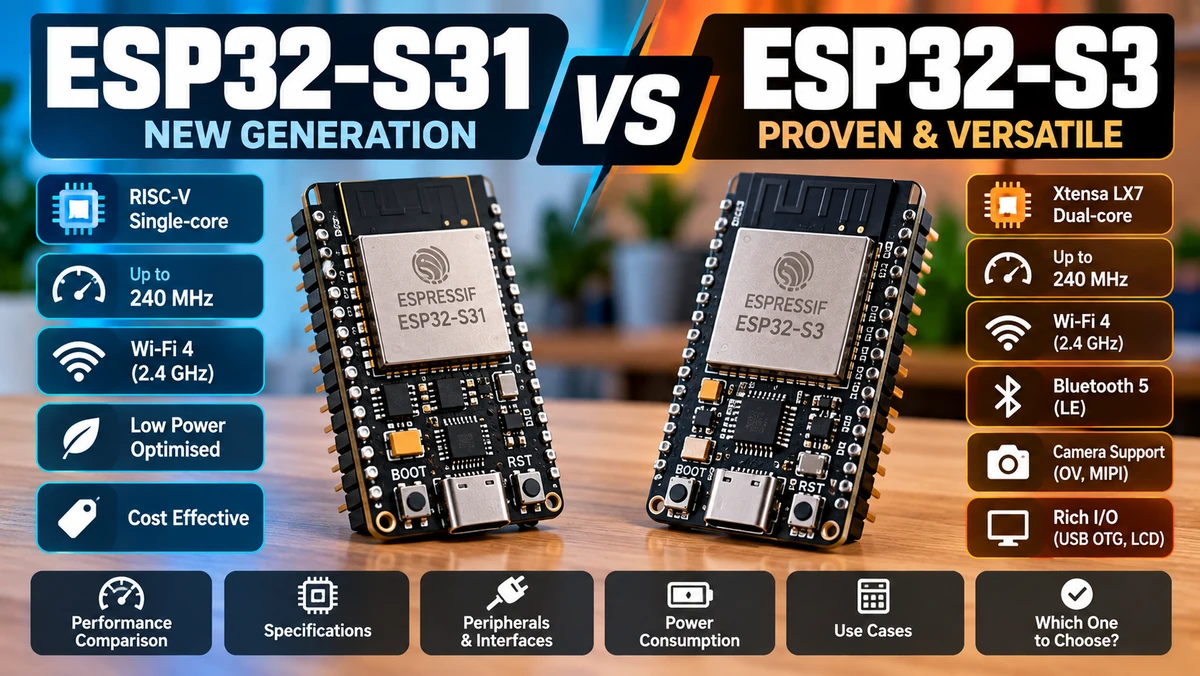
The ESP32-S31AliExpress price is the real next-generation successor to the ESP32-S3AliExpress price, but that does not mean every S3 project should immediately migrate. The S31 moves from dual-core Xtensa LX7 at 240 MHz to dual-core 32-bit RISC-V at up to 320 MHz, adds 2.4 GHz Wi-Fi 6, newer Bluetooth, IEEE 802.15.4 for Thread/Zigbee, a Gigabit Ethernet MAC, a wider modern multimedia subsystem and a 128-bit SIMD/vector data path aimed at AI, DSP and image workloads. It also supports high-speed external memory, including 8-bit DDR PSRAM, and expands the GPIO/peripheral budget substantially. The ESP32-S3AliExpress price remains extremely relevant because its Arduino, ESP-IDF, ESPHome, LVGL, camera, USB and board ecosystem is far more mature, and it is still more than powerful enough for most displays, cameras, BLE proxies, voice satellites and smart-home projects. For a new high-performance product or advanced HMI/AI design, S31 is the more future-proof platform. For a project you want working today with maximum community support, S3 is still the safer choice. The simplest rule is: S31 is the new S3 architecturally; S3 is still the easier S3 practically.
Materials You’ll Need
| Item | Why you need it |
|---|---|
| ESP32-S31AliExpress price development board | For testing the new RISC-V platform and modern peripherals |
| ESP32-S3 DevKitC-1AliExpress price or equivalent | Mature reference board for direct comparison |
| USB-C data cables | Power, flashing and USB testing |
| SPI/RGB display or supported LCD | HMI/LVGL comparison |
| Camera module | Image/camera pipeline testing |
| PSRAM-equipped board/module | Important for graphics, AI and camera workloads |
| Wi-Fi 6 access point | Lets the S31 use its newer Wi-Fi capability |
| Thread/Zigbee test network | Useful for S31 802.15.4 experiments |
| ESP-IDF | Most complete environment for early/new S31 features |
| Arduino-ESP32 | Useful for comparing mainstream application maturity |
Is the ESP32-S31 Really the Replacement for ESP32-S3?
Yes — in product-positioning terms, the S31 is clearly the next-generation high-performance wireless MCU that takes the role the S3 has occupied since 2021/2022. It is aimed at the same broad class of projects: smart displays, cameras, AI-enabled devices, audio, HMI, connected appliances and more demanding embedded applications.
But the word replacement can mean two different things:
Architectural successor?  → YES
Drop-in practical replacement today? → NO
The S31 changes CPU architecture, wireless capabilities, peripheral mix and software maturity. Existing S3 firmware is not simply a binary you move onto an S31 board.
ESP32-S31 vs ESP32-S3 Specifications
| Feature | ESP32-S31 | ESP32-S3 |
|---|---|---|
| CPU architecture | 32-bit RISC-V | Xtensa LX7 |
| CPU cores | Dual-core | Dual-core |
| Maximum CPU clock | 320 MHz | 240 MHz |
| Internal SRAM | ~512 KB class | ~512 KB |
| External PSRAM | High-speed DDR PSRAM support | PSRAM supported; mature Octal/Quad ecosystem |
| Wi-Fi | 2.4 GHz Wi-Fi 6 | 2.4 GHz Wi-Fi 4 (802.11 b/g/n) |
| Bluetooth | Newer Bluetooth generation | Bluetooth 5 LE |
| IEEE 802.15.4 | Yes | No |
| Thread | Yes | No native 802.15.4 |
| Zigbee | Yes | No native 802.15.4 |
| Ethernet MAC | Up to Gigabit-class MAC | No comparable integrated Gigabit MAC |
| USB | Modern USB subsystem + Serial/JTAG | USB 2.0 OTG + USB Serial/JTAG |
| Camera | DVP camera / enhanced imaging path | Parallel camera interface |
| LCD | Parallel LCD / richer display subsystem | LCD interface |
| JPEG / image acceleration | Expanded hardware acceleration | Useful vector/DMA/peripheral support |
| Vector / AI acceleration | 128-bit SIMD/vector data path | 128-bit vector/SIMD instructions |
| Touch | Up to 14 touch channels class | 14 capacitive-touch-capable GPIO class |
| GPIO | Up to ~60 GPIO class | Up to 45 GPIO at SoC level |
| Best current role | Next-gen HMI/AI/connected products | Mature displays/cameras/voice/BLE/ESPHome |
CPU: 320 MHz RISC-V vs 240 MHz Xtensa LX7
The most visible S31 upgrade is the processor. ESP32-S3 uses two Xtensa LX7 cores running at up to 240 MHz. S31 moves the high-performance S-series to dual-core RISC-V at up to 320 MHz.
ESP32-S3
2 × Xtensa LX7 @ up to 240 MHz

ESP32-S31
2 × RISC-V @ up to 320 MHz
Clock speed alone suggests roughly one-third more frequency, but the important change is broader than MHz. RISC-V gives Espressif a more flexible instruction-set platform and aligns the S31 with the direction already visible across newer C/H/P-series devices.
For users, this means newer compilers, architecture-specific optimisations and future Espressif libraries will increasingly target RISC-V rather than depending on Xtensa-specific code paths.
Does 320 MHz Mean S31 Is 33% Faster?
Not automatically. Performance depends on instruction mix, memory bandwidth, cache behaviour, SIMD use, peripheral offload and compiler optimisation.
A GPIO toggle or I²C temperature read will not become meaningfully better because the CPU runs at 320 MHz. The S31 advantage appears in workloads such as:
- LVGL rendering
- image manipulation
- camera processing
- audio DSP
- local ML inference
- compression/codec work
- larger network stacks
- more complex multitasking
This is why S31 is much more interesting for displays/AI than for a basic relay or BME280 sensor.
RISC-V Is a Major Strategic Change
ESP32-S3 belongs to the last major generation of high-end Espressif Xtensa devices. S31 represents a shift toward the RISC-V architecture already used in chips such as C3, C6, C5, H2 and P4.
The practical long-term benefit is ecosystem convergence. Compiler/toolchain work, vector libraries and platform optimisations can increasingly share a common RISC-V direction across more Espressif families.
The short-term cost is migration: low-level Xtensa assembly, architecture-specific libraries or unusual S3 optimisations may require changes.
Wi-Fi: S31 Finally Brings Wi-Fi 6 to the S-Series
ESP32-S3 supports 2.4 GHz 802.11 b/g/n — effectively the long-established Wi-Fi 4 generation.
ESP32-S31 upgrades the family to 2.4 GHz Wi-Fi 6.
| Wi-Fi feature | S31 | S3 |
|---|---|---|
| Band | 2.4 GHz | 2.4 GHz |
| Generation | Wi-Fi 6 | Wi-Fi 4 |
| 5 GHz | No in S31’s normal positioning | No |
| Smart-home efficiency | Newer Wi-Fi features | Mature and widely compatible |
| Legacy router compatibility | Yes | Excellent |
This is an upgrade, but it is not the same as the ESP32-C5’s dual-band 2.4 + 5 GHz Wi-Fi 6. If 5 GHz is a hard requirement, C5 remains the relevant comparison.
Does Wi-Fi 6 Matter for an ESP32?
For a simple MQTT sensor sending a few bytes every minute, not much. For a dense network, multimedia device or product expected to remain in service for years, the newer Wi-Fi generation is more meaningful.
Wi-Fi 6 can improve efficiency and coexistence in busy 2.4 GHz environments, particularly when the access point supports the relevant features.
802.15.4: A Huge Difference
The S3 has Wi-Fi and Bluetooth LE, but no IEEE 802.15.4 radio. That means it cannot natively operate as a Thread/Zigbee radio.
S31 adds 802.15.4, making native Thread, Zigbee and Matter-over-Thread architectures possible.
ESP32-S3
Wi-Fi + BLE

ESP32-S31
Wi-Fi 6 + BLE + IEEE 802.15.4
                  ├─ Thread
                  └─ Zigbee
This may be the single biggest functional upgrade for smart-home developers. A high-performance S-series device can now combine rich local UI/processing with modern low-power mesh protocols without automatically requiring a separate C6/H2 radio.
What S31’s 802.15.4 Enables
- Matter-over-Thread controllers/devices
- Thread border-router experiments
- Zigbee endpoints/routers/bridges
- Smart displays that communicate directly with low-power mesh devices
- Connected appliances combining Wi-Fi and Thread/Zigbee
As always, having the radio does not mean every combination is instantly supported in every framework. ESP-IDF and Espressif’s protocol stacks will expose capabilities earlier than generic Arduino/ESPHome abstractions.
Bluetooth
S31 also moves to a newer Bluetooth generation than S3. ESP32-S3 is a BLE-focused Bluetooth 5 device with a very mature ecosystem for BLE sensors, proxies and HID-style applications.
S31’s newer Bluetooth hardware broadens the platform for modern BLE features and future connected-product designs. The practical advantage will depend heavily on framework support — a new Bluetooth feature is useful only when the stack and libraries expose it cleanly.
Memory: Same Class of Internal SRAM, Much Stronger External-Memory Story
Both chips live in roughly the 512 KB internal SRAM class, so the S31 story is not “twice the internal RAM.” The real improvement is external-memory capability and bandwidth.
S31 supports high-speed 8-bit DDR PSRAM configurations, with memory interfaces designed for richer graphics, AI and multimedia workloads.
Internal SRAM → fast working memory
External PSRAM → framebuffers / camera buffers / ML tensors / assets

S31 emphasis: higher bandwidth external-memory path
S3 already has an excellent PSRAM ecosystem, particularly modules such as ESP32-S3-WROOM variants and boards designed for displays/cameras. That maturity is one of S3’s practical advantages today.
Why PSRAM Bandwidth Matters More Than PSRAM Size
A large display can consume megabytes of framebuffer memory, but rendering speed depends on how quickly the MCU can move that data.
800 × 480 RGB565 framebuffer
= 800 × 480 × 2 bytes
≈ 768 KB

Double buffer ≈ 1.5 MB
Once you add fonts, images, camera buffers, network stacks and application state, external PSRAM becomes essential. Higher external-memory bandwidth can therefore make a larger difference to real HMI performance than a small increase in CPU clock alone.
AI and DSP: Both Are Accelerated, S31 Goes Further
ESP32-S3 became popular for “AI on ESP32” because the LX7 cores include vector instructions that accelerate neural-network and signal-processing operations.
S31 retains that philosophy but shifts it into a newer RISC-V vector/SIMD architecture with a 128-bit SIMD data path. Combined with the faster cores and improved memory subsystem, that makes S31 more attractive for modern embedded inference.
- wake-word / audio preprocessing
- small image classifiers
- object/gesture detection
- sensor-fusion inference
- DSP filters
- voice front ends
- camera feature extraction
Do not confuse either chip with a desktop/GPU AI accelerator. The advantage is performing useful local inference at microcontroller cost and power.
S31 vs S3 for Camera Projects
S3 has a huge advantage in examples and known hardware. ESP32-S3 camera boards are everywhere, and the ecosystem around DVP camera modules is mature.
S31 improves the underlying multimedia platform and is clearly better positioned for more demanding camera/vision designs, but an early S31 camera project may require more direct ESP-IDF work and newer board-specific examples.
| Question | Winner |
|---|---|
| Need a camera project working quickly today | ESP32-S3 |
| Designing a new high-performance camera product | ESP32-S31 |
| Need maximum examples/tutorials | ESP32-S3 |
| Need newest AI/memory/network platform | ESP32-S31 |
S31 vs S3 for Displays and LVGL
This is one of the most interesting upgrade areas. S3 is already excellent for SPI and RGB displays, but large displays can push its CPU, PSRAM bandwidth and DMA architecture hard.
S31’s faster RISC-V cores, improved external-memory system and richer display/image acceleration make it the more promising platform for advanced LVGL and HMI.
Small SPI display → S3 already excellent
Medium RGB display → S3 good, S31 stronger
Rich HMI + animation + camera + networking → S31 increasingly attractive
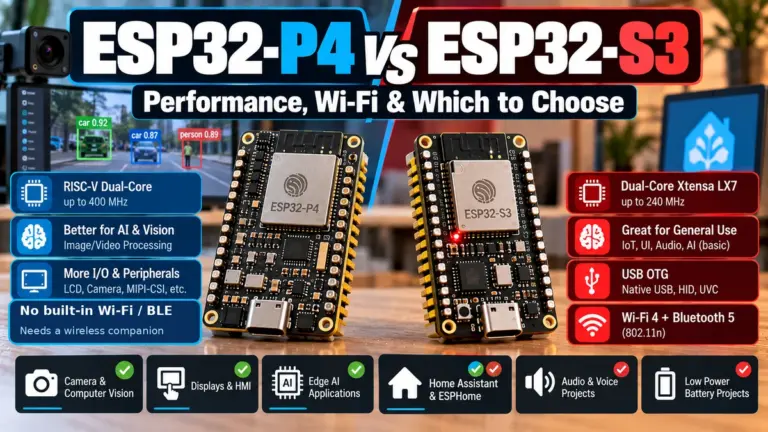
For very high-end MIPI HMI/vision work, the ESP32-P4 still sits above both because it was designed specifically around large-display/camera multimedia workloads.
S31 vs S3 vs P4
| Role | Best fit |
|---|---|
| Wireless HMI / smart display | S31 |
| Mature compact display/camera project | S3 |
| High-end MIPI display / camera / H.264-class multimedia | P4 |
| Wireless sensor node | C3/C6/C5 often more sensible |
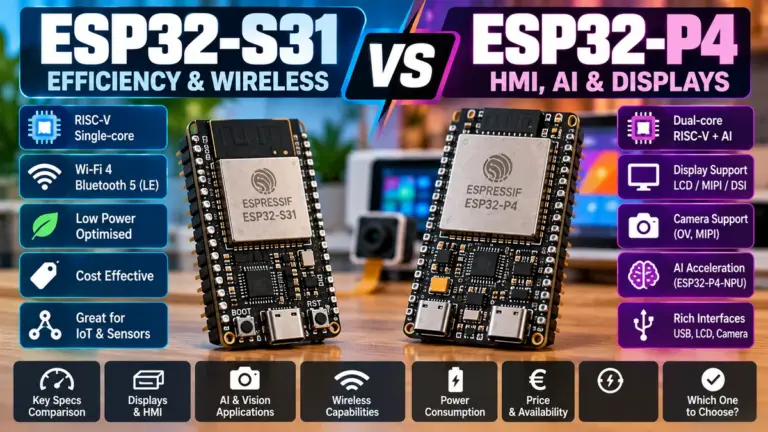
This is why S31 does not make P4 obsolete. S31 is the next high-performance wireless MCU; P4 is a much more specialised application/multimedia processor without integrated Wi-Fi/Bluetooth.
Ethernet: S31 Adds a Major Wired-Networking Capability
S31’s integrated high-speed Ethernet MAC is an important differentiator for industrial HMI, gateways and fixed devices.
S3 can use external Ethernet solutions, but it does not offer the same integrated Gigabit-class MAC architecture.
- industrial controllers
- building automation panels
- smart displays
- wired gateways
- cameras
- network appliances
Of course, a MAC is not an RJ45 socket. A board still needs the appropriate external PHY, magnetics and connector.
USB
ESP32-S3 is one of Espressif’s most popular USB chips because it offers native USB 2.0 OTG and USB Serial/JTAG. That makes it excellent for HID, MIDI, USB devices, debugging and host/device experimentation.
S31 continues with a modern USB subsystem rather than dropping this capability. The exact choice between S31 and S3 for a USB product will depend more on software maturity and required bandwidth/peripherals than on whether USB exists at all.
GPIO and Peripheral Expansion
S31 dramatically expands the high-end S-series peripheral budget, with up to roughly 60 GPIO-class resources depending on package/variant, compared with up to 45 GPIOs on S3.
That extra I/O matters for large displays, parallel cameras, audio, Ethernet, memory buses and multiple peripheral interfaces.
For a normal DevKit user connecting two I²C sensors, it makes no difference. For a complex product PCB, it can be transformative.
Touch Sensing
Both S3 and S31 support capacitive-touch-style applications, but the newer S31 platform is positioned for modern HMI/appliance interfaces where touch buttons, sliders and rich displays may coexist.
Touch quality depends on PCB/electrode design and firmware tuning as much as the headline number of touch-capable pins.
Power Consumption
S31 is faster and has more radios/peripherals, but that does not mean every S31 device automatically consumes more energy than every S3 device. Modern process design, clock gating and power domains can make newer silicon more efficient per unit of work.
For battery projects, however, neither S31 nor S3 should be chosen merely because they are the flagship S-series. A C3, C6, H2/H21 or another low-power-focused chip can be a better fit when the workload is simple.
ESP32-S3’s Biggest Advantage: Maturity
This is the part specification tables miss.
By 2026, S3 has years of accumulated support across:
- Arduino-ESP32
- ESP-IDF
- ESPHome
- LVGL
- PlatformIO
- camera libraries
- USB examples
- voice/audio projects
- AI libraries
- community boards
- display drivers
- PSRAM configurations
- debugging knowledge
If you search for an S3 problem, there is a good chance someone has already solved it. S31 cannot manufacture years of ecosystem history simply by entering mass production.
S31’s Biggest Advantage: Headroom
S31 gives a new design more room to grow: faster CPU, newer radios, 802.15.4, stronger external memory, Ethernet and a richer multimedia/peripheral platform.
That can avoid architectures such as:
S3 + C6 radio coprocessor + external Ethernet controller

when a future S31 design may integrate much more of that capability in one SoC
Fewer chips can mean lower BOM cost, simpler firmware and smaller boards — once the ecosystem is mature enough for the required features.
S31 Entered Mass Production in 2026
A key change from early S31 coverage is that this is no longer merely a preview chip. Espressif announced ESP32-S31 mass production and purchase availability on 27 July 2026.
That changes the recommendation. Earlier in 2026, S31 was interesting primarily for future planning. Now it can be considered for real new designs, although availability of specific modules, development boards and framework support still varies.
Official S31 Development Boards
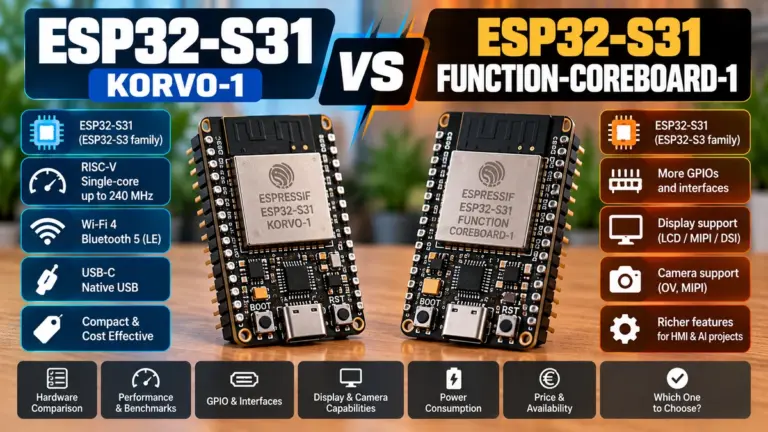
Espressif’s current S31 development ecosystem includes boards such as the ESP32-S31-Function-CoreBoard-1 and ESP32-S31-Korvo-1.
They target different needs: Function-CoreBoard-style hardware is a broad feature/peripheral development platform, while Korvo-class hardware focuses more heavily on audio/AI/HMI use cases.
This is a strong signal that Espressif expects S31 to serve not only as a simple DevKit MCU but as a platform for sophisticated end products.
Arduino Support: S3 Still Wins Today
For Arduino users, S3 remains the easy recommendation when project success matters more than owning the newest silicon.
S31 support will mature, but early in a chip’s life the biggest gaps often appear in board definitions, peripheral wrappers, third-party libraries and examples rather than basic GPIO support.
An I²C sensor may work quickly on a new SoC. A complex camera + display + USB + PSRAM application is where maturity differences become visible.
ESP-IDF: The Best Environment for Early S31 Work
If you are deliberately choosing S31 because of its new hardware, ESP-IDF is the natural environment. Espressif exposes new peripherals and silicon capabilities there first, long before every Arduino abstraction or community library is equally polished.
For professional/product development, that is not a disadvantage. For a hobbyist following tutorials, it can be.
ESPHome: Do Not Buy S31 Just for a Simple Home Assistant Node
A temperature sensor, relay, BLE proxy or mmWave node does not need a 320 MHz dual-core flagship.
For most ESPHome devices:
Cheap simple node → C3
Multiprotocol / Thread/Zigbee → C6
BLE / voice / display-heavy → S3
5 GHz Wi-Fi → C5
Future high-end HMI / AI / multiprotocol → S31
S31 becomes relevant to Home Assistant when the ESP32 is doing something unusually rich locally — display, audio, vision, gateway work, multiple protocols or complex UI.
S31 vs S3 for BLE Proxy
S3 remains the sensible choice today.
A BLE proxy workload is not CPU-bound enough to justify S31’s extra capability. S3 support is mature, modules are cheap and external-antenna board options are widely available.
Choose S31 only if the same device also needs its other capabilities.
S31 vs S3 for Voice Assist
This is more interesting. S3 is already excellent for ESPHome/voice-satellite style projects, and years of audio examples exist.
S31’s faster CPU and modern SIMD/DSP platform should provide more headroom for local audio processing, wake words and richer interfaces, but software maturity remains decisive.
| Goal | Best choice |
|---|---|
| Build a proven voice satellite today | S3 |
| Design next-generation local voice product | S31 |
S31 vs S3 for AI
Winner: S31 for new development.
The CPU speed, newer vector architecture, memory subsystem and multimedia pipeline all point in the same direction. S3 remains useful and has mature ESP-DL/AI examples, but S31 offers more future performance headroom.
S31 vs S3 for a Smart Display
S31 is the better long-term platform.
A smart display benefits from exactly the things S31 improves: memory bandwidth, graphics/image acceleration, CPU performance, networking and I/O.
S3 remains the easier choice for a small/medium display when you want known hardware and known LVGL examples now.
S31 vs S3 for a Camera
| Priority | Winner |
|---|---|
| Maximum current examples | S3 |
| Lowest integration risk | S3 |
| Highest future headroom | S31 |
| Combined camera + AI + rich networking | S31 |
S31 vs S3 for USB Projects
S3 is still an outstanding USB MCU with a proven TinyUSB/Arduino/ESP-IDF ecosystem. S31 adds performance and broader peripherals, but for a pure USB HID/MIDI/device project, the S3 can remain the more pragmatic choice.
S31 vs S3 for Industrial HMI
S31.
The combination of richer display/camera support, more GPIO, high-speed external memory, Ethernet MAC, Wi-Fi 6 and 802.15.4 makes S31 a much stronger single-chip candidate for modern industrial panels and gateways.
Can S31 Replace an S3 on an Existing PCB?
No — do not assume pin or package compatibility.
Even when two chips occupy the same product tier, the package, power pins, flash/PSRAM routing, RF design and peripheral pinout can differ substantially.
Treat an S31 migration as a new hardware revision, not as a drop-in component swap.
Can Existing S3 Code Be Reused?
High-level ESP-IDF/Arduino code that uses standard APIs may port relatively cleanly. Low-level register code, Xtensa-specific assembly, chip-specific peripheral assumptions and board pin mappings will require work.
Portable code:
WiFi / I2C / SPI / generic FreeRTOS logic → often reusable

Non-portable code:
Xtensa assembly / direct registers / S3 pin maps → must be reviewed
Should You Stop Buying ESP32-S3 Boards?
No.
S3 is not obsolete. It is mature, inexpensive and overpowered for many projects. A well-supported S3 board can be a better engineering choice than a newer S31 board if the S31 features are unused.
The S3 is likely to remain one of the most useful ESP32 families for years, just as the original ESP32 remained useful long after S2/S3/C3 arrived.
When I Would Choose ESP32-S3
- ESPHome BLE proxy
- Known-good voice satellite
- Existing S3 PCB/product
- SPI/RGB display with mature library
- Camera project following established examples
- USB HID/MIDI project
- Cost-sensitive product where S31 features are unnecessary
- Arduino-first project where library maturity matters
When I Would Choose ESP32-S31
- New advanced HMI
- Camera + local AI
- Connected appliance needing Thread/Zigbee as well as Wi-Fi
- Industrial gateway with Ethernet
- Audio/AI product needing more compute headroom
- Large/complex LVGL interface
- New design expected to remain in production for many years
- Product that would otherwise need multiple companion chips
When I Would Choose Neither
For many ESP32 projects, both are excessive.
| Project | Better option |
|---|---|
| Simple Wi-Fi sensor | ESP32-C3 |
| Matter/Thread/Zigbee sensor | ESP32-C6 |
| Battery Thread/Zigbee endpoint | ESP32-H2/H21 |
| Need 5 GHz Wi-Fi | ESP32-C5 |
| High-end MIPI display/camera/H.264 | ESP32-P4 |
The Biggest S31 Upgrade Is Integration
It is tempting to summarise S31 as “S3 but 320 MHz.” That misses the point.
S3 → high-performance Wi-Fi/BLE MCU

S31 → high-performance Wi-Fi 6/BLE/802.15.4 MCU
      + stronger AI/SIMD
      + faster external memory
      + richer multimedia
      + Ethernet MAC
      + more I/O
The value is that a single S31 can cover roles that previously pushed designers toward an S3 plus one or more companion chips.
The Biggest S3 Advantage Is Predictability
S3 designs have known modules, known quirks, known PSRAM configurations, known camera pinouts, mature board support and thousands of community examples.
For an engineer shipping a product next month, predictable integration can be worth more than another 80 MHz or a radio protocol the product does not use.
My 2026 Verdict
| Category | Winner |
|---|---|
| CPU performance | S31 |
| Future AI/DSP headroom | S31 |
| Wi-Fi technology | S31 |
| Thread/Zigbee capability | S31 |
| Ethernet integration | S31 |
| External-memory headroom | S31 |
| Arduino maturity | S3 |
| ESPHome maturity | S3 |
| Camera examples | S3 today |
| Board availability / variety | S3 today |
| Best new high-end design | S31 |
| Lowest-risk existing project | S3 |
Decision Flow
Existing S3 project working well?
 └─ YES → Stay on S3 unless S31 solves a real limitation
 └─ NO
     Need 802.15.4 / Thread / Zigbee?
      └─ YES → S31
      └─ NO
          Need maximum HMI/AI/memory/Ethernet headroom?
           └─ YES → S31
           └─ NO
               Need mature Arduino/ESPHome/camera ecosystem today?
                └─ YES → S3
                └─ NO → S31 for future-facing design
Final Recommendation
Yes, the ESP32-S31 is the new ESP32-S3 — but in the same way a new platform generation replaces the old one, not as a drop-in board swap.
Architecturally, S31 wins decisively: 320 MHz dual-core RISC-V, Wi-Fi 6, IEEE 802.15.4, newer Bluetooth, faster external memory, richer multimedia, more I/O and high-speed Ethernet support.
Practically, S3 remains extremely strong because years of software, boards and community experience matter. If I were starting a new advanced product in late 2026, I would design around S31 unless an important library/peripheral requirement was not mature. If I wanted a camera, display, BLE proxy or voice project working this weekend, I would still be perfectly happy choosing S3.
S31 = future platform
S3  = mature platform
The most important thing is not to upgrade for the name. Upgrade when your project can actually use the S31’s extra CPU, 802.15.4, Wi-Fi 6, memory bandwidth, Ethernet or multimedia capability.
Related ESP32 Guides
- ESP32 Versions Explained: Which Board Should You Buy?
- ESP32-S3-DevKitC-1 Pinout + Safe GPIOs
- ESP32-C5 vs ESP32-S3: 5 GHz Wi-Fi or Dual-Core Performance?
- ESP32-P4 Function-EV-Board Pinout + Complete Guide
- Best ESP32 for Home Assistant: S3 vs C3 vs C6 vs C5
Datasheets & External Resources
All manufacturer/framework references are collected here so the main article keeps readers inside esp32.co.uk.
- Espressif ESP32-S31 Product Page — current S31 positioning, features, modules and development hardware.
- ESP32-S31 Mass Production Announcement — Espressif announcement that S31 entered mass production and became available for purchase on 27 July 2026.
- ESP32-S31 Official Portal — current S31 documentation, FAQ and development resources.
- Espressif ESP32-S3 Product Page — official S3 CPU, Wi-Fi/BLE, AI/vector, USB and peripheral overview.
- ESP32-S3 Series Datasheet — detailed S3 hardware, memory, GPIO and peripheral specifications.
- ESP-IDF Programming Guide — current Espressif software framework and SoC support.