For most ESP32AliExpress price and Home Assistant projects, the SHT40AliExpress price remains the best-value choice. The SHT41AliExpress price is essentially a tighter-tolerance SHT40AliExpress price: both have the same typical ±1.8% RH and ±0.2°C accuracy, but the SHT41AliExpress price guarantees substantially better worst-case humidity accuracy across a wider range. The SHT45 is the accuracy winner, with typical specifications of ±1.0% RH and ±0.1°C and maximum humidity error around ±2% RH through most of its range. All three use the same compact SHT4x architecture, I²C interface, extremely low-power design and integrated heater. If SHT40 and SHT41 cost almost the same, buy the SHT41; if maximum measurement quality matters, buy the SHT45. (Sensirion AG)
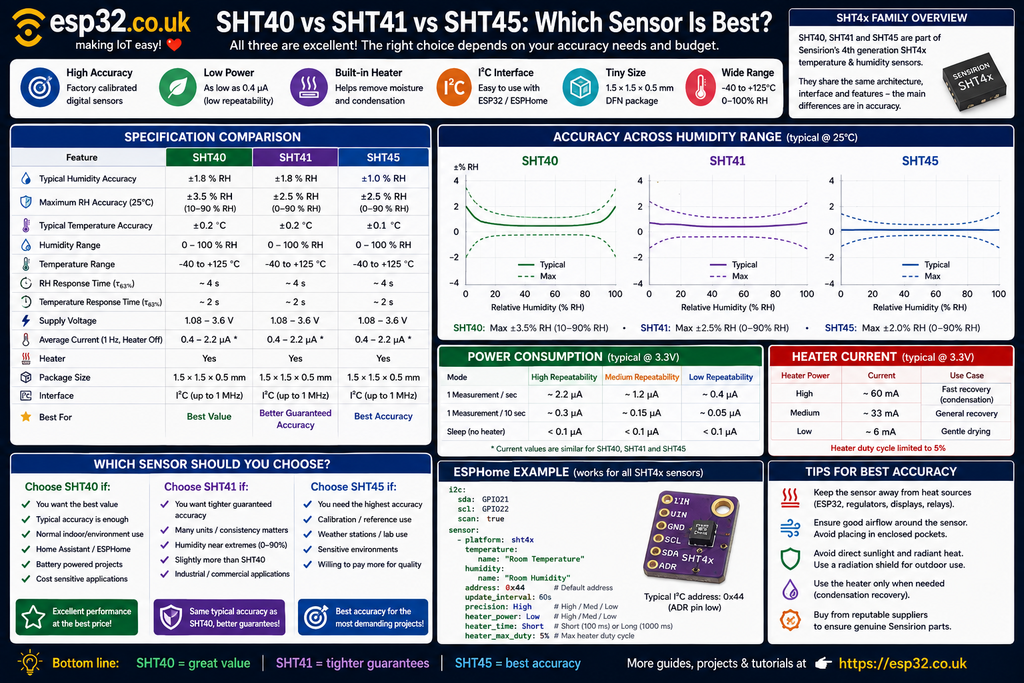
SHT40, SHT41 and SHT45 at a glance
All three sensors belong to Sensirion’s fourth-generation SHT4x temperature and humidity family.
They share far more similarities than differences:
- Digital temperature measurement
- Digital relative-humidity measurement
- I²C interface
- Factory calibration
- Integrated heater
- 1.08–3.6 V supply
- Tiny 1.5 × 1.5 × 0.5 mm package
- -40°C to +125°C specified temperature range
- 0–100% RH extended humidity range
- approximately 4-second humidity response
- approximately 2-second temperature response
- very low power consumption
The real difference is measurement tolerance.
| Feature | SHT40 | SHT41 | SHT45 |
|---|---|---|---|
| Typical humidity accuracy | ±1.8% RH | ±1.8% RH | ±1.0% RH |
| Maximum RH accuracy* | ±3.5% RH | ±2.5% RH | ±2.0% RH |
| Typical temperature accuracy | ±0.2°C | ±0.2°C | ±0.1°C |
| RH response | ~4 s | ~4 s | ~4 s |
| Temperature response | ~2 s | ~2 s | ~2 s |
| RH range | 0–100% | 0–100% | 0–100% |
| Temperature range | -40 to +125°C | -40 to +125°C | -40 to +125°C |
| Standard interface | I²C | I²C | I²C |
| Heater | Yes | Yes | Yes |
| Package | 1.5 × 1.5 × 0.5 mm | Same | Same |
| Best for | Best value | Better guaranteed accuracy | Best accuracy |
*The maximum figures depend on humidity range and temperature. At 25°C Sensirion specifies approximately ±3.5% RH for the SHT40 between 10–90% RH, ±2.5% RH for the SHT41 across approximately 0–90% RH, and ±2% RH for the SHT45 across approximately 0–90% RH. (Sensirion AG)
The most important point: SHT40 and SHT41 have the same typical accuracy
This is where the comparison becomes interesting.
At first glance, the specifications appear to suggest that the SHT40 and SHT41 are identical:
SHT40
±1.8% RH typical
±0.2°C typical

SHT41
±1.8% RH typical
±0.2°C typical
And for many sensors operating around normal room conditions, they may indeed produce nearly indistinguishable results.
The difference becomes clear when looking at maximum error, rather than only typical accuracy.
The SHT40 has a maximum humidity tolerance of approximately:
±3.5% RH from 10–90% RH
while SHT41 tightens that to approximately:
±2.5% RH from 0–90% RH.
That is the real reason SHT41 exists.
It provides a tighter guaranteed tolerance, not dramatically different typical performance.
Typical accuracy vs maximum accuracy
This distinction matters when choosing a sensor.
Suppose the true humidity is:
50% RHA typical SHT40 might read:
49.2% RHand a typical SHT41 might also read:
49.2% RHbecause both have the same typical ±1.8% RH specification.
But when designing equipment that must meet a guaranteed tolerance across many thousands of sensors, the worst-case specification becomes more important.
That is where SHT41 has the advantage.
For a one-off ESP32 project, typical performance may matter more.
For:
- manufactured products
- HVAC controls
- environmental logging
- commercial sensors
- larger batches of devices
the tighter maximum specification can justify the SHT41.
SHT40: the value choice
The SHT40 is the entry point into the standard SHT4x family.
Sensirion specifies:
Humidity: ±1.8% RH typical
Temperature: ±0.2°C typical
It offers approximately:
4-second humidity response
and:
2-second temperature response.
For ordinary applications such as:
- Home Assistant
- bedrooms
- bathrooms
- HVAC
- greenhouses
- ESPHome nodes
- weather monitoring
- battery sensors
that is already excellent performance.
A difference of one or two percentage points in humidity is rarely critical for typical home automation.
Why SHT40 is so attractive for ESP32 projects
The SHT40 combines several characteristics that matter more in real projects than chasing the last fraction of a percent of laboratory accuracy.
It is:
- inexpensive
- widely available
- tiny
- digital
- factory calibrated
- extremely low power
- supported by ESPHome
- supported by many Arduino libraries
- fast enough for environmental monitoring
For something like:
If bathroom humidity > 70%
→ fan ON

If humidity < 60%
→ fan OFF
there is effectively no practical advantage in paying substantially more for an SHT45.
The automation threshold itself is much broader than the sensor’s measurement error.
SHT41: the sensor people often overlook
The SHT41 is probably the most misunderstood member of the three.
It is not halfway between SHT40 and SHT45 in typical accuracy.
Its published typical figures remain:
Humidity ±1.8% RH
Temperature ±0.2°C
exactly like SHT40. (Sensirion AG)
What changes is the tighter maximum humidity tolerance.
This makes SHT41 particularly useful when consistency between different sensors matters.
Imagine deploying:
Sensor 1
Sensor 2
Sensor 3
...
Sensor 100
The SHT41 provides stronger limits on how far an individual unit should deviate.
SHT41 also behaves better toward humidity extremes
Sensirion’s accuracy graphs show another subtle improvement.
The SHT40’s typical accuracy is around:
±1.8% RH in the central range
but rises toward roughly:
±3% RH near 0% and 100% RH
depending on temperature.
SHT41’s typical behaviour is flatter, remaining around:
±2% RH even toward the ends of the humidity range in the published extended-range plots.
This will not matter much in a living room at 45–60% RH.
It becomes more useful for:
- drying applications
- high-humidity rooms
- greenhouses
- environmental chambers
- industrial monitoring
SHT45: the accuracy winner
The SHT45 is clearly the best sensor of the three when measurement accuracy is the main objective.
Sensirion specifies:
Humidity: ±1.0% RH typical
and:
Temperature: ±0.1°C typical. (Sensirion AG)
That is a meaningful improvement.
Compared with SHT40:
Humidity

SHT40
±1.8% RH typical

SHT45
±1.0% RH typical
and:
Temperature

SHT40
±0.2°C typical

SHT45
±0.1°C typical
It also improves the maximum humidity tolerance to approximately ±2% RH across most of the normal range.
When does ±1% RH actually matter?
For a simple Home Assistant dashboard, perhaps not much.
Consider:
SHT40:
47.2% RH

SHT45:
47.8% RH
Both tell essentially the same story:
the room is around 48% humidity.
The SHT45 becomes more worthwhile when the actual numeric measurement matters.
Examples include:
- calibration/reference monitoring
- musical-instrument storage
- museum environments
- archive storage
- environmental testing
- high-quality weather stations
- server/environment monitoring
- HVAC commissioning
- comparing several rooms accurately
- humidity-sensitive manufacturing
In those applications, cutting the typical humidity error almost in half is valuable.
Which sensor is best for Home Assistant?
For a normal Home Assistant room sensor:
SHT40
is the most sensible choice.
It is already far more accurate than many inexpensive humidity sensors commonly used in smart-home hardware.
For someone who wants a slightly higher-grade Home Assistant installation and finds SHT41 for only a little more:
SHT41
is arguably an even better purchase.
For a premium environmental monitoring node:
SHT45
is the obvious choice.
Which is best for ESPHome?
From ESPHome’s perspective, there is almost no difference.
All three use:
platform: sht4xESPHome’s native SHT4x component supports temperature, humidity, measurement precision and heater configuration.
A simple configuration is:
i2c:
  sda: GPIO21
  scl: GPIO22
  scan: true

sensor:
  - platform: sht4x
    temperature:
      name: "Room Temperature"

    humidity:
      name: "Room Humidity"

    address: 0x44
    update_interval: 60s
For most standard modules:
0x44is the expected I²C address.
ESPHome defaults to that address.
ESPHome does not need to know whether it is SHT40 or SHT45
This is another advantage of the family.
There is no:
platform: sht40or:
platform: sht45configuration.
They all use:
platform: sht4xbecause the command interface is shared across the family.
The accuracy difference is in the sensor silicon and factory calibration, not in the ESPHome YAML.
ESPHome measurement precision
ESPHome provides three measurement modes:
High
Med
Low
with:
Highas the default.
Example:
sensor:
  - platform: sht4x
    temperature:
      name: "Bedroom Temperature"

    humidity:
      name: "Bedroom Humidity"

    precision: High
    update_interval: 60s
For mains-powered Home Assistant nodes, High is normally the sensible option.
High precision does use more current
The SHT4x family is extremely low power, but there is a useful detail that often gets lost in simple product comparisons.
Sensirion’s headline product pages quote approximately:
0.4 µA average supply current.
However, the detailed SHT4x datasheet shows that average current at one measurement per second depends on measurement repeatability:
High repeatability
~2.2 µA

Medium repeatability
~1.2 µA

Low repeatability
~0.4 µA
with the heater off.
So the often-quoted:
0.4 µAcorresponds to the low-repeatability operating mode rather than every possible measurement configuration.
Even at 2.2 µA, however, the sensor itself consumes very little compared with an active ESP32 Wi-Fi connection.
Are SHT40, SHT41 and SHT45 equally power efficient?
For practical purposes, yes.
They use the same SHT4x architecture and the electrical specifications apply across the family.
Choosing SHT45 does not mean accepting a large power penalty for the extra accuracy.
That makes SHT45 particularly attractive for high-end battery sensors.
The bigger power-consumption problem is almost always the development board surrounding the sensor.
A poorly designed ESP32 board may consume:
1–5 mAduring supposed deep sleep.
Saving:
1 µAon the humidity sensor will not fix that.
Best sensor for battery-powered ESP32 projects
If prices are considered:
SHT40
is probably the best overall battery choice.
It provides:
- very low power
- strong accuracy
- fast measurements
- inexpensive modules
If measurement quality matters more than price:
SHT45
provides the best combination of low power and accuracy.
SHT41 sits in between from a quality-control perspective, rather than from a power perspective.
Measurement speed
There is no meaningful speed advantage among the three.
Sensirion specifies approximately:
Humidity response
~4 seconds

Temperature response
~2 seconds
for the SHT4x family.
For normal home automation, environmental changes are much slower than that anyway.
Updating Home Assistant every:
30–60 secondsis usually more than sufficient.
Don’t confuse response time with update interval
An ESPHome configuration of:
update_interval: 60sdoes not mean the sensor takes 60 seconds to perform a measurement.
The SHT4x actually completes a digital measurement in milliseconds.
The response-time specification describes how quickly the physical sensing element responds to a real environmental change.
For example, after moving from:
40% RHinto:
70% RHair, the sensor does not instantly represent the new humidity because moisture must diffuse into the sensing element.
That physical response is approximately four seconds under Sensirion’s specified airflow test conditions.
All three have an integrated heater
The SHT4x contains a heater that can help recover the sensing element from:
- condensation
- very high humidity
- water droplets
- moisture contamination
ESPHome exposes:
heater_power:
heater_time:
heater_max_duty:
for the SHT4x component.
Available heater powers are:
High
Med
Low
and durations:
Long
Short
ESPHome identifies these as approximately:
Long = 1000 ms
Short = 100 ms
and limits the configured heater duty cycle to 5%.
The heater is not for normal temperature measurement
The heater should not simply be left running because:
"more heat = better sensor"During heater operation, the local sensor temperature rises.
That causes:
- artificially high temperature
- artificially low relative humidity
ESPHome stops publishing normal measurements while its configured heater cycle is operating.
For an ordinary indoor sensor:
leave the heater off.
Use it when condensation recovery is actually required.
Heater current is much higher than normal sensor current
The contrast is dramatic.
The SHT4x normally operates in the microamp range.
The integrated heater can draw approximately:
High heater
~60 mA typical

Medium heater
~33 mA typical

Low heater
~6 mA typical
depending on supply conditions.
That is still fine for short heater pulses, but it matters in battery-powered designs.
A sensor that normally consumes microamps can suddenly require tens of milliamps while the heater is active.
Recommended operating conditions
Although the sensors have an extended specified range of:
0–100% RH
-40 to +125°C
Sensirion recommends normal long-term operation approximately within:
5–60°C
20–80% RH
for best performance.
Long exposure above 80% RH can temporarily shift the humidity reading.
Sensirion gives an example of roughly:
+3% RH offsetafter approximately 60 hours above 80% RH, with the sensor recovering after returning to normal conditions.
This does not mean SHT4x cannot be used in bathrooms or greenhouses.
It means prolonged extreme conditions can temporarily affect accuracy.
Sensor placement matters more than choosing SHT41 over SHT40
This is perhaps the most important practical lesson.
Imagine:
SHT40
properly ventilated
10 cm from ESP32
versus:
SHT45
mounted directly above
a warm voltage regulator
The SHT40 may produce the more accurate room-temperature measurement.
Heat sources include:
- ESP32 itself
- voltage regulator
- USB-UART converter
- displays
- relays
- power supplies
- charging circuits
For accurate room measurements:
- keep the sensor away from the ESP32
- place it near the PCB edge
- provide ventilation
- avoid direct sunlight
- avoid warm wall surfaces
- separate it physically from regulators
Sensor installation can create several degrees of error, vastly more than the 0.1°C difference between SHT40 and SHT45 specifications.
Breakout board quality matters too
The bare Sensirion sensor may have excellent specifications.
But a cheap breakout board can compromise them through:
- poor PCB layout
- contamination
- regulator heat
- incorrect pull-up resistors
- poor airflow
- questionable soldering
- incorrectly labelled chips
This is especially relevant for SHT45.
If the reason for paying extra is:
±0.1°Cthen placing a genuine SHT45 beside a hot regulator defeats the purpose.
For high-accuracy projects, buy the module from a trusted supplier.
Protective membrane versions
Sensirion also produces protected SHT4x variants such as:
- SHT40-AD1F
- SHT45-AD1F
with an integrated PTFE membrane that provides additional protection against particles and harsh environmental exposure while retaining the core sensing specifications.
These can be useful for:
- outdoor sensors
- HVAC ducts
- dusty environments
- condensing installations
- industrial monitoring
A membrane version may be more valuable in a harsh environment than simply upgrading from SHT40 to an unprotected SHT45.
SHT40 vs SHT41
This comparison is simpler than it first appears.
Choose SHT40 if:
- price matters
- normal room conditions dominate
- ±1.8% RH typical accuracy is enough
- the sensor is for Home Assistant
- you’re building many inexpensive nodes
Choose SHT41 if:
- its price is close to SHT40
- tighter worst-case accuracy matters
- consistency across multiple sensors matters
- humidity may operate closer to range extremes
The key distinction is:
SHT40 and SHT41 have similar typical performance.
SHT41 gives a stronger guarantee around maximum error.
SHT41 vs SHT45
Here the distinction is much clearer.
SHT41
±1.8% RH typical
±0.2°C typical
SHT45
±1.0% RH typical
±0.1°C typical
SHT45 is not merely a tighter-bin SHT41 around maximum humidity tolerance.
It provides genuinely better typical humidity and temperature accuracy.
If accuracy is the reason for upgrading, skip directly to SHT45.
SHT40 vs SHT45
This is probably the buying decision most ESP32 hobbyists actually face.
Choose:
SHT40
when value matters.
Choose:
SHT45
when accuracy matters.
The SHT45 effectively cuts the typical humidity tolerance from:
±1.8% RHto:
±1.0% RHand temperature tolerance from:
±0.2°Cto:
±0.1°Cwithout changing the interface, size or basic power architecture.
That makes it a very clean upgrade.
Best sensor for a bathroom
SHT40
is usually the logical choice.
A bathroom automation may simply need to identify:
Humidity rising rapidly
→ ventilation ON
Absolute laboratory-grade accuracy is unnecessary.
Fast response, reliable digital measurements and the ability to recover from high humidity are more important.
If the installation is particularly harsh or likely to see moisture droplets, consider a membrane-protected variant.
Best sensor for a bedroom
For normal comfort monitoring:
SHT40
For someone building a premium room sensor:
SHT45
Typical bedroom decisions such as:
Humidity below 40%
→ dry

40–60%
→ comfortable

above 65%
→ high
do not require ±1% RH accuracy.
Best sensor for a greenhouse
SHT41 or SHT45
makes more sense here.
A greenhouse can spend long periods at relatively high humidity, so the tighter SHT41 humidity tolerance is useful.
For more serious environmental logging:
SHT45
is preferable.
But placement, condensation protection and airflow remain more important than the final 0.8% difference in typical accuracy.
Best sensor for a weather station
For a normal DIY weather station:
SHT40
provides excellent value.
For a higher-quality station intended to compare measurements with official weather sources:
SHT45
is more appropriate.
A weather station should also shield the sensor from:
- direct sunlight
- rain
- radiant heating
- stagnant air
using an appropriate radiation shield.
Even the best humidity sensor will produce poor measurements if mounted directly in the sun.
Best sensor for calibration/reference use
SHT45
There is little reason to choose SHT40 or SHT41 if the entire goal is the highest possible measurement accuracy from this family.
Its:
±1% RH
±0.1°C
typical specification makes the decision easy.
Best value
For most readers:
SHT40
still wins on pure price/performance.
But there is one important qualification:
If SHT41 costs only slightly more than SHT40 from the same reputable supplier, buy SHT41.
It gives tighter maximum humidity tolerances without sacrificing power, speed or software compatibility.
The upgrade is therefore effectively free from a design perspective.
Which one should you actually buy?
The easiest decision tree is:
Ordinary ESP32/Home Assistant sensor
SHT40
SHT41 costs almost the same as SHT40
SHT41
Best possible temperature/humidity accuracy
SHT45
Battery-powered sensor
SHT40 or SHT45
depending on budget and required accuracy.
Many units where worst-case tolerance matters
SHT41 or SHT45
Harsh or dusty environment
Look for a suitable membrane-protected SHT4x variant, not only the sensor number.
Final ranking
Best overall value
SHT40
Excellent accuracy at low cost.
Best middle option
SHT41
Same typical accuracy as SHT40, but tighter maximum RH error and better performance toward humidity extremes.
Best sensor
SHT45
The clear winner for measurement quality with ±1.0% RH and ±0.1°C typical accuracy.
Final recommendation
The important thing about this comparison is that:
SHT40 → SHT41 → SHT45is not a simple linear ladder where every step gives a proportionally more accurate sensor.
The real relationship is:
SHT40 = excellent standard sensor
SHT41 = SHT40-class typical performance with tighter guaranteed tolerances
SHT45 = genuinely higher-accuracy sensor
Sensirion’s current specifications make this very clear: SHT40 and SHT41 share the same ±1.8% RH and ±0.2°C typical figures, whereas SHT45 improves them to ±1.0% RH and ±0.1°C.
For most ESP32 projects:
buy SHT40.
If SHT41 is only marginally more expensive:
buy SHT41.
If the measurement itself matters enough that a one-percentage-point humidity difference is important:
buy SHT45.
And whichever one is chosen, give equal attention to sensor placement, ventilation and PCB heat, because a badly positioned SHT45 can easily perform worse in the real world than a properly installed SHT40.
Metadata
SEO title:
SHT40 vs SHT41 vs SHT45: Which Sensor Is Best?