Quick summary: Wireless-Tag has listed the WT32P4C5-43S, a complete touchscreen development board built around an ESP32-P4AliExpress price application processor and a separate wireless companion. The store title names an ESP32-C5AliExpress price, while its description also mentions ESP32-C61 configurations. The board combines a 4.3-inch, 800 × 480 touch display, camera expansion, microSD storage, two USB interfaces and GPIO expansion. The base model is listed at $32, but the store currently marks it sold out and describes availability at the end of November as tentative.
A development board, not a new ESP32 chip
The naming needs a little care. WT32P4C5-43S is Wireless-Tag’s finished development board. Its main controller is Espressif’s ESP32-P4AliExpress price, a dual-core RISC-V system-on-chip designed for graphics, cameras and other high-bandwidth embedded work. The P4 itself has no integrated Wi-Fi or Bluetooth, so the board adds a second ESP32 device as a wireless companion.
The store title names an ESP32-C5AliExpress price, while the description says configurations may use either an ESP32-C5AliExpress price or ESP32-C61 module. That difference matters: buyers should confirm the fitted wireless module rather than assuming every radio feature of the C5 is present on every version. Espressif specifies dual-band 2.4/5 GHz Wi-Fi 6, Bluetooth LE and IEEE 802.15.4 for the ESP32-C5 silicon, but silicon capability alone does not prove that every protocol is enabled in the board firmware.
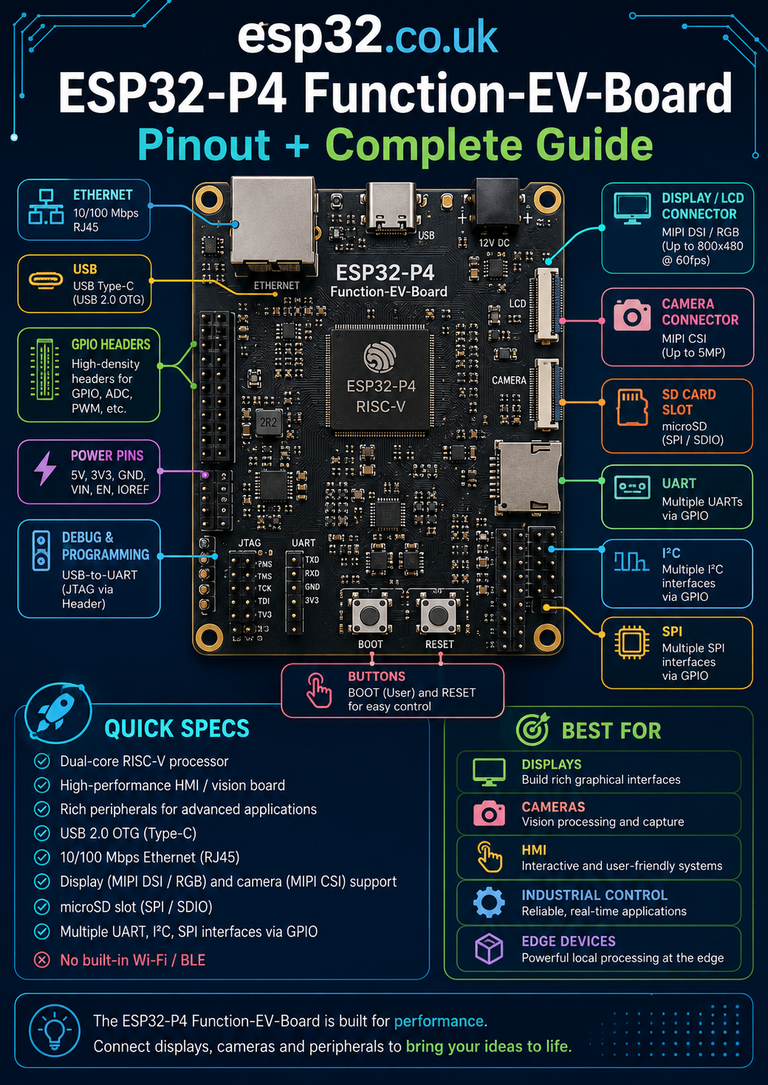
| Part | Manufacturer-stated detail |
|---|---|
| Main controller | ESP32-P4 |
| Wireless companion | Store title: ESP32-C5; description: ESP32-C5 or ESP32-C61 depending on configuration |
| Display | 4.3-inch 800 × 480 TFT colour touchscreen |
| Camera expansion | CSI camera interface |
| Storage | Onboard microSD slot |
| USB | Debug USB plus USB 2.0 High-Speed application interface |
| Expansion | Header exposing GPIO and peripheral interfaces |
Why the integrated screen matters
Many ESP32-P4 boards expose display connectors but leave the screen, touch controller and mechanical integration to the developer. Wireless-Tag’s board is closer to a ready-made panel: the display and touch hardware are already part of the assembly, while the P4 supplies the processing headroom for richer graphical interfaces.
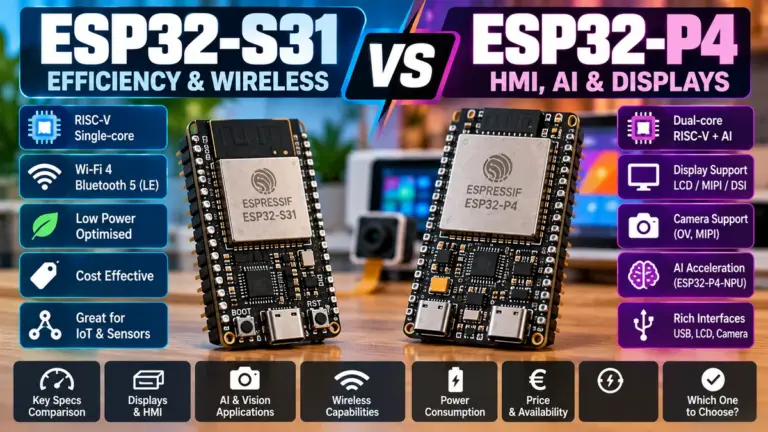
Espressif rates the ESP32-P4’s two high-performance RISC-V cores at up to 400 MHz and gives the chip parallel display and camera interfaces, MIPI CSI/DSI, a pixel-processing accelerator and H.264 encoding hardware. Those are capabilities of the chip, however; they should not be read as a promise that every interface is exposed or supported by this particular board. For context, our ESP32-P4 versus ESP32-S3 comparison explains why the P4 needs a companion radio, while our ESP32-C5, C6 and H-series guide separates the wireless families and their likely roles.
Software support is still the main caveat
Wireless-Tag links separate code repositories for the ESP32-P4 host and the C5/C61 wireless side. The companion repository documents an ESP-Hosted connection over SDIO and an ESP-IDF 6.0.1 build path. That is useful evidence that the two-chip architecture is supported, but it is not the same as a polished Arduino board package or ready-made ESPHome configuration.
Anyone planning a Home Assistant wall panel, industrial HMI or camera terminal should therefore budget for firmware and interface work. The product listing does not promise ESPHome support, a finished Home Assistant dashboard image or compatibility with a particular camera sensor. Early adopters should also confirm the precise module, memory configuration, included programming hardware and delivery date before paying.
Price and availability
The WT32P4C5-43S base option is listed at $32. Wireless-Tag labels it as a pre-order and says samples are being expedited, with availability possibly at the end of November. At the time of writing on 13 October 2026, the product page also shows “Sold out”, so this is an announced pre-production listing rather than confirmed shipping stock.