Quick Summary (TL;DR):
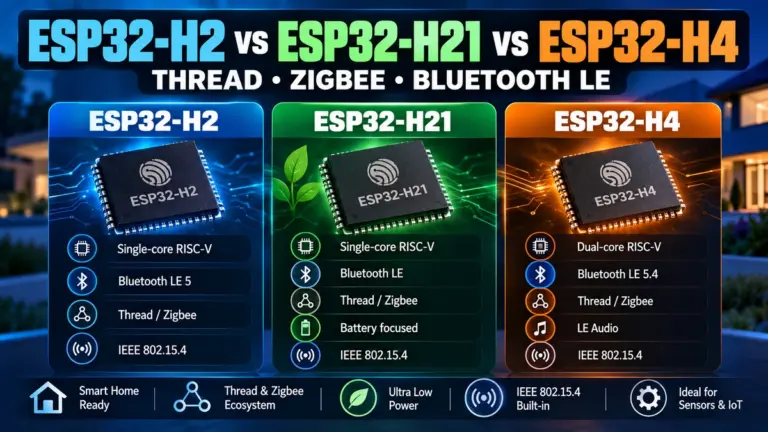
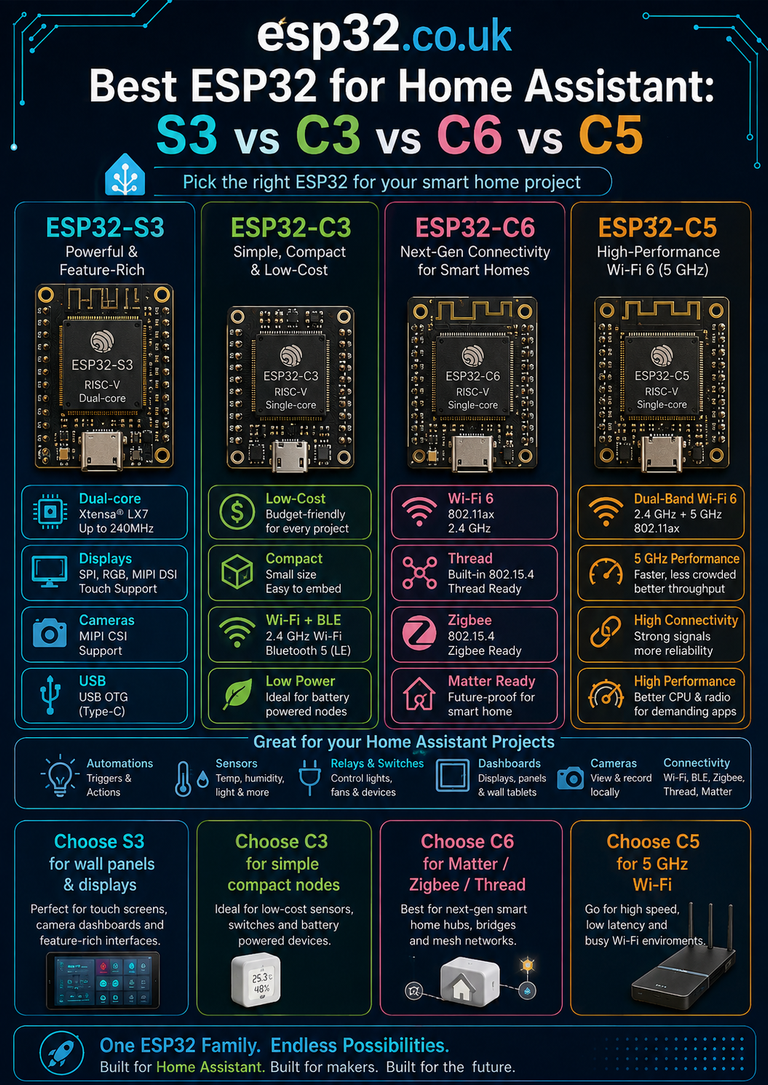
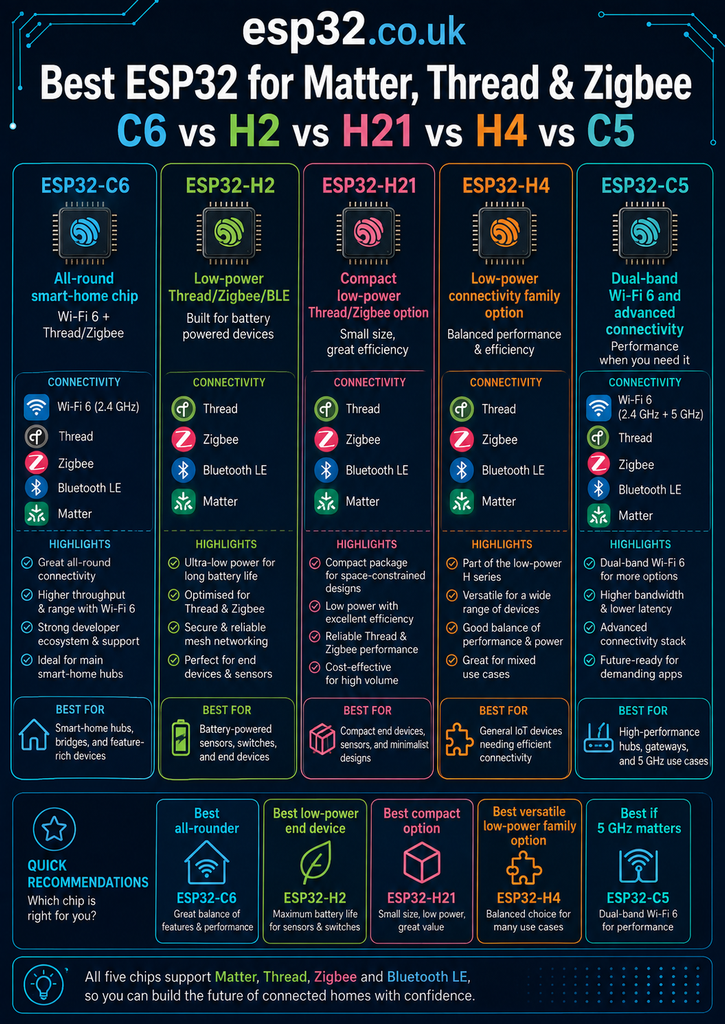
For most people building a Matter, Thread or Zigbee project in 2026, the ESP32-C6AliExpress price is still the best all-round starting point: it combines a mature 160 MHz RISC-V platform, 2.4 GHz Wi-Fi 6, Bluetooth LE and IEEE 802.15.4 in one inexpensive SoC, with strong ESP-IDF, Arduino and smart-home ecosystem support. For a battery-powered Thread/Zigbee endpoint, the ESP32-H2AliExpress price remains the proven choice, while the newer ESP32-H21 is effectively the low-power successor because it adds an integrated DC-DC converter. The ESP32-H4 is the high-end H-series option: dual-core, more memory, PSRAM support, USB OTG, CAN FD, touch and advanced BLE/LE Audio capabilities, but it is excessive for a simple contact or temperature sensor. The ESP32-C5 is the most capable all-in-one wireless option, adding 2.4 + 5 GHz Wi-Fi 6, Bluetooth 6-class features, Thread 1.4, Zigbee 3.0 and optional PSRAM; choose it when 5 GHz Wi-Fi, higher performance or a richer application really matters. If you simply want the safest recommendation: C6 for general smart-home development, H2/H21 for low-power endpoints, H4 for advanced low-power products, and C5 for premium multiprotocol devices.
Materials You’ll Need
| Item | Why it helps |
|---|---|
| ESP32-C6AliExpress price development board | Best baseline board for comparing Wi-Fi + Thread/Zigbee |
| ESP32-H2AliExpress price or H2 SuperMini | Useful for testing dedicated low-power 802.15.4 endpoints |
| ESP32-C5 development board | For dual-band Wi-Fi + 802.15.4 experiments |
| ESP32-H21/H4 hardware | Optional newer-generation testing where boards/modules are available |
| USB-C data cables | Power, flashing and serial/JTAG debugging |
| Zigbee coordinator | Needed to join and test Zigbee end devices in a real network |
| Thread Border Router | Needed to connect Thread devices to the normal IP network |
| Home Assistant system | Useful for Matter, Thread and Zigbee integration testing |
| Breadboard + jumper wires | Prototyping sensors, buttons and actuators |
| Low-power sensor | Makes power/end-device differences between the chips meaningful |
The First Thing to Understand: Matter, Thread and Zigbee Are Not the Same Thing
A lot of ESP32 buying advice becomes confusing because Matter, Thread, Zigbee and IEEE 802.15.4 are mixed together as if they were competing radio standards. They are not.
IEEE 802.15.4 = low-power radio/MAC foundation
        ├─ Zigbee = its own mesh networking/application ecosystem
        └─ Thread = IPv6 mesh networking
                  └─ Matter can run over Thread

Matter can also run over Wi-Fi / Ethernet
Bluetooth LE is commonly used for commissioning
Matter is an application-layer smart-home standard. A Matter device normally communicates over an IP network. That IP connection can be provided by Wi-Fi, Ethernet or Thread. Zigbee, in contrast, is a separate non-IP smart-home stack built on the same 2.4 GHz 802.15.4 radio family.
This distinction immediately explains why there is no single “best Matter chip.” A mains-powered Matter-over-Wi-Fi controller has very different requirements from a coin-cell Matter-over-Thread contact sensor.
The Five Chips at a Glance
| Chip | CPU | Wi-Fi | BLE | 802.15.4 | Best role |
|---|---|---|---|---|---|
| ESP32-C6AliExpress price | 1× 160 MHz + 20 MHz LP RISC-V | 2.4 GHz Wi-Fi 6 | BLE 5.3 | Thread + Zigbee | Best all-round smart-home SoC |
| ESP32-H2 | 1× 96 MHz RISC-V | No | BLE 5.3 | Thread 1.4 + Zigbee 3.0 | Proven low-power endpoint |
| ESP32-H21 | 1× 96 MHz RISC-V | No | BLE + 802.15.4 | Thread + Zigbee | New low-power H2 successor |
| ESP32-H4 | 2× 96 MHz RISC-V | No | BLE 5.4 / BLE 6 certified | Thread 1.4 + Zigbee 3.0 | Advanced low-power / audio / HMI |
| ESP32-C5 | 1× 240 MHz + LP RISC-V | 2.4 + 5 GHz Wi-Fi 6 | Bluetooth 6-class | Thread 1.4 + Zigbee 3.0 | Premium multiprotocol device |
Which One Should You Buy?
| Project | Best choice | Why |
|---|---|---|
| First Thread/Zigbee project | ESP32-C6 | Mature, inexpensive, Wi-Fi + BLE + 802.15.4 in one device |
| Battery Zigbee sensor | ESP32-H2 / H21 | No Wi-Fi overhead; purpose-built low-power mesh role |
| Battery Matter-over-Thread sensor | ESP32-H21 if available; otherwise H2 | H21 adds integrated DC-DC efficiency; H2 is proven today |
| Mains-powered smart-home node | ESP32-C6 | Excellent balance of connectivity, ecosystem and cost |
| 5 GHz Matter/Wi-Fi product | ESP32-C5 | Only one here with dual-band 2.4/5 GHz Wi-Fi |
| Advanced remote / LE Audio / touch product | ESP32-H4 | Dual-core + PSRAM + USB OTG + touch + advanced BLE |
| Thread Border Router experiment | C6 or C5 | Both contain IP-side Wi-Fi plus 802.15.4 in one SoC |
| Dedicated 802.15.4 radio coprocessor | H2 / H21 | Simple, low-power and well matched to RCP roles |
ESP32-C6: The Best Default Choice
The ESP32-C6 is still the board I would recommend to someone who says: “I want to start building Matter, Thread or Zigbee devices, but I am not yet sure exactly what the final architecture will be.”
It combines four things that matter in practice: 2.4 GHz Wi-Fi 6, Bluetooth LE, IEEE 802.15.4 and a mature software ecosystem. The 160 MHz main RISC-V CPU is fast enough for ordinary smart-home devices, while a separate 20 MHz low-power RISC-V core gives Espressif room for power-management and always-on tasks.
| ESP32-C6 feature | Why it matters |
|---|---|
| 160 MHz HP RISC-V CPU | Enough performance for most sensors, relays and controllers |
| 20 MHz LP RISC-V CPU | Useful low-power architecture |
| 512 KB HP SRAM + 16 KB LP SRAM | Comfortable for embedded smart-home stacks |
| 2.4 GHz Wi-Fi 6 | Direct IP networking and Matter-over-Wi-Fi |
| Bluetooth LE 5.3 | Commissioning, BLE devices and coexistence |
| IEEE 802.15.4 | Thread and Zigbee radio support |
| Thread 1.3 / Zigbee 3.0 in current datasheet | Mature smart-home protocol support |
| USB Serial/JTAG | Very convenient development |
The big practical advantage is flexibility. You can begin with Wi-Fi, later experiment with Zigbee, move to OpenThread, or use the C6 as part of a radio-coprocessor architecture without replacing the entire platform.
Why C6 Is Not Automatically the Best Battery Sensor
The C6 can be power-efficient, but it carries hardware for Wi-Fi that a dedicated Zigbee/Thread endpoint may never use. If the product is a small battery-powered door contact whose only job is to wake, report a state and sleep again, the H-series makes more architectural sense.
That does not make the C6 “bad at low power.” It means the H2/H21 family is more specialised and can be a cleaner fit when Wi-Fi is definitely unnecessary.
ESP32-H2: The Proven Low-Power Thread/Zigbee Choice
The ESP32-H2 removes Wi-Fi and concentrates on Bluetooth LE + IEEE 802.15.4. It uses a 96 MHz single-core RISC-V CPU, 320 KB SRAM, 4 KB low-power memory and 2 MB or 4 MB in-package flash.
For a low-power mesh endpoint, those specifications are not a compromise. A contact sensor, temperature sensor, switch or occupancy sensor does not need a 240 MHz processor or 5 GHz Wi-Fi.
- Zigbee 3.0
- Thread 1.4
- Matter support through Thread architectures
- Bluetooth LE 5.3
- approximately 7 µA SoC deep sleep
- 19 programmable GPIOs
- 5 ADC channels
- USB Serial/JTAG
The H2 also has a major 2026 advantage: it is no longer a speculative new chip. There are official modules, DevKits, tiny third-party boards and mature ESP-IDF support. That makes it the safe low-power recommendation even when a newer H-series chip looks slightly better on paper.
ESP32-H21: Think of It as the Low-Power H2 Evolution
Espressif announced the ESP32-H21 in March 2026 as an incremental improvement to the H2 platform. The headline change is an integrated DC-DC converter, specifically intended to reduce active current and extend battery life.
The basic philosophy remains very H2-like: a 96 MHz single-core RISC-V processor, around 320 KB SRAM, Bluetooth LE and IEEE 802.15.4 for Thread, Matter and Zigbee devices.
For a battery product, the integrated DC-DC is more meaningful than a small CPU-speed increase would have been. A mesh sensor spends its life moving between sleep, short bursts of CPU work and radio activity; improving supply efficiency during those active windows can directly improve battery life.
H21 vs H2: Which Would I Choose?
| Question | Recommendation |
|---|---|
| Need a board today with broad community support? | H2 |
| Designing a new production battery device? | H21 deserves priority |
| Need proven examples, modules and third-party boards? | H2 |
| Battery life is the dominant design constraint? | H21 |
| Just learning Zigbee/Thread? | H2 |
The H21 is technically the more attractive low-power direction, but ecosystem maturity matters. In 2026 the H2 still has the advantage in available boards, examples, community experience and known hardware behaviour.
ESP32-H4: Much More Than an H2 Replacement
The ESP32-H4 is easy to misunderstand. It is not simply an H2 with a slightly newer Bluetooth revision. It moves the H-series into a substantially more capable class.
| ESP32-H4 capability | Why it matters |
|---|---|
| Dual-core RISC-V up to 96 MHz | More application headroom than H2/H21 |
| 384 KB SRAM | More room for richer stacks and buffers |
| External PSRAM support | Important for audio, displays and large data buffers |
| Bluetooth 5.4 features / BLE 6 certification | LE Audio, PAwR, direction finding and newer BLE features |
| IEEE 802.15.4 | Thread 1.4 and Zigbee 3.0 |
| Integrated DC-DC | Designed for battery-powered products |
| USB OTG | Real USB device/host possibilities |
| CAN FD | Industrial/automotive-style communications |
| 15 touch-sensing GPIOs | Useful for remotes, interfaces and appliances |
| I²S + richer peripherals | Audio and higher-function embedded devices |
The H4 therefore makes sense for products such as smart remotes, low-power display controllers, LE Audio devices, smart-home hubs, healthcare products and feature-rich battery devices.
For a basic Zigbee temperature sensor it is overkill. The H2/H21 is smaller conceptually and easier to justify. For a remote control with touch buttons, audio, a display and Thread connectivity, the H4 is in another league.
H4 Availability and Maturity Matter
Espressif announced H4 sample availability in March 2026 and now lists the H4 family and H4-WROOM-1 in its product portfolio. That makes it real hardware rather than a paper announcement, but it is still far newer than H2/C6.
For an enthusiast or early product design, that is exciting. For a project where the priority is copying a known example today and getting it working in one evening, H2 or C6 remains the easier path.
ESP32-C5: The Most Capable All-In-One Wireless Option
The ESP32-C5 combines the smart-home radio flexibility of the C6 with a much stronger general connectivity platform.
- 240 MHz RISC-V CPU
- 2.4 GHz + 5 GHz dual-band Wi-Fi 6
- Bluetooth Core 6.0 certified capabilities
- IEEE 802.15.4
- Thread 1.4
- Zigbee 3.0
- optional PSRAM up to 8 MB in current WROOM configurations
- flash options up to 32 MB on modules
- CAN FD and rich peripheral set
The obvious differentiator is 5 GHz Wi-Fi. Neither the C6 nor the H-series gives you that.
For a mains-powered controller in a congested apartment building, a smart display, bridge or premium Matter device, the ability to use 5 GHz Wi-Fi while still having 802.15.4 available can be genuinely useful.
Does 5 GHz Wi-Fi Matter for Matter?
Matter itself does not require 5 GHz. Many Matter-over-Wi-Fi products are perfectly happy on 2.4 GHz because of its longer range and better wall penetration.
The C5 advantage appears when the product is doing more than sending occasional switch states: richer local web interfaces, higher data throughput, noisy 2.4 GHz environments, or a product expected to remain on a modern dual-band network for years.
Do not pay for C5 simply because “5 is newer than 6.” Buy it when the application benefits from its specific connectivity and performance advantages.
Matter-over-Wi-Fi vs Matter-over-Thread
| Characteristic | Matter over Wi-Fi | Matter over Thread |
|---|---|---|
| Typical power source | Usually mains / larger battery | Excellent for low-power battery devices |
| Network | Connects directly to Wi-Fi AP | Joins Thread mesh |
| Border router required | No | Yes |
| Range strategy | Wi-Fi infrastructure | Mesh routers + border router |
| Typical ESP32 choice | C6 / C5 / S3 etc. | C6 / C5 / H2 / H21 / H4 |
| Good examples | Plugs, displays, appliances | Sensors, locks, buttons, thermostats |
C6 and C5 are special because they can participate in both worlds at the silicon level: Wi-Fi for direct IP connectivity and 802.15.4 for Thread.
H2, H21 and H4 are naturally aligned with Matter-over-Thread because they have no integrated Wi-Fi.
What Is a Thread Border Router?
A Thread device does not normally talk directly to your Ethernet/Wi-Fi LAN. A Thread Border Router provides the IP bridge between the Thread mesh and the rest of the network.
Matter Thread sensor
      ↓ 802.15.4 / Thread
Thread Border Router
      ↓ normal IP network
Home Assistant / Matter controller
Espressif explicitly supports architectures where an ESP32-H-series 802.15.4 device is combined with a Wi-Fi-capable ESP32 to create a Thread Border Router. C5 and C6 also contain both Wi-Fi and 802.15.4 hardware, which makes single-SoC experimentation possible, although production border-router designs still need careful attention to coexistence, throughput, certification and software architecture.
A Radio Chip Is Not Automatically a Good Home Assistant Coordinator
This is an important practical distinction. Having an 802.15.4 radio means the chip can run Zigbee or Thread software. It does not automatically mean a random dev board is the ideal permanent coordinator for a large Home Assistant installation.
For a production home network, dedicated coordinator or border-router hardware often provides better antenna placement, firmware stability, enclosure design and upgrade isolation. ESP32 boards are excellent for development, custom endpoints, bridges and experimentation, but “contains 802.15.4” and “best coordinator appliance” are different questions.
Zigbee Roles: Coordinator, Router and End Device
| Role | What it does | Best ESP32 fit |
|---|---|---|
| Coordinator | Forms/manages a Zigbee network | C6/H2/H21/H4 can do it in suitable software designs |
| Router | Mains-powered mesh repeater + application | C6, H2, H21, H4 |
| End device | Can sleep; usually sensor/button | H2/H21 particularly attractive |
A battery-powered Zigbee sensor normally wants to be an end device, not a router. That is exactly the role where the H2/H21 power-focused architecture makes the most sense.
Thread Roles: End Device, Router and Border Router
| Role | Description | Best fit |
|---|---|---|
| Sleepy End Device | Battery device that sleeps aggressively | H2 / H21 |
| End Device | Normal Thread endpoint | H2 / H21 / H4 / C6 / C5 |
| Router | Forwards Thread mesh traffic | H4 / C6 / C5; H2 also capable |
| Border Router | Connects Thread mesh to IP LAN | C6/C5 experiment or multi-chip design |
Bluetooth Still Matters
Even when the finished device communicates over Thread, Bluetooth LE often remains important for commissioning and provisioning.
This is why all five chips include BLE. The H4 goes further with modern BLE features such as LE Audio, isochronous channels, PAwR and direction finding, while C5 also brings a much newer Bluetooth feature set than C6/H2.
For a simple Matter temperature sensor, those advanced BLE features may never matter. For a smart remote, wearable or audio-oriented control device, they can completely change the product design.
RF Coexistence: One Antenna Cannot Do Everything at Once
When Wi-Fi, BLE and 802.15.4 exist in the same chip, they share 2.4 GHz RF resources. The silicon uses coexistence scheduling so the protocols can take turns.
For ordinary smart-home traffic this works well, but it is not magic. A design that simultaneously pushes heavy Wi-Fi traffic, continuous BLE scanning and a busy Thread/Zigbee router has a harder RF problem than a sleepy H2 sensor.
This is another reason the H-series remains useful even though C5/C6 technically contain more radios: specialisation can simplify power and coexistence behaviour.
Best Choice for a Battery Sensor
Best proven choice: ESP32-H2.
Best newer low-power direction: ESP32-H21.
A battery sensor usually does not need Wi-Fi, large PSRAM, dual-core CPU performance or USB OTG. It needs a reliable 802.15.4 radio, enough processing for its sensor stack, and excellent sleep/active efficiency.
H21’s integrated DC-DC is specifically aimed at that problem, but H2 wins today when development-board availability and community maturity are more important than squeezing the final percentage of power efficiency.
Best Choice for a Mains-Powered Smart-Home Device
For relays, plugs, fixed sensors, wall controllers and development hardware, the C6 gives the most useful balance of cost, maturity and protocol choice. You can use Wi-Fi today and still have BLE/802.15.4 available for a future firmware direction.
Best Choice for a Premium Matter Device
ESP32-C5 when the product benefits from 5 GHz Wi-Fi, higher CPU performance, more flash/PSRAM or richer local processing.
A premium smart appliance, controller or hub can justify the C5 much more easily than a €10 battery contact sensor.
Best Choice for Advanced Low-Power Products
The H4 is the most interesting choice when “low power” does not mean “simple.” If the product needs Thread/Zigbee plus audio, touch, USB OTG, CAN FD, PSRAM or substantially richer BLE functionality, the H4 solves problems that H2/H21 were not designed to solve.
Software Maturity in 2026
| Chip | 2026 software/hardware maturity | Practical view |
|---|---|---|
| ESP32-C6 | High | Excellent starting point; broad board and framework support |
| ESP32-H2 | High | Mature low-power 802.15.4 option |
| ESP32-C5 | Good and rapidly maturing | Official modules/framework support; newer than C6 |
| ESP32-H21 | New in 2026 | Promising low-power successor; less community history |
| ESP32-H4 | New in 2026 | Samples/modules emerging; advanced early-adopter platform |
This table matters more than benchmark numbers. A mature C6/H2 project can be easier to ship than a technically superior device based on a chip whose board ecosystem is still forming.
Arduino Support
Arduino-ESP32 now provides strong support for the established C6/H2/C5 family, including Zigbee APIs on supported 802.15.4 targets. Matter-over-Thread is possible on C6/C5, but some current Arduino configurations require building Arduino as an ESP-IDF component or rebuilding libraries rather than relying only on the standard precompiled package.
For advanced Matter, Thread and new H21/H4 work, ESP-IDF remains the reference environment. Arduino is excellent for getting a light, switch or sensor running quickly; ESP-IDF gives access to the complete networking and low-power architecture.
ESPHome and Home Assistant
ESPHome has moved far beyond being purely a Wi-Fi YAML environment. Current releases provide Zigbee support for ESP32-H2/C6-class devices and OpenThread components for supported 802.15.4 ESP32 targets.
The important architectural question is still the same: decide whether the ESP32 is supposed to be a normal Wi-Fi ESPHome node, a Zigbee endpoint, a Thread device, or radio infrastructure. Do not choose a chip purely because its feature list contains all four protocol names.
Can One Chip Run Wi-Fi and Thread/Zigbee Simultaneously?
C6 and C5 contain both Wi-Fi and 802.15.4, so the hardware supports multiprotocol coexistence. But the radio is shared and the application/framework must explicitly support the desired combination.
A simple device rarely needs to be a Wi-Fi node, Zigbee router and Thread router simultaneously. Choosing a clean role normally produces a more reliable product than turning on every radio simply because the silicon allows it.
C6 vs H2
Choose C6 if Wi-Fi might ever matter, you want maximum flexibility, or this is your first smart-home ESP32 project.
Choose H2 if the product is deliberately a Zigbee/Thread/BLE endpoint and you want a proven low-power platform.
H2 vs H21
Choose H2 for mature boards and examples today.
Choose H21 for a new battery-oriented product where the integrated DC-DC and newer power architecture justify being an earlier adopter.
H21 vs H4
Choose H21 for a simple, efficient mesh endpoint.
Choose H4 when the endpoint itself is sophisticated: audio, touch, PSRAM, USB, CAN FD or much richer BLE functionality.
C6 vs C5
Choose C6 for value, maturity and ordinary smart-home work.
Choose C5 for 5 GHz Wi-Fi, higher performance, newer Bluetooth capabilities, PSRAM options and more demanding products.
C5 vs H4
These two are both high-end, but aimed in opposite directions.
ESP32-C5 = connectivity-heavy
2.4/5 GHz Wi-Fi + BLE + Thread/Zigbee + 240 MHz

ESP32-H4 = low-power feature-heavy
BLE + Thread/Zigbee + dual-core + PSRAM + USB OTG + touch + LE Audio
If the product lives on Wi-Fi, C5. If it lives on a low-power mesh but needs unusually rich local hardware, H4.
Decision Flow
Need 5 GHz Wi-Fi?
 └─ YES → ESP32-C5
 └─ NO
     Need Wi-Fi at all?
      └─ YES → ESP32-C6
      └─ NO
          Simple battery Thread/Zigbee sensor?
           └─ YES → H2 today / H21 for newest low-power design
           └─ NO
               Need audio, PSRAM, USB OTG, touch or advanced BLE?
                └─ YES → ESP32-H4
                └─ NO → ESP32-H2 / H21
My 2026 Ranking
| Rank / role | Chip | Reason |
|---|---|---|
| Best overall | ESP32-C6 | Best combination of maturity, price and multiprotocol capability |
| Best low-power proven endpoint | ESP32-H2 | Purpose-built, mature and widely available |
| Best future low-power endpoint | ESP32-H21 | H2 concept plus integrated DC-DC |
| Best advanced low-power SoC | ESP32-H4 | Dual-core, PSRAM, USB OTG, touch, LE Audio-class BLE |
| Best premium multiprotocol SoC | ESP32-C5 | 5 GHz Wi-Fi + 802.15.4 + more performance |
Common Mistake: Buying C5 Just Because It Is the Newest C-Series
For a Zigbee temperature sensor, the C5 is usually unnecessary. Its 5 GHz Wi-Fi and higher performance do not improve a device that sleeps for 99.9% of its life and sends a tiny 802.15.4 packet every few minutes.
Common Mistake: Assuming H2/H21/H4 Can Join Wi-Fi
They cannot. The H-series devices in this comparison provide BLE + 802.15.4, not integrated Wi-Fi. If a project needs direct Wi-Fi connectivity, choose C6/C5 or pair the H-series radio with another network processor.
Common Mistake: Treating Zigbee as Matter
A Zigbee device does not become a Matter device simply because both use 802.15.4 radio hardware. Bridging Zigbee devices into Matter is possible, but the bridge translates between two different ecosystems.
Common Mistake: Expecting Thread Without a Border Router
A Matter-over-Thread endpoint can form/join a Thread mesh, but normal communication with Home Assistant or another IP controller requires suitable Thread border-router infrastructure.
Common Mistake: Ignoring Software Maturity
H4 can be a much more capable chip than H2 and still be the wrong choice for a weekend sensor project if the required example, dev board or framework integration is not yet as mature. Hardware specifications do not replace a working ecosystem.
Final Recommendation
For most readers, the answer is simpler than the five-chip comparison first suggests.
ESP32-C6  → best default / general smart-home choice
ESP32-H2  → best proven low-power Thread/Zigbee endpoint
ESP32-H21 → best new low-power endpoint direction
ESP32-H4  → best advanced low-power / BLE / audio / HMI platform
ESP32-C5  → best premium all-in-one with 5 GHz Wi-Fi
If I were building a new mains-powered Home Assistant/Matter experiment, I would start with the C6. If I were building a battery Zigbee or Thread sensor, I would use the H2 today and seriously evaluate the H21 for a new production design. If I wanted a sophisticated low-power remote or interface, I would choose H4. And if the device needed 5 GHz Wi-Fi plus Thread/Zigbee, the C5 is the obvious winner.
The key is to choose the chip for the role the device will actually play in the network, not for the longest radio-feature list.
Related ESP32 Guides
- ESP32-C6 SuperMini Pinout + Safe GPIOs
- ESP32-H2 SuperMini Pinout + Safe GPIOs
- ESP32-C3 vs ESP32-C6: Which One Should You Use?
- Which ESP32-C Series Should You Buy?
- ESP32 Versions Explained: Complete Chip & Board Comparison
Datasheets & External Resources
All manufacturer/framework references are collected here so the main article keeps readers inside esp32.co.uk.
- ESP32-C6 Series Datasheet — official C6 CPU, Wi-Fi 6, BLE, Thread/Zigbee and power specifications.
- ESP32-H2 Series Datasheet — official H2 CPU, memory, Thread 1.4, Zigbee 3.0 and low-power specifications.
- Espressif ESP32-H21 Announcement — H21 positioning, integrated DC-DC and low-power smart-home target applications.
- Espressif ESP32-H4 Product Overview — H4 dual-core, BLE, 802.15.4, PSRAM, USB OTG and low-power capabilities.
- ESP32-C5 Series Datasheet — dual-band Wi-Fi 6, BLE, Thread/Zigbee, CPU and peripheral specifications.
- ESP-Matter Programming Guide — official Matter Wi-Fi, Thread device, border-router and bridging architectures.
- Arduino-ESP32 Library Support Matrix — current Zigbee/Matter notes for supported ESP32 families.