Bitmerse opened crowdfunding for Romu on 13 October 2026, offering a tiny USB Type-A development board built around Raspberry Pi’s RP2354A microcontroller. Backing starts at US$40, with shipping currently estimated for 26 April 2027. The appeal is straightforward: develop a programmable USB device that sits almost entirely inside a computer’s port.
The important distinction is what Romu is not. This is a third-party microcontroller board using Raspberry Pi silicon, not a Raspberry Pi Linux computer or a miniature PicoAliExpress price with a row of sensor connections.
Quick summary
- Status: crowdfunding, not an in-stock retail launch.
- Hardware: 15.5 × 12 mm PCB, RP2354A, 520 KB SRAM and 2 MB flash.
- Development: MicroPython is advertised as preloaded; an optional jig provides deeper debug access.
- Best fit: USB input devices, status indicators and firmware experiments rather than breadboardAliExpress price wiring.
A USB-first board, not a GPIO breakout
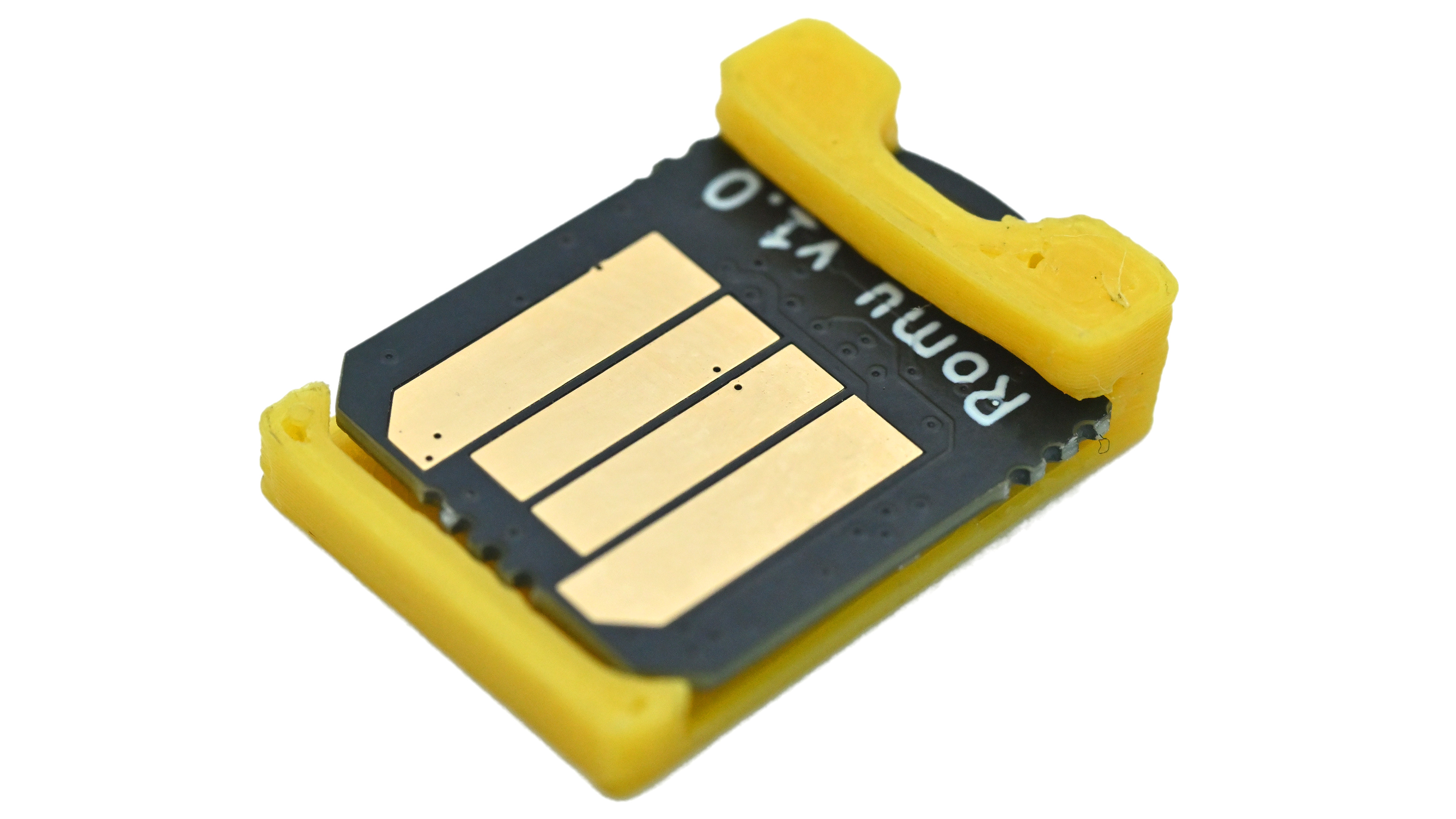
Romu deliberately trades expansion headers for a direct USB connection. Its built-in capacitive touch input and RGB LEDAliExpress price provide a simple interaction loop: touch the board, send an event to the host and show feedback. A preinstalled 3D-printed shim protects the small PCB and helps it fit the port.
That makes a compact macro trigger or custom Human Interface Device a more natural project than connecting several external sensors. For readers choosing a conventional development board, our Pico 2 pinout and GPIO guide covers a different, expansion-friendly layout. Its pin assignments should not be transferred to Romu.
| Feature | Romu specification |
|---|---|
| Microcontroller | Raspberry Pi RP2354A, up to 150 MHz |
| Working memory and flash | 520 KB SRAM; 2 MB flash |
| USB | Native Full-Speed USB through direct Type-A contacts |
| Local controls | Capacitive touch input, RGB LED and boot button |
| PCB size | 15.5 × 12 × 1.65 mm |
| Power | 5 V from USB, regulated to 3.3 V on the board |
Why the RP2354A matters
Raspberry Pi lists RP2354A as an RP2350-family variant with 2 MB of stacked flash in its package. That distinction matters on a board this small: it avoids assuming that every RP2350 design needs the same separate flash arrangement as an official Pico 2.
The family offers Arm Cortex-M33 and Hazard3 RISC-V processor options, with two application cores available rather than four running together. Architecture choice is a firmware matter, not a promise that an existing binary can switch instruction sets unchanged. Our RP2040 versus RP2350 comparison provides the wider platform context.
MicroPython first, with an optional debugging jig
Bitmerse’s documentation describes starting with the preloaded MicroPython firmware and Thonny. For lower-level work, the optional pogo-pin jig exposes SWD and UART and connects through USB-C. The board itself remains a Type-A device: buying the jig does not change that connector.
The repository also explains how to enter bootloader mode to replace firmware or recover an unresponsive board. Its FIDO2 example is a separate firmware option, not something to assume is running alongside the factory MicroPython image. A security-key demonstration is not, by itself, evidence of certification or an independent security audit; we have not tested the hardware or authenticator firmware.
Price, delivery and the crowdfunding caveat
As checked on 15 October, Crowd Supply lists a single Romu at US$40 or a board with the programming jig at US$65. Listed shipping is US$8 within the US or US$18 worldwide; those figures are not a confirmed UK or EU tax-inclusive delivered price.
The US$5,000 campaign closes on 26 November 2026. The advertised 26 April 2027 shipping date is an estimate, not immediate availability. Treat this as backing a production run: delivery timing and the final software experience remain important uncertainties. Romu is an interesting specialised USB platform, but its small footprint is a trade-off, not a universal upgrade over a general-purpose board.
Sources
- Bitmerse campaign-launch announcement — 13 October 2026
- Crowd Supply campaign, pricing and estimated shipping — checked 15 October 2026
- Bitmerse Romu product manual
- Official Romu repository, bootloader instructions and firmware options
- Raspberry Pi RP2350-family specifications and RP2354A package details