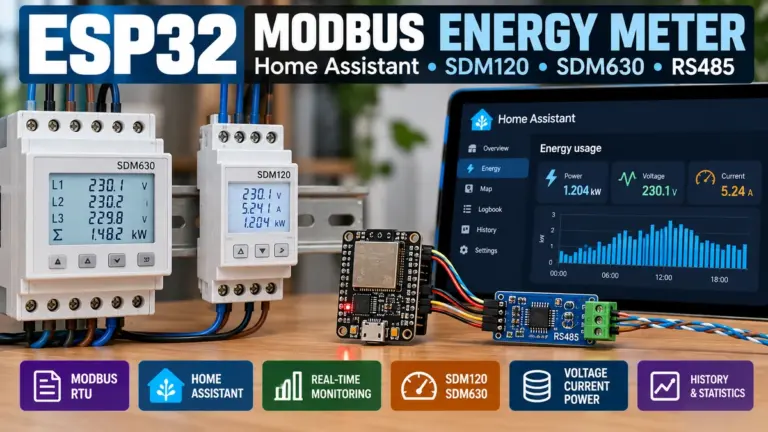
Quick Summary (TL;DR)
Choose your energy monitor around the electricity supply and the measurement boundary, not the number of appliances you own. A single-phase property usually needs one appropriately specified measurement channel for its whole-grid connection. A typical European three-phase, four-wire home needs a correctly configured three-phase meter or three channels that measure each phase with its matching voltage reference. Three arbitrary current clamps do not automatically make an accurate three-phase energy meterAliExpress price.
For Home Assistant, the most useful foundation is a reliable pair of cumulative grid-import and grid-export energy readings in kWh, plus an instantaneous signed grid-power reading if available. Per-phase watts, voltage and current are excellent diagnostics, especially for EV charging, heat pumps and solar, but they should not be confused with the property’s billing totals. Determine how your grid meter treats simultaneous import and export on different phases before recreating its totals in software.
Practical hardware choice: consider a properly specified single-phase meter or supported CT-based device for a single-phase supply; for a conventional three-phase home, shortlist a purpose-built three-phase monitor such as the Shelly Pro 3EM or an appropriate three-phase Modbus energy meterAliExpress price. An electrician must confirm the supply arrangement, phase mapping, CT ratings, voltage references, enclosure space and compliance. The Shelly Pro 3EM is also documented for certain single-phase, multiple-circuit arrangements, so the product label alone does not determine the installation.
Single-phase and three-phase: what changes when you measure energy?
In a common European single-phase residential supply, one live (line) conductor and a neutral feed the installation. The nominal line-to-neutral voltage is typically 230 V at 50 Hz, but local systems vary. A single incoming live conductor carries the home’s total supply current; appropriately installed metering at that boundary can measure net grid power and energy.
In a common three-phase, four-wire arrangement, three line conductors—often called L1, L2 and L3—and a neutral enter the property. The nominal line-to-neutral voltage is typically 230 V and line-to-line voltage approximately 400 V. The house may have single-phase circuits assigned to different phases and dedicated three-phase loads, such as certain EV chargers or heat pumps. An electrician should identify the actual supply topology; North American split-phase, three-phase delta and other arrangements cannot simply be treated as European 230/400 V wye systems.
One meter input or CT corresponds to one defined electrical path. For a three-phase service entrance, the monitor must capture the contribution from each relevant line. Measuring only L1 will omit loads supplied from L2 or L3. Measuring all three currents without correct voltage and phase relationships can still be inaccurate when power factor changes, or when a phase is importing while another exports.
| Characteristic | Single-phase residence | Three-phase residence (typical 4-wire) |
|---|---|---|
| Grid conductors measured | One line, with suitable voltage reference | Three lines and their voltage references; neutral arrangement must be verified |
| Typical European nominal voltages | 230 V line-neutral | 230 V line-neutral; 400 V line-line |
| Whole-home current measurement | Normally one correctly placed channel | Normally one channel per phase |
| Diagnostic detail | Total power and optional branch circuits | Per-phase power, voltage, current, imbalance, and total |
| Solar/export complexity | Import/export on the one phase | Different phases can import and export at the same instant |
| Hardware starting point | Single-phase meter or specified CT monitor | Meter designed/configured for this three-phase topology |
These examples describe a conventional European arrangement, not a universal electrical standard. Do not infer the supply from the number of breakers or the shape of a socket.
Current is not power, and power is not energy
A current transformerAliExpress price (CT) measures alternating current. It does not inherently know the instantaneous line voltage, the phase angle between current and voltage, or how much useful electrical energy flowed over an hour. For an AC load, real power is related to voltage, current and power factor: for a simple sinusoidal single-phase example, P = V × I × PF. Real-world meters measure waveforms or use approved metering algorithms to account for phase angle and distortion.
At a 230 V reference, 10 A at power factor 1 corresponds to about 2.3 kW of real power, whereas 10 A at power factor 0.70 corresponds to about 1.61 kW in that simplified example. The current is unchanged: a current-only calculation that always assumes PF = 1 would overstate the second load. This matters with motors, variable-speed heat pumps, switch-mode power supplies and other non-resistive loads.
Three-phase real power is the algebraic sum of the measured real power on each phase: Ptotal = PL1 + PL2 + PL3, using a consistent sign convention. The familiar √3 × Vline-line × I × PF expression describes an appropriately balanced sinusoidal three-phase case; it is not a shortcut for an unbalanced house with independent circuits, solar export and differing power factors.
Power is measured in W or kW; energy accumulates over time in Wh or kWh. A steady 2 kW import for 30 minutes is 1 kWh. Home Assistant’s Energy dashboard needs suitable cumulative energy statistics for accounting; a sensor that currently reads 2,000 W should not be entered as if its value were 2,000 kWh.
Three-phase import and export: the worked example most guides skip
Suppose a house has rooftop solar generation connected to one or more phases and its three-phase monitor reports these signed grid-power values at one instant. In the convention below, a positive number indicates import from the grid and a negative number indicates export. This is an illustrative arithmetic example, not measured product data.
| Phase | Signed grid power | What’s happening |
|---|---|---|
| L1 | +2.0 kW | Importing |
| L2 | +1.2 kW | Importing |
| L3 | −2.4 kW | Exporting |
| Signed three-phase total | +0.8 kW | Net instantaneous import after algebraic summing |
If you separately sum the positive phase values, simultaneous gross phase imports are 3.2 kW, while the magnitude of simultaneous phase exports is 2.4 kW. If you first algebraically sum all phases and then split the total by sign, the netted whole-grid reading is instead 0.8 kW import and 0 kW export at that instant. Both calculations describe something real, but they describe different accounting boundaries.
A utility’s settlement meter or billing rules may aggregate, net or register phase flows according to its approved configuration and local tariff regime. Do not assume that an Energy dashboard built by summing three per-phase import counters will match a utility meter that nets the phases first—or vice versa. The correct approach for bill comparison is to use the utility meter’s own cumulative import and export registers when these are accessible, or a secondary meter configured to mirror its approved measurement convention.
Critical practical point: you cannot necessarily reconstruct billed import/export accurately from occasional instantaneous phase samples. Import/export may switch between samples; integrating separately clipped phase powers is different from clipping the sum first; meter sampling and internal accumulation can differ. Choose native cumulative counters covering the correct site boundary where possible.
Where to measure: choose the boundary before the meter
The location of a measurement is as consequential as the model. A CT on an outgoing air-conditioning circuit tells you that circuit’s consumption; a CT on the grid incomer tells you power crossing the grid boundary. Neither number is automatically “total home use” once solar PV, batteries or a generator can deliver power locally.
| Meter position | What it should tell you | What it does not tell you on its own |
|---|---|---|
| Grid connection, upstream of site branches | Import/export across grid boundary | Total solar production or true household demand if onsite generation exists |
| Solar inverter AC output | AC production from that inverter | How much was exported or consumed directly |
| Battery inverter AC connection | Power through that inverter, with a documented sign convention | Battery state of charge or usable capacity without BMS data |
| Dedicated EV charger feeder | Charger circuit power/energy | Grid import attributable to EV if the car also uses solar energy |
| Heat-pump feeder | Electrical consumption of that circuit | Delivered thermal energy or heat-pump COP without heat measurement |
| Individual lighting/cooker circuits | Branch energy and troubleshooting | Whole-house consumption unless all relevant circuits are measured consistently |
For an uncomplicated property without storage, an illustrative power balance is house consumption ≈ solar generation + grid import − grid export, with all terms measured at compatible boundaries and at the same time. This is not a general identity once batteries, losses, multiple inverter outputs, auxiliary generators, or different AC/DC boundaries are introduced. Define a complete energy-flow diagram before adding computed “consumption” sensors.
Single-phase monitoring: which approach is sensible?
For a genuine single-phase supply, the simplest robust solution is often one compliant meter or a supported CT system that measures voltage, current and real energy at the incomer. A direct-connected DIN-rail meter may provide cumulative import/export and sometimes a pulse output or Modbus interface. The electrician must check its approved voltage, frequency, maximum current, wiring topology, mounting conditions and whether it belongs in the intended section of the distribution system.
A split-core CT monitor can avoid breaking the main conductor solely to pass it through a measuring sensor, but installation in a distribution board is still electrical work with potentially dangerous accessible parts. An electrician must confirm the CT ratio/output, location and orientation, the monitor’s voltage measurement and applicable protective requirements. Shelly offers single-phase products including the Shelly EM Gen3; verify the exact generation, number of channels, included clamps and regional specification before ordering.
A three-phase-capable device is not inherently wasted on a single-phase home. Shelly explicitly documents supported single-phase configurations for Pro 3EM in which multiple CT channels can monitor different circuits on the same line. That does not justify improvising three phase-reference connections: the installer’s design must follow the manufacturer’s actual single-phase wiring diagram. If you only need one incoming measurement, a correctly matched one-channel system may be easier and cheaper to install and maintain.
Three-phase monitoring: what a complete meter must know
A purpose-built three-phase meter determines real power using the relevant phase currents and voltage references. On a conventional three-phase/four-wire home, each CT must correspond to the line voltage being measured as that phase, and the meter must be configured for the correct wiring system. A swapped CT, backwards sensor, incorrect phase mapping, or misconfigured three-wire/ four-wire mode may produce plausible-looking amps alongside nonsensical or reversed watts.
Do not confuse a neutral connection with a fourth energy phase. In a four-wire wye supply, neutral carries the vector sum of phase currents for unbalanced loads and may contain harmonic components. An optional neutral CT on a supported meter may aid diagnostics, but measuring only neutral current does not reconstruct total power. Never disconnect a neutral for the sake of monitoring, and never treat a neutral CT as permission to alter protective devices.
Delta, split-phase and unusual supplies require a compatible metering model. For example, the Shelly Pro 3EM documentation states that its specified installation instructions must be followed and that it is not appropriate to connect it in an unsupported delta/no-neutral configuration. Some industrial three-phase meters explicitly support three-wire systems; others only support four-wire layouts or require a different connection configuration. Read the exact datasheet for the part number and region, not a generic retailer listing.
| Specification to verify | Why it matters | What to ask before purchase |
|---|---|---|
| Electrical topology | 3P4W versus 3P3W and neutral requirements differ | Does the exact meter support my electrician’s confirmed supply? |
| Voltage reference | Wrong phase/reference distorts real-power sign and magnitude | Does it measure each required phase voltage? |
| Measurement range | Meter or CT can saturate or exceed approved ratings | What is the actual maximum current per phase? |
| Import/export counters | Energy dashboards need reliable cumulative readings | Are separate total import and export kWh exposed? |
| Phase data | Find imbalance and monitor phase-constrained EV/heat pumps | Are watts/amps/voltage shown per phase? |
| Local interface | Determines dependence on vendor cloud | Ethernet, local API, Modbus RTU or Modbus TCP? |
| Installation/access | Enclosure space, CT clearance, electrician time | What terminals, CTs, protection and housing are required? |
| Compliance/use case | Sub-metering is not automatically legal billing metering | Are certifications sufficient for the intended jurisdiction and use? |
Hardware choices for Home Assistant
The “best” energy monitor depends on whether the goal is a quick dashboard, reliable all-local statistics, an expandable plant-room installation, or a legally approved settlement/billing meter. The shortlist below compares architectures, not measured performance rankings, and deliberately omits unverified prices.
| Option | Good fit | Strengths | Limits and checks |
|---|---|---|---|
| Single-phase DIN-rail meter with Modbus or verified local reader | Single-phase grid connection or a major branch | Dedicated meter, native cumulative kWh on suitable models | Confirm direct-connect rating, physical installation and exact register map |
| Single-phase CT monitor (e.g. compatible Shelly EM family) | Existing single-phase panel where CT measurement suits the job | May simplify sensing without routing the full supply through meter body; Home Assistant options | Correct generation, clamp type, phase voltage and approved location |
| Shelly Pro 3EM family | Supported three-phase/four-wire service; selected multi-circuit single-phase layouts | Three-channel real-power/energy measurement, documented local-network operation, Ethernet/Wi-Fi options | Confirm exact revision, three phase-voltage references, CT range and permitted topology |
| Three-phase Modbus RTU meter | Cabinet with dependable RS-485 communications and long-term integration plan | Wired telemetry, register-level access, potentially broad industrial choice | Exact model’s 3P3W/3P4W modes, register scaling, CT/direct rating, isolation and gateway |
| CT/metering IC + ESP32AliExpress price/ESPHome build | Experimental sub-metering on a properly engineered low-voltage interface | Learning, custom sensors and local integration potential | Extra calibration and analogue design; not inherently a certified mains or billing meter |
| Utility meter’s authorised local readout | Billing reconciliation and whole-grid consumption | Closest available representation of the registered energy boundary | Reader access, port availability and utility restrictions vary by country and meter |
Shelly Pro 3EM: Shelly describes the device as a DIN-rail three-phase energy monitor with per-phase power/energy, integrated LAN or Wi-Fi connectivity, and a documented local interface. Its official Home Assistant integration can discover and communicate with supported Shelly devices locally. Shelly lists a Pro 3EM 120A v2; check the exact supplied revision and CT package, rather than assuming all similarly named variants have identical capabilities.
Modbus route: an appropriately specified single-phase or three-phase meter with RS-485 can work well where Wi-Fi is unreliable inside a metal distribution cabinet. A Home Assistant host typically needs an RS-485 adapter or appropriate gateway; the hardware should be electrically and physically appropriate for the environment. The Home Assistant Modbus integration supports reading documented registers. That does not mean every marketed “Modbus meter” exposes the required cumulative import/export, or that its registers share the same addresses or number formats. Verify an official register manual for the exact part number and firmware.
CT-based ESP32AliExpress price route: ESPHome can read suitable sensors, but the ESP32 alone does not provide safe mains voltage measurement or bill-grade power accuracy. A purpose-built metering analogue front end, correct isolation and professional mains-side design are essential. For an introduction to alternative methods, see our ESP32 monitoring methods comparison and CT clamp energy monitor guide. They are not a substitute for a certified main-meter installation.
Home Assistant setup: total grid sensors first, phases second
Home Assistant’s electricity-grid documentation recommends selecting the energy imported from the grid and, where applicable, energy returned to the grid. These are energy measurements (usually kWh) whose statistics continue accumulating correctly over time; instantaneous watt sensors are additional diagnostics.
For a three-phase supply, your first question is “Which entities represent the total at the same boundary and on the same accounting basis as my utility meter?” Prefer an explicit meter-provided cumulative total import and total export where their meanings are documented. Only compute totals from phase sensors if the manufacturer’s definitions and billing method make the calculation appropriate. Simply adding three positive phase counters can overstate billed import in a system that nets phases internally.
In Settings → Dashboards → Energy (labels can move between Home Assistant versions), configure the grid source using the import energy counter and optional export energy counter. Choose suitable solar production sensors separately, and add storage only if you have a complete and consistent battery measurement model. Do not enter each phase as an independent grid connection merely to make three charts if the site has one physical connection: you risk double counting or changing the intended meaning of the dashboard.
If a sensor is missing from the Energy selector, check its device_class, state_class, unit of measurement and whether Recorder/statistics are enabled. An energy counter typically uses device_class: energy, units such as kWh and an appropriate total-type state class. The total_increasing class is designed for counters that normally advance and may reset; a signed net-energy value that can move backwards is not interchangeable. Home Assistant documents the meaning of sensor state classes, and our Energy dashboard troubleshooting guide addresses common statistics issues.
Suggested entity inventory
| Entity purpose | Typical unit | Where it belongs |
|---|---|---|
| Total imported electricity | kWh, cumulative | Energy dashboard → grid consumption |
| Total exported electricity | kWh, cumulative | Energy dashboard → return to grid, if applicable |
| Signed instantaneous grid power | W or kW | Live dashboard / optional supported power measurement |
| Per-phase grid power L1/L2/L3 | W or kW, signed where provided | Diagnostics and automations, not automatically three billing inputs |
| Per-phase currents | A | Load balancing, capacity visibility and troubleshooting |
| Per-phase voltages | V | Diagnostics, only within device measurement capability |
| Solar PV production | kWh, cumulative | Separate solar production source |
Be careful with derived sensors: adding three signed power sensors yields a useful instantaneous net power if their signs, timestamps and phase mapping align. But splitting a time series into import and export after a long polling interval is generally inferior to using the meter’s actual energy registers, especially around zero crossings or fast EV/PV changes.
Designing around solar PV and home batteries
Solar export makes phase-aware monitoring much more valuable. On a site with a single-phase inverter connected to one phase of a three-phase supply, the other phases can be importing at the same time. On a system with a three-phase inverter, production distribution and grid flow depend on inverter topology, load allocation and control strategy. Do not assume solar is distributed equally across phases or that “3 kW solar” guarantees no phase exceeds its local current limit.
A whole-grid meter should tell you net power at the service boundary using its specified accounting convention. A dedicated inverter meter (or trustworthy inverter integration) should tell you generation independently. A home battery adds at least one more energy path, and its charging and discharging signs must be explicitly documented before calculating household use or self-consumption. For battery state of charge, use suitable inverter/BMS data rather than trying to infer it solely from a grid CT.
Common failure: a site shows −1.5 kW grid power during sunny weather, but Home Assistant’s Energy dashboard depicts export as household consumption. Before changing templates, inspect the source meter’s sign convention, cumulative import/export registers, CT orientations and entity types. An inverted signed power sensor is not equivalent to reversing a kWh counter. If the grid meter exports a positive “exported energy” register, leave that register positive and map it to the export input.
Three-phase EV chargers, heat pumps and phase imbalance
Electric vehicle charging is one of the clearest reasons to measure individual phases. A three-phase charger can draw current from each phase, but the actual power depends on charger configuration, vehicle capability, supply voltage and power factor. A single-phase charger concentrates most charging current on one phase. A site may have a modest total grid import while one phase is close to the installation’s permitted load or breaker limit.
For illustration, a 16 A predominantly resistive single-phase load at 230 V corresponds to roughly 3.7 kW. Three balanced 16 A phase loads of similar power factor would total roughly 11 kW at 230 V per phase. These are approximations, not installation limits or charging-performance guarantees. Real installations must observe the contracted supply, cable and protection design, charger configuration and applicable standards.
A three-phase monitor with per-phase currents helps identify a heavily loaded phase and can support dashboards for available capacity. However, Home Assistant automations should not replace the charger manufacturer’s certified overload prevention, residual-current protection, grid requirements or load-management safety functions. Any EV load-shedding integration must fail safely when communications drop or readings become stale, and an electrician should design the actual protective and control architecture.
Heat pumps can also be single or three phase depending on model and capacity. A three-phase supply does not mean every heat pump is a three-phase load, nor that phases are perfectly balanced. Meter the heat-pump feeder separately only if the purpose is meaningful appliance-specific consumption tracking; do not confuse electrical kWh with useful heat output or seasonal COP. Per-phase readings at the grid boundary remain a capacity-management tool, not a complete heat-pump efficiency measurement.
Network and data reliability: local does not mean maintenance-free
A distribution cabinet can attenuate Wi-Fi, and multiple electrical devices can create a noisy environment. Where offered, Ethernet can be attractive for a fixed monitor; an RS-485 Modbus RTU bus can be a good fit when already supported by the chosen certified meter and properly installed. Wired communication does not automatically mean the energy data is accessible locally: confirm the actual interface and integration.
Shelly’s official Home Assistant integration is a useful local-network option for supported devices. With Modbus, Home Assistant can read selected registers once a suitable gateway and connection are configured; you remain responsible for correct register addresses, word order, scale and update rate. A Modbus float decoded with the wrong word order can produce wildly wrong, yet numerically valid, readings. Avoid copying a configuration from a similarly named meter revision without checking the current register manual.
Energy history depends on more than connectivity. Ask whether the meter stores totals in non-volatile memory, whether missing network samples can be reconciled later, and what happens after a reboot, firmware update or device replacement. Home Assistant long-term statistics depend on properly characterised counter behaviour; an unplanned counter decrease can be interpreted as a reset. Preserve notes on entity identifiers, meter serial/model, supply arrangement, calibration and replacement dates.
Practical acceptance checklist for your electrician and Home Assistant setup
Before purchasing, describe your exact supply and ask an electrician to confirm where the installation can be safely monitored. Then check that the product provides the data you need, not merely an attractive app screenshot. The following steps are a commissioning specification rather than instructions for working on live equipment.
- Identify the service: single-phase, three-phase four-wire, three-wire, split-phase or another scheme; record nominal voltage and supply limits.
- Draw the energy boundaries: grid incomer, PV inverters, batteries, EV charger and heat-pump feeders. Specify what each meter should represent.
- Select compatible hardware: rated electrical system, voltage inputs, current/CT types, import/export counters, approvals, environment and local communications.
- Plan professional installation: manufacturer wiring arrangement, protective devices, accessible working space and cabinet/network provisions as applicable.
- Confirm phase mapping: have the installer validate that L1 current corresponds to L1 voltage and so on, and document sensor direction and which branch each channel covers.
- Validate real power: under safe, known operating conditions compare the sign and plausible magnitude of each phase’s power with the known connected loads; significant PF/sign anomalies call for installer review.
- Validate imported/exported energy: compare cumulative counters and trends against the utility meter over a meaningful time interval, allowing for different resolution, timing and approved accounting policy.
- Configure Home Assistant: choose authoritative total kWh counters for grid inputs; keep phase diagnostics separate; confirm correct units, statistics and history persistence.
- Test failure behaviour: disconnect the monitoring network (not any mains protection) and verify that missing telemetry cannot trigger unsafe charger or heating control.
- Record maintenance data: product revision, CT model/rating, phase map, IP or Modbus details, entity IDs and which counters must never be manually reset.
Budgeting: compare the installed system, not the device price
A whole-home energy monitor’s purchase price is only one part of the project. A true three-phase installation can require a meter with the correct topology, three compatible CTs or a suitable direct-connected design, protected supply and sensing connections, DIN-rail space, an appropriate enclosure where needed, data cabling or network provision, a gateway, and professional labour. If the electrician must also resolve unlabelled phases or an overcrowded board, the real project becomes more complex.
For a simpler single-phase monitor, you may avoid some channels and associated accessories, but that does not remove the need for a safe, compliant installation. A direct-connected meter and a CT meter have different trade-offs. Ask for an itemised quotation covering meter, genuine CTs, network/RS-485 equipment, protective hardware, enclosure work, commissioning and warranty support, rather than comparing a bare online listing with a professionally installed alternative.
Operating costs are usually modest for a low-power monitor but should not be assumed zero. Confirm whether any cloud analytics or export feature needs a subscription, whether local operation works without the manufacturer’s servers, and how firmware support is managed. We have deliberately avoided live price quotations here because prices and bundles vary by country and revision; the choice rests on functionality and total installed cost.
Troubleshooting: symptoms and the likely class of problem
| Symptom | Likely area to investigate | Safe next action |
|---|---|---|
| Three-phase total seems to show only a third of household load | Only one phase monitored; wrong topology; missing channel | Ask installer to confirm incoming supply and all channel connections |
| One phase shows strong negative watts when appliances are on | CT direction, phase assignment, actual solar export or sign convention | Compare against known site conditions; have installer verify |
| Amps look plausible but watts are much too small | Current/voltage pairing, PF, wrong metering configuration | Check documented per-phase voltage/PF data and request inspection |
| Grid import on dashboard exceeds utility-billed import | Phase import summed separately versus utility phase netting; incorrect boundary | Compare counter definitions with utility documentation |
| Solar generation appears as household usage | Reversed sign, wrong meter placement or counter mapping | Audit measurement boundaries and positive import/export registers |
| Home Assistant shows W but no selectable grid kWh | Power-only entity, missing energy statistics/state class | Choose a cumulative kWh sensor and check HA Energy diagnostics |
| Numbers jump or change after restart | Non-persistent totals, counter resets, register decoding or statistics | Review device logs and counter definitions before changing entities |
| Data disappears in the metal cabinet | Wi-Fi attenuation, gateway/power/network reliability | Assess a supported wired interface or network redesign |
Frequently asked questions
Can I measure a three-phase house using one CT clamp?
Not accurately at the service boundary of a normal three-line supply. A single CT measures current in one conductor (or a specifically designed measurement arrangement); it cannot see loads on other phases. Putting a clamp around all three conductors is not an equivalent shortcut—the alternating magnetic fields can cancel. Use a three-phase meter configured for the actual wiring topology.
Can a Shelly Pro 3EM monitor a single-phase home?
Yes, Shelly documents supported single-phase applications, including monitoring separate circuits with its channels. Installation still has to follow the exact model’s single-phase instructions. It may be more capability than a single whole-home incomer requires.
Does a three-phase meter automatically give me my exact electricity bill?
No. Meter class, measurement location, configuration, supply topology, clock/tariff treatment and phase-netting policy can all affect reconciliation. A secondary monitor is excellent for visibility, but the approved utility settlement meter remains the billing reference unless your provider explicitly specifies otherwise.
Should I add L1, L2 and L3 import kWh together?
Only if you intend to measure the sum of positive import on each individual phase and the meaning aligns with your accounting objective. If the utility meter nets power across phases before accumulating whole-grid import/export, the sum of independent per-phase positive counters may diverge. Native whole-grid import/export counters are generally the safer Energy-dashboard inputs.
Can I use an ESP32 and three CT sensors instead of a dedicated meter?
A carefully engineered monitoring circuit may be a useful experimental or branch-monitoring project, but three raw CTs and an ESP32 ADC alone do not provide an accurate, isolated or certified three-phase energy meter. Voltage references, suitable analogue circuitry, isolation, calibration and an approved installation are essential.
Does Home Assistant need each phase to create its Energy dashboard?
No. If a compatible meter provides accurate cumulative whole-grid import/export energy, those totals are sufficient for the grid section. Phase-level entities are optional detail for diagnostics, load balancing and automation.
The recommendation
For most ordinary single-phase homes: choose one suitable meter or a compatible CT-based monitor at the correct boundary, ideally with cumulative import/export kWh and a reliable Home Assistant integration. Pay for extra channels only when you genuinely need circuit-by-circuit monitoring.
For a conventional three-phase home: prioritise a properly configured three-phase meter with a documented mapping from L1/L2/L3 to the correct voltage references, separate import/export counters, and a stable local interface. Shelly Pro 3EM is one mainstream option for supported systems; a compatible three-phase Modbus meter is an alternative for a wired infrastructure. Compare the complete installation cost, not just the product sticker.
For a home with solar, EV charging or battery storage: demand clarity about phase netting, energy boundaries and authoritative counters before building automations. Knowing the total grid watts is useful; knowing which phase is loaded and which counter your utility actually bills is what makes the system dependable.
Further reading on esp32.co.uk/
- ESP32 Energy Monitoring Methods Compared: Pulse, CT, PZEM and Modbus
- ESP32 Modbus Energy Meter with Home Assistant: SDM120 and SDM630
- ESP32 CT Clamp Energy Monitor for Home Assistant
- Home Assistant Energy Dashboard Troubleshooting for ESPHome
Official documentation and references
- Home Assistant — Integrating your electricity grid: utility meter, CT, power and energy source configuration.
- Home Assistant — Energy FAQ: specialised grid, solar and export scenarios.
- Home Assistant — Home energy management: Energy dashboard sources and integration requirements.
- Home Assistant developer docs — Sensor entity: energy state classes and long-term statistics.
- Home Assistant — Shelly integration: official local integration.
- Home Assistant — Modbus integration: bus and register-based integrations.
- Shelly — Pro 3EM 120A v2: supported topology, metering features, CT ratings and documentation.
- Shelly — Pro 3EM: model specification and connection diagrams.
Editorial method: this is a technical decision guide based on manufacturer and Home Assistant documentation reviewed in October 2026, not a laboratory comparison or an account of hands-on product testing. Electrical arrangements and billing rules differ by territory, supplier and meter configuration. Have a competent local professional confirm the installation and verify product part numbers and firmware before purchase.