
For most Home Assistant rooms, the LD2410 is still the best all-round mmWave presence sensor because it is inexpensive, mature, highly configurable and particularly good at detecting a person who is sitting or barely moving. Choose the LD2450 when you want X/Y position, room zones and tracking of up to three targets. The LD2420 is better suited to simple presence detection where long range and automatic gate calibration matter more than position tracking. The Ai-Thinker RD-03D is a strong LD2450 alternative for multi-target tracking, especially the newer V2 with an advertised range up to 8 m, but it is fundamentally more movement-dependent and is not the best choice for detecting a completely motionless person. All four now have native ESPHome integrations.
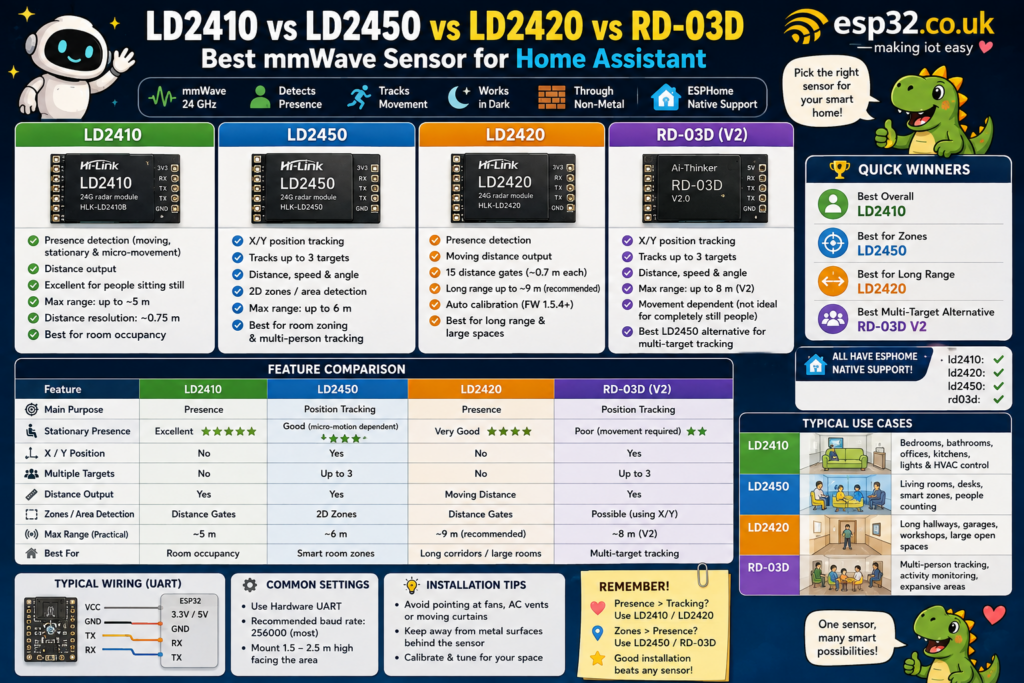
1. Why mmWave sensors are so useful in Home Assistant
A traditional PIR motion sensor answers a simple question:
“Did something move?”
A millimeter-wave radar sensor can answer a much more useful question:
“Is someone still in the room?”
That difference matters when automating:
- lights
- heating and air conditioning
- bathroom fans
- office equipment
- displays
- music
- room occupancy
- alarm systems
A PIR sensor may stop detecting someone who sits still on a sofa or works quietly at a desk. Radar modules such as the LD2410 and LD2420 are designed to detect much smaller movements and can therefore maintain occupancy far more reliably. Hi-Link specifically describes the LD2410 as detecting moving, stationary and micro-moving human targets.
The newer tracking sensors go further. Instead of only reporting presence, the LD2450 and RD-03D can report where a target is located.
That enables automations such as:
Someone is sitting on the sofa → switch on the reading lights.
instead of:
Someone exists somewhere in the living room → switch everything on.
2. The four sensors compared
Here is the practical difference before getting into the details.
| Feature | LD2410 | LD2420 | LD2450 | RD-03D |
|---|---|---|---|---|
| Frequency | 24 GHz | 24 GHz | 24 GHz | 24 GHz |
| Main purpose | Presence | Presence | Position tracking | Position tracking |
| Stationary presence | Excellent | Very good | Good/micro-motion dependent | Poor for completely stationary targets |
| Distance output | Yes | Moving distance | Yes | Yes |
| X/Y position | No | No | Yes | Yes |
| Multiple targets | No | No | Up to 3 | Up to 3 |
| Target speed | No | No | Yes | Yes |
| Target angle | No | No | Yes | Yes |
| Zones | Distance gates | Distance gates | 2D zones | Possible using X/Y data |
| Advertised/practical range | Up to ~5 m | ~9 m recommended | Up to 6 m | Up to 8 m on V2 |
| Native ESPHome | Yes | Yes | Yes | Yes |
| Best use | Room occupancy | Long-range presence | Zoned rooms | Multi-target tracking |
LD2450 officially supports precise target localization and tracking to 6 m with approximately ±60° azimuth coverage. ESPHome exposes presence, moving/still target states and tracking information.
The current RD-03D ESPHome integration exposes up to three targets including X, Y, speed, angle, distance and individual target presence.
3. LD2410: best overall Home Assistant presence sensor
The HLK-LD2410 is the easiest one to recommend for a normal room.
It was designed specifically for human presence detection, rather than trajectory tracking.
Hi-Link describes it as a 24 GHz FMCW radar capable of identifying:
- moving people
- stationary people
- very small human movements
- approximate target distance
Its maximum stated sensing range is around 5 metres, with approximately 0.75 m distance resolution.
Why LD2410 works so well in Home Assistant
The LD2410 divides its detection range into distance gates.
Each gate can have separate sensitivity settings for:
- moving targets
- still targets
That means a room can be tuned surprisingly precisely.
For example:
- Gate 0–2 → ignore because furniture creates reflections
- Gate 3–5 → high sensitivity around sofa
- Gate 6 → lower sensitivity near doorway
- Gate 7–8 → disable because radar sees through a thin wall
This type of tuning is why LD2410 often performs better as a simple occupied / unoccupied sensor than the more sophisticated tracking modules.
ESPHome support
ESPHome has a dedicated ld2410 component supporting the LD2410, LD2410B and LD2410C families. Communication uses UART, normally at 256000 baud, and ESPHome recommends using a hardware UART.
A basic configuration looks like:
uart:
  id: uart_ld2410
  tx_pin: GPIO17
  rx_pin: GPIO16
  baud_rate: 256000
  parity: NONE
  stop_bits: 1

ld2410:

binary_sensor:
  - platform: ld2410
    has_target:
      name: "Room Presence"
    has_moving_target:
      name: "Moving Target"
    has_still_target:
      name: "Still Target"
Best use cases
LD2410 is excellent for:
- bedrooms
- bathrooms
- offices
- kitchens
- living rooms
- hallways
- lighting automation
If the requirement is simply:
“Keep the light on while someone is in the room”
the LD2410 is usually the best choice.
4. LD2450: best for zones and multi-person tracking
The LD2450 is a different type of sensor.
Rather than concentrating primarily on presence, it attempts to determine the position of moving human targets inside a two-dimensional detection area.
Hi-Link describes it as a one-transmitter/two-receiver 24 GHz FMCW tracking radar capable of measuring:
- target position
- distance
- angle
- speed
with a maximum specified detection distance of around 6 metres and azimuth coverage of approximately ±60°.
It can track up to three people
This is the feature that makes LD2450 interesting for Home Assistant.
Instead of:
Presence = ON
the ESP32 can receive information such as:
Target 1:
X = -1250 mm
Y = 3200 mm

Target 2:
X = 900 mm
Y = 4100 mm
ESPHome’s native LD2450 component exposes target information and provides presence states for moving and still targets. ESPHome recommends firmware V2.02.23090617 or newer for proper integration.
Why X/Y coordinates are useful
Imagine a living room divided into three virtual areas:
┌─────────────────────────────┐
│                             │
│   DESK        SOFA          │
│                             │
│                 TV          │
│                             │
│        LD2450               │
└─────────────────────────────┘
Instead of installing three separate motion sensors, one LD2450 can potentially determine which part of the room is occupied.
Automations can then become much smarter.
Examples:
Desk occupied
→ turn on desk lamp.
Sofa occupied
→ activate TV lighting scene.
Nobody in either zone
→ turn everything off.
Where LD2450 is weaker
Tracking requires reliable radar reflections and movement information.
A person sitting absolutely motionless can therefore be harder to maintain consistently than with a sensor designed primarily around micro-motion/stationary presence.
In practice, this makes LD2450 more attractive when position matters, while LD2410 remains easier when presence reliability is the main objective.
5. LD2420: the underrated long-range presence sensor
The LD2420 receives much less attention than LD2410 and LD2450, but it has some very useful characteristics.
Like the LD2410, its main job is presence detection, not X/Y tracking.
ESPHome exposes:
- presence
- moving distance
- individual detection gates
- moving thresholds
- still thresholds
- presence timeout
- minimum and maximum detection distance
- automatic calibration tools
Much longer configurable range
LD2420 provides up to 15 distance gates, each representing approximately 70 cm.
ESPHome notes that setting the maximum to gate 15 corresponds to roughly 12 metres, although accuracy becomes weaker at that distance. A maximum gate of 12, roughly 9 metres, is recommended for more practical operation.
That gives LD2420 a clear advantage in spaces such as:
- long corridors
- garages
- large rooms
- workshops
- open-plan spaces
Automatic calibration is a major advantage
With firmware 1.5.4 or newer, ESPHome can observe the energy detected in each gate.
Calibration mode measures:
- average background energy
- peak energy
- unwanted reflections
- environmental noise
ESPHome can then calculate appropriate moving and stationary thresholds automatically.
This is particularly useful with mmWave sensors because every room behaves differently.
Walls, metal objects, fans, monitors and even other radar modules can create unexpected reflections.
Firmware differences matter
LD2420 firmware versions behave differently.
ESPHome documents:
- firmware before 1.5.3 → typically 256000 baud
- firmware 1.5.3+ → typically 115200 baud
- TX output pin also changed with firmware 1.5.3
- firmware 1.5.4+ adds gate energy monitoring and dynamic calibration
So checking firmware should be one of the first steps when setting up an LD2420.
6. RD-03D: the strongest LD2450 alternative
The RD-03D comes from Ai-Thinker rather than Hi-Link.
Like LD2450, it is a 24 GHz 1T2R FMCW multi-target tracking radar.
The newer RD-03D V2 uses Ai-Thinker’s ICL1122-based design and is intended for:
- human tracking
- position detection
- speed measurement
- distance measurement
- multiple-target detection
Ai-Thinker’s V2 specification states:
- maximum detection range: 8 m
- azimuth: approximately ±60°
- elevation: approximately ±30°
- power: 5 V
- UART interface
- default UART speed: 256000 baud
- module dimensions: approximately 15 × 44 mm
That makes its physical format and purpose very similar to LD2450.
Up to three targets in ESPHome
ESPHome now has native RD-03D support and can expose:
- overall target count
- Target 1 X/Y
- Target 2 X/Y
- Target 3 X/Y
- speed
- distance
- angle
- resolution
- separate binary presence for each target
It can also be switched between:
- single-target mode
- multi-target mode
The big limitation: stationary people
ESPHome explicitly warns that RD-03D relies on Doppler shift and cannot detect or range objects that are not moving.
That is important.
For applications such as:
“Is someone sitting quietly at a desk?”
LD2410 or LD2420 is the safer choice.
For:
“Where are people moving around the room?”
RD-03D becomes much more interesting.
7. LD2450 vs RD-03D
These are the two most directly comparable sensors.
Both provide:
- 24 GHz FMCW radar
- 1 transmitter / 2 receiver antennas
- X/Y tracking
- multi-person tracking
- speed information
- UART communication
- native ESPHome support
The main practical differences are:
| Feature | LD2450 | RD-03D V2 |
|---|---|---|
| Manufacturer | Hi-Link | Ai-Thinker |
| Maximum stated range | 6 m | 8 m |
| Targets | Up to 3 | Up to 3 |
| X/Y tracking | Yes | Yes |
| Speed | Yes | Yes |
| ESPHome integration | Mature | Native and newer |
| Still-target entity | Yes | Movement dependent |
| Mobile configuration app | HLKRadarTool | Ai-Thinker tools |
| Best choice | Established zoning | Longer-range tracking |
The LD2450 currently has the more established Home Assistant/ESPHome user base, while RD-03D V2 has attractive hardware specifications and more range.
For a first multi-zone Home Assistant project, LD2450 remains the easier recommendation.
For experimentation or a larger room, RD-03D V2 is very compelling.
8. LD2410 vs LD2420
These two are the better comparison if the goal is presence rather than tracking.
Choose LD2410 if:
- the room is relatively small
- stationary presence matters
- easy tuning matters
- there are lots of existing tutorials/examples
- the sensor needs to simply report occupied/unoccupied
Choose LD2420 if:
- the room or corridor is large
- longer sensing distance matters
- automatic environmental calibration is useful
- detailed gate-energy tuning is desirable
LD2420’s approximately 9 m recommended configuration gives it considerably more reach than LD2410’s roughly 5 m rated detection range.
9. Which sensor is best for different rooms?
Bedroom
Winner: LD2410
A sleeping person barely moves. Micro-motion and stationary presence detection are more important than position.
Bathroom
Winner: LD2410
Bathrooms are small and people may remain nearly motionless.
Home office
Winner: LD2410 or LD2420
For a normal office:
LD2410
For a larger workspace where calibration and longer range matter:
LD2420
Living room
Winner: LD2450
A living room benefits enormously from zones.
For example:
- sofa
- dining area
- doorway
- desk
can potentially be represented within the same radar coordinate system.
Large open-plan room
Winner: LD2450 or RD-03D V2
Choose LD2450 for established ESPHome zoning.
Choose RD-03D V2 if its longer 8 m tracking range is useful.
Corridor
Winner: LD2420
Position tracking normally adds little value in a narrow corridor, while long range does.
10. Best sensor for detecting someone sitting still
This is one of the most important questions when choosing mmWave.
Best: LD2410
Then:
LD2420
Tracking radars are impressive, but this does not automatically make them better presence sensors.
For lighting automation where falsely declaring a room empty is irritating, the simpler LD2410 can actually outperform a more sophisticated tracking sensor.
11. Best sensor for room zones
Winner: LD2450
LD2450’s X/Y coordinates allow Home Assistant logic to determine whether targets fall inside rectangular areas.
For example:
Zone 1 – Sofa
X: -2500 to -500
Y: 1500 to 4500

Zone 2 – Desk
X: 500 to 2200
Y: 2000 to 4000
When a target moves into one of those coordinate ranges, ESPHome can create a corresponding binary sensor.
RD-03D can achieve similar logic because ESPHome exposes its X/Y coordinates, but LD2450 currently remains the more established platform for this style of setup.
12. Best sensor for multiple people
There are two clear choices:
LD2450
RD-03D
Both can track up to three targets.
LD2410 and LD2420 should instead be considered occupancy detectors. They may respond to multiple people, but they do not provide separate identities or X/Y coordinates for them.
13. Best sensor for longest range
Of these four:
LD2420 provides the longest configurable detection-gate range.
Its theoretical gate configuration reaches roughly 12 m, while ESPHome recommends about 9 m as a more practical maximum.
For tracking rather than simple presence:
RD-03D V2 → approximately 8 m
LD2450 → approximately 6 m
LD2410 is rated for around 5 m.
14. Best ESPHome support
All four now have dedicated ESPHome components:
ld2410:
ld2420:
ld2450:
rd03d:
That means no custom component is required for a normal installation.
For maturity and documentation, the rough order is:
LD2410 → LD2450 → LD2420 → RD-03D
RD-03D support is now native, however, so this difference matters much less than it did previously.
15. UART requirements
These sensors communicate with the ESP32 using UART.
A typical ESP32 connection is:
Remember:
TX connects to RX.
and:
RX connects to TX.
Both LD2410 and LD2450 normally use 256000 baud, so ESPHome recommends using a hardware UART rather than software serial.
RD-03D also uses 256000 baud in its current ESPHome integration.
LD2420 is the exception because its baud rate depends on firmware version.
16. False detections and installation matter more than the sensor
mmWave radar can detect through many non-metallic objects.
That is both useful and annoying.
A sensor may detect:
- someone behind a thin wall
- a ceiling fan
- curtains
- moving doors
- vibrating equipment
- activity outside the intended room
LD2420’s ESPHome documentation specifically warns that walls and other solid objects can create reflections and abnormal thresholds. It also advises against overlapping the fields of multiple radar sensors.
The same general principle applies to all four sensors.
A £4 radar installed carefully can outperform a much more expensive radar installed badly.
17. Final ranking
Best overall
1. LD2410
Best balance of price, stationary detection, configuration and ESPHome maturity.
Best for zones
2. LD2450
The obvious choice when knowing where someone is matters.
Best for long-range presence
3. LD2420
Excellent gate control and calibration with significantly longer potential range.
Best alternative tracking sensor
4. RD-03D V2
Very capable three-target tracking with up to 8 m specified range, but not the first choice for completely stationary presence.
18. Which one should you actually buy?
For a first Home Assistant mmWave project:
Buy the LD2410.
For a second project where the goal is to experiment with room zones:
Buy the LD2450.
For a long garage, corridor or workshop:
Try the LD2420.
For experimenting with multi-target tracking and comparing it against the LD2450:
Try the RD-03D V2.
There is no single sensor that is objectively best at everything.
The key distinction is:
LD2410 / LD2420 = “Is someone here?”
LD2450 / RD-03D = “Where is the person moving?”
Once that distinction is clear, choosing between them becomes much easier.