Quick Answer:
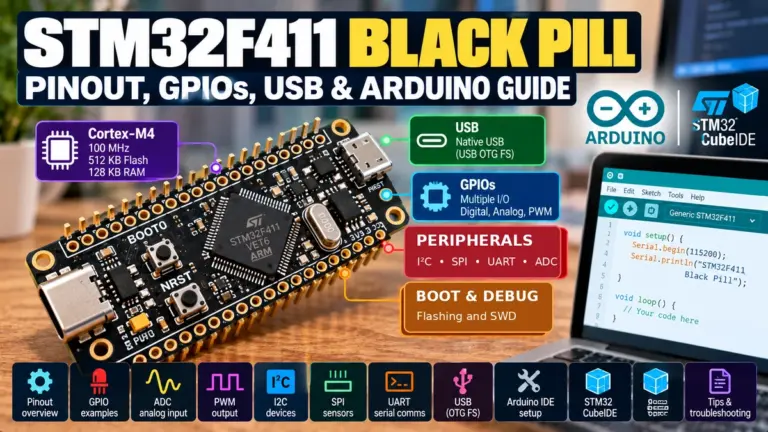
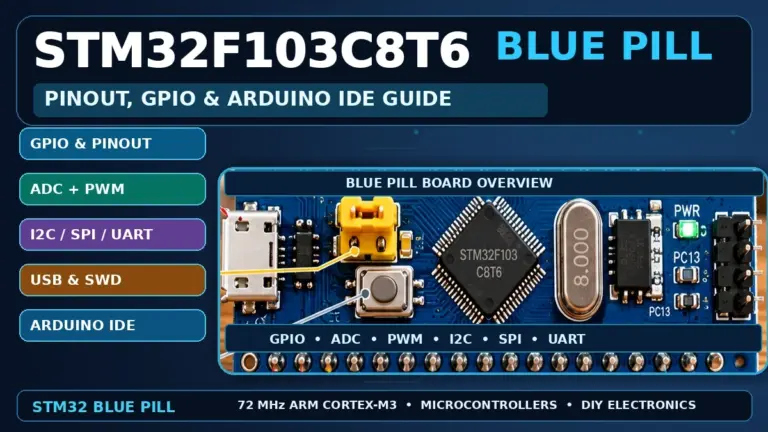
For most new projects, the STM32F411AliExpress price Black PillAliExpress price is the better board. It is dramatically faster, has far more memory, includes a Cortex-M4 FPU/DSP engine, supports factory USB DFU programming and gives you 512 KB flash plus 128 KB SRAM. The older STM32F103C8AliExpress price Blue PillAliExpress price still has two important advantages: it is extremely common and it includes a native CAN 2.0B controller, which the F411 does not. If you want a general-purpose STM32 board for USB, signal processing, robotics, audio, larger Arduino sketches or learning a modern STM32 workflow, choose the Black PillAliExpress price. If your project specifically needs the F103 ecosystem, native CAN, a very low-cost board, or compatibility with an existing Blue Pill design, the F103 remains useful.
Blue Pill vs Black Pill: The Short Version
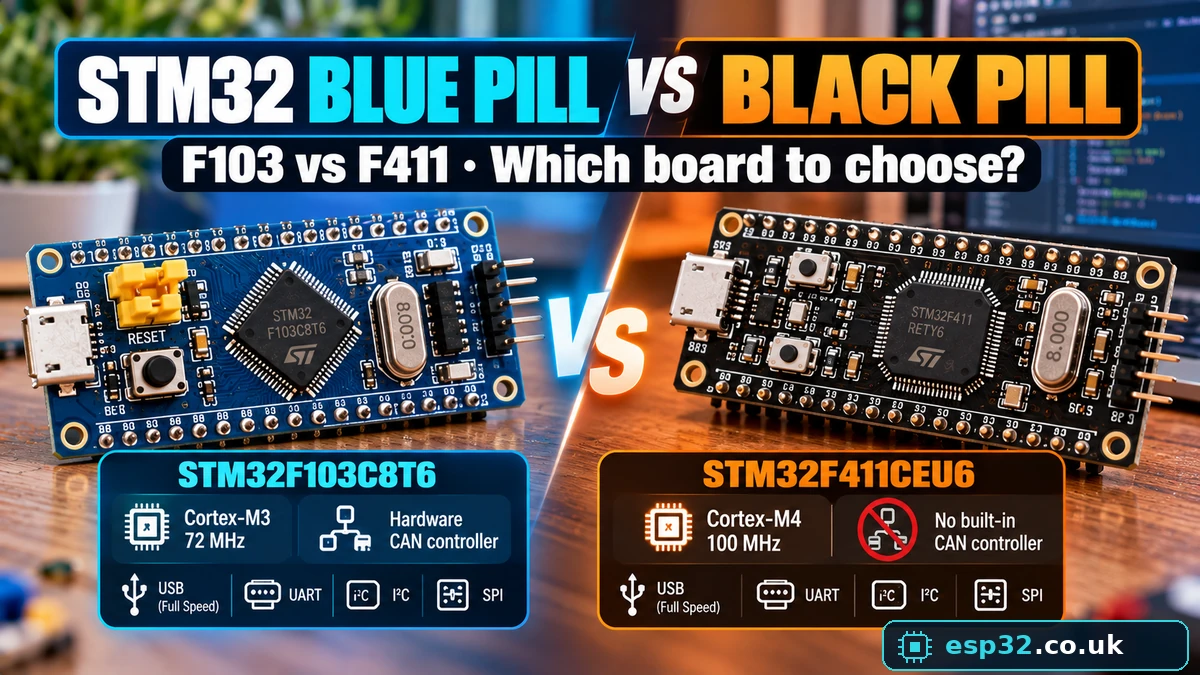
| Feature | STM32F103C8 Blue Pill | STM32F411CE Black Pill | Winner |
|---|---|---|---|
| CPU | 72 MHz Cortex-M3 | 100 MHz Cortex-M4 + FPU/DSP | Black Pill |
| Flash | 64 KB official C8 | 512 KB | Black Pill |
| SRAM | 20 KB | 128 KB | Black Pill |
| ADC | 2 × 12-bit | 1 × 12-bit | Blue Pill for ADC count |
| USB peripheral | USB full-speed device | USB full-speed OTG | Black Pill |
| Factory USB DFU | No | Yes | Black Pill |
| Native CAN controller | Yes | No | Blue Pill |
| SDIO | No | Yes | Black Pill |
| FPU | No | Yes | Black Pill |
| SWD debugging | Yes | Yes | Tie |
| Arduino STM32 core | Supported | Supported | Tie |
| Typical USB connector | Micro-USB | USB-C on common WeAct board | Black Pill |
| Best for new general projects | Still capable | Recommended | Black Pill |
What Are the Blue Pill and Black Pill?
The names Blue Pill and Black Pill refer to families of inexpensive STM32 development boards rather than official STMicroelectronics product names. Both became popular because they put a real STM32 microcontroller on a small breadboard-friendly PCB with the MCU pins exposed on two long header rows.
The classic Blue Pill uses the STM32F103C8T6, a 72 MHz Cortex-M3 device from the STM32F1 family. The Black Pill covered here uses the STM32F411CEU6, a 100 MHz Cortex-M4 device from the STM32F4 family. There are also F401 Black Pill boards, so always check the part number rather than buying by PCB colour alone.
Both boards can be programmed with the official STM32 Arduino core, STM32CubeIDE, PlatformIO and other STM32 toolchains. They are therefore much closer relatives than an STM32 board and an ESP32, but the generation gap between the F103 and F411 is large enough to change what you can realistically build.
CPU Performance: Cortex-M3 vs Cortex-M4
The F103 Blue Pill uses a 72 MHz Arm Cortex-M3. That remains perfectly adequate for GPIO control, sensor reading, basic motor control, protocol handling and moderate embedded workloads.
The F411 Black Pill moves to a 100 MHz Cortex-M4. Clock speed alone only increases from 72 to 100 MHz, but the architecture change matters more than the raw MHz figure. Cortex-M4 adds DSP-oriented instructions and the STM32F411 includes a single-precision floating-point unit.
That makes the F411 far better suited to digital filters, FFT-style signal processing, sensor fusion, audio, control algorithms and calculations that use floating-point maths heavily. A Blue Pill can still perform those tasks, but the Black Pill gives you considerably more headroom.
For simple digital I/O, the difference may not be noticeable. For processing-heavy firmware, the F411 is in a different class.
Memory: This Is the Biggest Practical Difference
| Memory | Blue Pill F103C8 | Black Pill F411CE |
|---|---|---|
| Flash | 64 KB | 512 KB |
| SRAM | 20 KB | 128 KB |
| Flash advantage | 1× | 8× |
| RAM advantage | 1× | 6.4× |
The difference in memory is often more important than the CPU. A genuine STM32F103C8 is officially a 64 KB flash device with 20 KB SRAM. Historical Blue Pill tutorials often mention 128 KB because some C8-marked parts appeared to expose additional usable flash, but software should not rely on that behaviour.
The STM32F411CE provides 512 KB flash and 128 KB SRAM. That extra space changes the development experience. Larger libraries, USB stacks, display drivers, file systems, protocol stacks and more complex C++ code fit far more comfortably.
If you are constantly checking whether a library will fit into a Blue Pill, the Black Pill removes much of that constraint. For a new board purchase, this alone is a strong reason to choose the F411.
GPIO and Pin Availability
Both boards expose roughly the same style of dual-row headers and provide plenty of GPIO for ordinary projects. The exact Arduino pin counts differ slightly, but the more important question is which pins are already committed to USB, debugging, crystals, LEDs, buttons or boot functions.
| Board-level function | Blue Pill | Black Pill |
|---|---|---|
| Onboard LED | PC13, active-low | PC13, active-low |
| User button | Usually none | PA0 on common WeAct boards |
| SWDIO | PA13 | PA13 |
| SWCLK | PA14 | PA14 |
| USB D− / D+ | PA11 / PA12 | PA11 / PA12 |
| BOOT control | BOOT0 jumper + BOOT1/PB2 | BOOT0 push button |
| Reset | NRST | NRST push button |
For Arduino development, both boards are easiest to use with the native pin labels — PA0, PB6, PC13 and so on. That matches ST documentation and makes it much easier to understand alternate peripheral functions.
ADC: Blue Pill Has More ADC Hardware
The Blue Pill has an advantage that is easy to miss in headline comparisons: the STM32F103 medium-density family provides two 12-bit ADCs, while the STM32F411CE has one 12-bit ADC.
Both boards expose ten convenient analogue-capable pins around PA0–PA7 and PB0–PB1. For ordinary sensor readings, either board is more than sufficient. If your design depends on simultaneous/concurrent ADC behaviour or the specific dual-ADC features of the F103, however, the Blue Pill can actually be the better MCU.
For most hobby applications, this does not outweigh the Black Pill’s huge RAM, flash and CPU advantages. But it is a good example of why ‘newer and faster’ does not automatically mean every peripheral is superior.
USB: Black Pill Wins Easily
USB is one of the clearest differences between these boards. Both microcontrollers have native full-speed USB hardware, but their bootloader behaviour and USB capabilities are not the same.
Blue Pill USB
The STM32F103C8 provides a USB full-speed device peripheral. Its PA11 and PA12 pins are normally wired to the board’s Micro-USB connector. Firmware can therefore implement USB CDC serial, HID and other device classes.
The problem is initial programming. The STM32F103 medium-density factory system-memory bootloader does not provide USB DFU. A blank Blue Pill normally needs SWD or USART programming before a custom USB bootloader or USB-enabled application can be installed.
Black Pill USB
The STM32F411 provides USB 2.0 full-speed OTG with an on-chip PHY, and its factory system-memory bootloader supports USB DFU. On the common WeAct board, PA11/PA12 connect to USB-C.
That means a stock Black Pill can be connected by USB, placed into system-memory mode with BOOT0 + reset and programmed through DFU without installing a third-party bootloader first.
If USB-device development is one of your main goals, the Black Pill is the much cleaner platform.
CAN Bus: Blue Pill Wins
The biggest peripheral advantage of the Blue Pill is native CAN. The STM32F103C8 contains a CAN 2.0B controller. You still need an external CAN transceiver to connect the MCU to CANH/CANL, but the protocol controller itself is inside the STM32.
The STM32F411 does not have a native CAN controller. To use CAN with a Black Pill you need an external CAN controller such as an SPI-connected device, or you need to choose a different STM32 MCU.
For automotive diagnostics, DIY ECUs, machine networks or embedded equipment where native CAN is central to the design, this can make the older Blue Pill the better choice despite its lower performance.
I²C, SPI and UART
| Interface | Blue Pill F103C8 | Black Pill F411CE |
|---|---|---|
| I²C | Up to 2 | Up to 3 |
| USART/UART | Up to 3 | Up to 3 |
| SPI | Up to 2 | Multiple SPI/I²S interfaces |
| Default Arduino I²C | PB6 SCL / PB7 SDA | PB6 SCL / PB7 SDA |
| Default Arduino SPI1 | PA5 SCK / PA6 MISO / PA7 MOSI | PA5 SCK / PA6 MISO / PA7 MOSI |
| Default Arduino USART1 | PA9 TX / PA10 RX | PA9 TX / PA10 RX |
The useful result is that many simple Arduino projects can move between the boards with very similar wiring. The default I²C, SPI1 and USART1 pin mappings line up nicely.
The F411 offers the richer communications subsystem overall, but if your project only needs one I²C bus, one SPI device and a serial port, both boards handle that easily.
Timers and Real-Time Control
STM32 microcontrollers are well known for their timer peripherals. Both boards are good for PWM, input capture, output compare, pulse measurement and motor-control-style tasks.
The F103 includes the timer architecture that helped make STM32 popular for motor-control and embedded-control projects. The F411 also provides a rich timer set, including 16-bit and 32-bit timers, while adding the extra processing performance of Cortex-M4.
For a basic servo, PWM fan or frequency counter, the difference is minor. For control algorithms that combine timers with significant floating-point computation, the Black Pill has much more performance margin.
SD Cards and Storage
The Black Pill has another modern advantage: the STM32F411 includes an SDIO peripheral. That gives you a route to higher-performance SD-card interfaces when your chosen software stack and pin allocation support it.
The Blue Pill normally accesses SD cards through SPI. That is perfectly adequate for configuration files and basic logging, but high-rate data logging, audio and storage-heavy applications favour the F411.
Programming: ST-Link, Serial and DFU
| Programming method | Blue Pill | Black Pill |
|---|---|---|
| ST-Link / SWD | Yes | Yes |
| Factory UART bootloader | Yes | Yes |
| Factory USB DFU | No | Yes |
| Custom USB bootloader possible | Yes | Possible but often unnecessary |
| Best first method | ST-Link / SWD | USB DFU or ST-Link / SWD |
For the Blue Pill, I strongly recommend owning an ST-Link. It eliminates most of the confusion around old Maple bootloader instructions and unreliable clone USB hardware.
For the Black Pill, USB DFU makes first programming much easier. You should still consider an ST-Link if you want breakpoints, register inspection, proper debugging or a reliable low-level recovery route.
Arduino IDE Support
Both boards are supported by the official Arduino Core for STM32. In Arduino IDE 2, install the STM32 MCU based boards package through Boards Manager and select the appropriate board target.
| Board | Typical official Arduino selection |
|---|---|
| Blue Pill | Generic STM32F1 series → BluePill F103C8 |
| Black Pill | Generic STM32F4 series → BlackPill F411CE |
The fact that both use the same official STM32 Arduino ecosystem is useful. You can learn one development workflow and move between the boards depending on the peripheral needs of each project.
Blue Pill Flash-Size Confusion
One reason the Blue Pill ecosystem can feel messy is the long-running question of C8 flash size. The official STM32F103C8 specification is 64 KB flash. The STM32F103CB is the 128 KB device.
Some Blue Pill boards historically contained C8-marked chips that appeared to expose more than 64 KB. That led to tutorials instructing users to select 128 KB settings. It may work on some hardware, but it is not a portable assumption and should not be the basis of a new design.
The F411CE is much simpler in this respect: the part provides 512 KB flash, so large-sketch headroom is not a constant concern.
Clone Quality and Board Variations
Neither ‘Blue Pill’ nor ‘Black Pill’ guarantees a single manufacturer. This matters because clone quality can change the real-world experience more than a specification table suggests.
Common Blue Pill Variations
- Different 3.3 V regulators.
- Incorrect USB D+ pull-up resistor values on some old clones.
- MCUs from alternative manufacturers or questionable STM32 markings.
- Different crystal/component quality.
- Small silkscreen and connector-layout changes.
Common Black Pill Variations
- STM32F401 and STM32F411 versions sold under the same broad ‘Black Pill’ name.
- 8 MHz versus 25 MHz HSE crystal variants.
- Different board revisions.
- Optional SPI flash fitted on some boards but not others.
- Unofficial clones copying the WeAct layout.
For the Black Pill especially, check that the board really contains the STM32F411CEU6 if that is the target you want.
Which Is Better for Beginners?
Historically the Blue Pill was often presented as the cheap way to learn STM32, but in 2026 I would normally point a beginner toward the F411 Black Pill instead.
- USB DFU makes first programming easier.
- The extra memory gives beginners far more room for libraries and experimentation.
- USB-C is more convenient on common current boards.
- Cortex-M4 + FPU makes the board useful for more advanced projects later.
- The official STM32 Arduino core supports it directly.
- An ST-Link can still be added when you want proper debugging.
The Blue Pill remains a good learning board when you already own one, when your tutorial/course uses the F103 or when you specifically want to learn the STM32F1 family.
Which Is Better for Automotive Projects?
This depends heavily on CAN. If the project needs a native CAN controller, the Blue Pill has an immediate advantage. Add a proper CAN transceiver and the F103 can participate in CAN networks without a separate SPI CAN controller.
The Black Pill has more processing performance, so it may still be attractive for data processing, dashboards or USB-connected automotive tools. But if CAN is mandatory, account for the extra external controller or choose a different STM32 with both Cortex-M4-level performance and CAN.
For safety-critical vehicle control, neither board should be treated as an automotive-qualified production module just because the MCU can perform the required calculations. Power protection, transients, EMC, watchdog strategy, fail-safe design and component qualification all matter.
Which Is Better for USB Projects?
Black Pill. This is one of the easiest decisions in the comparison. The F411’s USB OTG hardware, factory USB DFU bootloader and common USB-C board implementation make it a much better starting point for USB CDC, HID, MIDI and custom USB-device projects.
The Blue Pill can absolutely run USB-device firmware, but the first-programming experience is less convenient and clone USB hardware has historically been more variable.
Which Is Better for Data Logging and Signal Processing?
Black Pill. The F411’s 128 KB SRAM, 512 KB flash, Cortex-M4 FPU/DSP capability and SDIO support give it far more room for buffering, filtering and storage-related firmware.
A Blue Pill is fine for modest logging jobs. The Black Pill is the board I would choose when sampling rates, buffer sizes or processing complexity are likely to increase.
Which Is Better for Simple Sensors and GPIO?
For a temperature sensor, relay board, encoder, small OLED or basic I²C/SPI project, either board is more than capable. The Black Pill’s extra performance may sit mostly unused.
If you already own Blue Pills, there is little reason to replace them for simple embedded nodes. If you are buying new boards and the price difference is small, the F411 gives you a much larger performance and memory reserve for future projects.
Which Is Better Than ESP32?
Neither STM32 board is a direct replacement for an ESP32. An ESP32 is usually the more practical choice for Wi-Fi, Bluetooth, MQTT, ESPHome and Home Assistant because wireless networking is integrated into the SoC.
The STM32 boards become attractive when your priorities are deterministic peripheral control, SWD debugging, specific timer behaviour, USB-device development or a conventional STM32 firmware stack. The Black Pill is the closer performance competitor; the Blue Pill is the simpler low-end embedded controller.
In many systems the best answer is not either/or. An STM32 can handle time-critical control while an ESP32 handles Wi-Fi, web interfaces or Home Assistant connectivity.
Project-by-Project Recommendation
| Project | Recommended board | Why |
|---|---|---|
| Learning STM32 in 2026 | Black Pill | More modern CPU, huge memory advantage, USB DFU |
| Very low-cost basic GPIO/sensors | Either | Both are easily powerful enough |
| Native CAN project | Blue Pill | F103 includes CAN controller |
| USB HID / MIDI / CDC | Black Pill | USB OTG + factory DFU |
| Digital signal processing | Black Pill | Cortex-M4 DSP + FPU |
| Audio experiments | Black Pill | More RAM/CPU and richer peripheral set |
| Large Arduino libraries | Black Pill | 512 KB flash / 128 KB RAM |
| Existing Blue Pill hardware design | Blue Pill | Drop-in compatibility matters more than specs |
| SD-card intensive logging | Black Pill | More RAM and SDIO |
| Two-ADC-specific design | Blue Pill | F103 provides two ADC blocks |
| Cheap CAN sensor node | Blue Pill | Native CAN + adequate CPU |
| General new STM32 project | Black Pill | Best overall capability |
When I Would Still Choose the Blue Pill
- The project needs the STM32F103’s native CAN controller.
- I already have working F103 firmware, a PCB or a known-good Blue Pill hardware design.
- The second ADC block matters.
- I need compatibility with an existing Blue Pill tutorial, educational setup or hardware ecosystem.
- The board is being used for a very simple job where the F411’s extra resources provide no practical benefit.
- Blue Pills are already available in quantity and replacing them would add cost without solving a problem.
When I Would Choose the Black Pill
- I am starting a new general-purpose STM32 project.
- I want USB programming without installing a custom bootloader.
- The firmware uses floating-point or DSP-heavy algorithms.
- I need significantly more RAM or flash.
- I want USB HID, MIDI, CDC or other USB-device work.
- I expect the project to grow and want more performance margin.
- I need higher-performance SD-card access through SDIO.
- I am learning STM32 and want a board that remains useful beyond beginner projects.
Final Verdict
The STM32F411 Black Pill is the clear overall winner for most users in 2026. Its 100 MHz Cortex-M4 core, FPU/DSP support, 512 KB flash, 128 KB SRAM, USB OTG and factory USB DFU bootloader make it a much more capable and convenient development board.
The STM32F103C8 Blue Pill is not obsolete. It remains a useful embedded controller and has one feature that can outweigh almost everything else for the right project: native CAN. It also offers two ADC blocks and an enormous existing ecosystem of tutorials and hardware designs.
If I were buying one board today with no existing constraints, I would buy the F411 Black Pill. If I needed native CAN or compatibility with an existing STM32F103 design, I would choose the Blue Pill. The right decision comes down to peripherals first, then performance.
Related STM32 Guides
- STM32F103C8T6 Blue Pill Pinout, GPIOs & Arduino IDE Guide
- STM32F411 Black Pill Pinout, GPIOs, USB & Arduino Guide
- ESP32 DevKitC V4 Pinout Diagram & Safe GPIOs
- ESP32-S3 DevKitC-1 Pinout Diagram & Safe GPIOs
Datasheets & External Resources
- STMicroelectronics STM32F103C8 Product Page — official 72 MHz Cortex-M3, memory, ADC, USB and CAN specifications.
- STMicroelectronics STM32F411CE Product Page — official 100 MHz Cortex-M4, FPU, 512 KB flash and 128 KB SRAM specifications.
- ST AN2606 System-Memory Bootloader Application Note — bootloader interfaces including the F103/F411 USB-DFU difference.
- Official Arduino Core for STM32 — supported Blue Pill and Black Pill targets.
- WeAct MiniSTM32F4x1 Hardware Repository — Black Pill board documentation and revisions.