
Home Assistant Yellow is the official expandable smart home hub designed for people who want more flexibility than Home Assistant Green. It runs Home Assistant locally, supports Raspberry Pi Compute Module hardware, includes built-in Zigbee and Thread-capable radio hardware, and gives advanced users room to upgrade storage, compute power and connectivity.
There is one important update first: Home Assistant Yellow is no longer in production. Home Assistant announced in October 2025 that production had ended, although the device will continue to receive software support. That means Yellow is still useful if you already own one or can still find stock, but Home Assistant Green is now the easier official starting point for most new users.
What is Home Assistant Yellow?
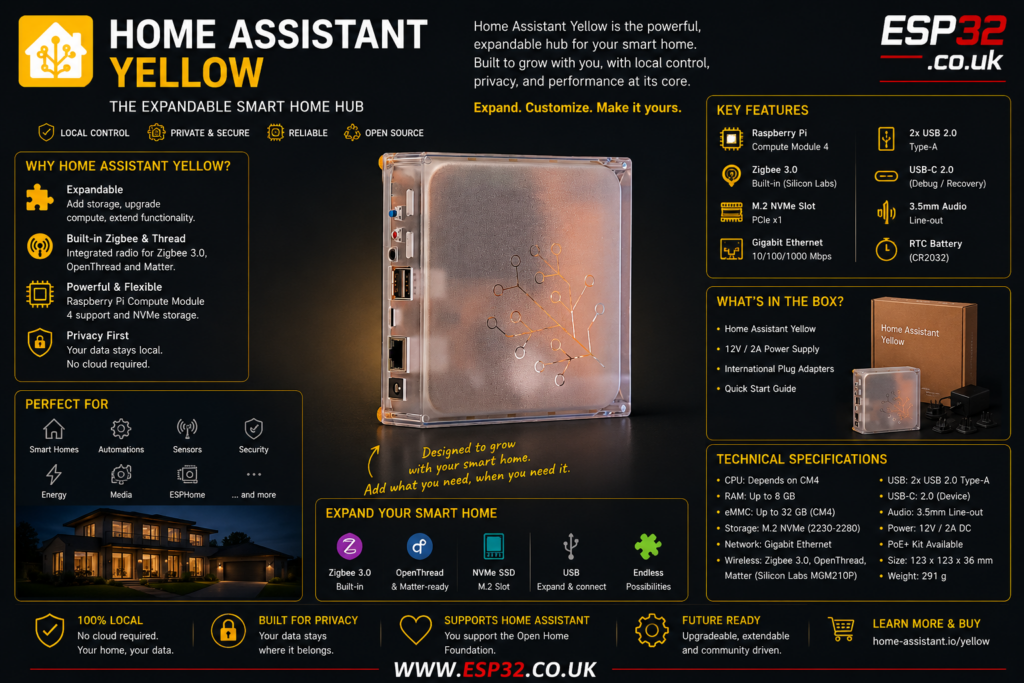
Home Assistant Yellow is a dedicated Home Assistant computer built around the Raspberry Pi Compute Module platform. Unlike a normal Raspberry Pi board in a plastic case, Yellow is a purpose-built carrier board with a proper enclosure, cooling, built-in smart home radio hardware and expansion options.
The original idea was simple: create a Home Assistant hub that could grow with the user.
Home Assistant Yellow supports Raspberry Pi Compute Module 4, has an M.2 slot for NVMe storage, includes Gigabit Ethernet, has two USB ports, and includes integrated smart home wireless hardware based on a Silicon Labs MGM210P module. The official specifications list support for Zigbee 3.0, OpenThread and Matter.
Why Home Assistant Yellow was different
Home Assistant Yellow was aimed more at power users than complete beginners.
Home Assistant Green is the simple plug-and-play box. Yellow was the expandable box. It gave users more control over hardware choices, storage and future upgrades.
That made it interesting for people who wanted:
- Built-in Zigbee hardware
- Thread and Matter-over-Thread potential
- NVMe SSD storage
- Optional Power-over-Ethernet
- Raspberry Pi Compute Module flexibility
- A proper Home Assistant enclosure
- Local-first smart home control
- Long-term repairability and upgrade options
Home Assistant later explained that Yellow was designed with expandability in mind, including onboard Zigbee/Thread radio, M.2 storage, USB expansion and the ability to swap the Raspberry Pi Compute Module.
Key features
Home Assistant Yellow includes:
- Carrier board for Raspberry Pi Compute Module 4
- Support for Compute Module 4 variants
- Built-in Zigbee 3.0 radio
- OpenThread and Matter-capable radio hardware
- M.2 M-Key slot for NVMe SSDs
- Gigabit Ethernet
- Two USB 2.0 Type-A ports
- USB-C device port for debug/recovery
- 3.5 mm stereo audio line-out
- RTC with CR2032 battery backup
- Status LEDs
- Passive cooling with custom heatsink
- Translucent polycarbonate case
- Optional Power-over-Ethernet variant
The official product page lists the Yellow board as compatible with CM4 variants up to 8 GB RAM and up to 32 GB eMMC storage, with direct boot support from NVMe devices.
Home Assistant Yellow specifications
| Feature | Specification |
|---|---|
| Compute platform | Raspberry Pi Compute Module 4 carrier board |
| CPU | Depends on installed CM4 |
| CM4 CPU | Quad-core Cortex-A72, 64-bit, 1.5 GHz |
| RAM | Up to 8 GB depending on CM4 |
| eMMC | Up to 32 GB depending on CM4 |
| Storage expansion | M.2 M-Key NVMe SSD slot |
| Network | Gigabit Ethernet |
| USB | 2 × USB 2.0 Type-A |
| Recovery / debug | USB-C 2.0 device port |
| Smart home radio | Silicon Labs MGM210P |
| Wireless protocols | Zigbee 3.0, OpenThread, Matter-capable |
| Audio | 3.5 mm stereo line-out |
| Power | 12 V / 2 A barrel jack or PoE+ on PoE model |
| Case | Translucent polycarbonate |
| Size | 123 × 123 × 36 mm |
The M.2 slot supports 2230, 2242, 2260 and 2280 NVMe modules, using PCIe x1. Home Assistant notes that the Google Coral AI Accelerator does not work in Yellow’s expansion slot.
Yellow vs Green: the simple difference
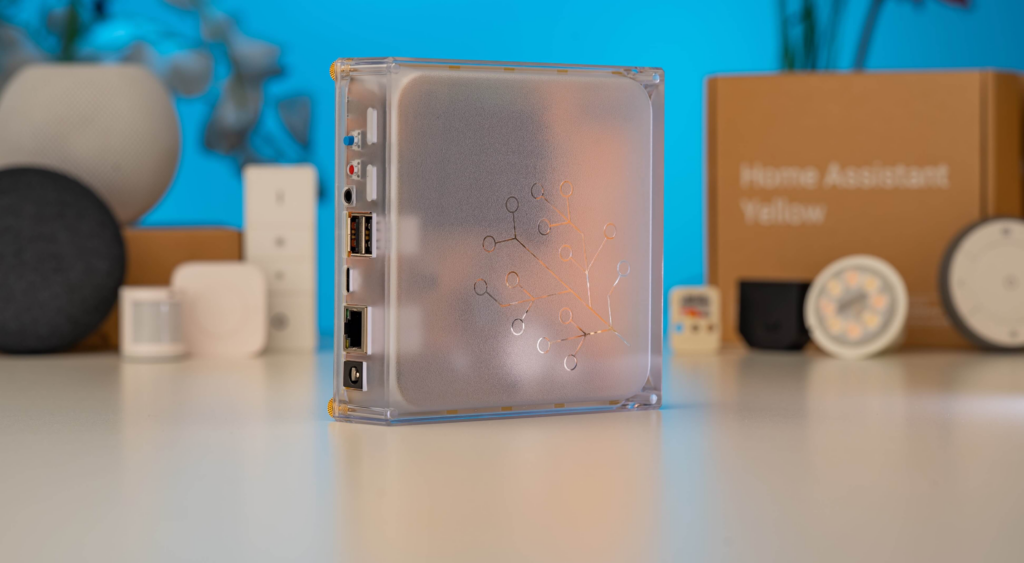
Home Assistant Green is easier.
Home Assistant Yellow is more expandable.
That is the real difference.
Green is the better choice if you want to plug in a box and start using Home Assistant with almost no hardware decisions. Yellow is better if you want built-in smart home radio hardware, NVMe storage, PoE options or the ability to change the compute module.
For most beginners in 2026, Green makes more sense because Yellow is no longer being produced. But Yellow is still a good device for people who already own one, find one in stock, or specifically want the upgrade options. Home Assistant itself now recommends Green for users looking for a plug-and-play experience.
Built-in Zigbee and Thread support
One of the strongest features of Home Assistant Yellow is the built-in smart home radio.
Yellow includes a Silicon Labs MGM210P Mighty Gecko module. The official specifications list support for Zigbee 3.0, OpenThread and Matter, with Zigbee 3.0 firmware pre-installed.
This means Yellow can act as the coordinator for Zigbee devices such as:
- Smart bulbs
- Smart plugs
- Motion sensors
- Door and window sensors
- Temperature sensors
- Water leak sensors
- Buttons and remotes
- Thermostatic radiator valves
It can also be configured for Thread, but there is a catch. Home Assistant’s support guide explains that switching Yellow’s built-in radio to Thread-only firmware means you will no longer be able to control Zigbee devices with that same adapter. If you want to keep Zigbee and add Thread, Home Assistant recommends using an external adapter for Thread.
That is important. Built-in radio sounds simple, but Zigbee and Thread planning still matters.
Storage expansion with NVMe
Another major advantage over basic Raspberry Pi setups is the M.2 slot.
Home Assistant can create a lot of database writes over time, especially if you collect energy data, sensor history, logs and long-term statistics. Cheap microSD cards are not ideal for that. Yellow’s NVMe support gives you a much better storage path.
The official specs state that Yellow supports direct boot from NVMe devices, including for CM4 Lite modules that do not have eMMC storage.
This makes Yellow suitable for larger Home Assistant setups with more devices, more history and more add-ons.
Power-over-Ethernet option
Home Assistant Yellow was also available as a Power-over-Ethernet kit.
That is useful if you want a cleaner installation with one cable carrying both network and power. The PoE kit does not include a power supply because power comes from a PoE-capable router or switch.
For a smart home controller, PoE is genuinely useful. It keeps the installation tidy and can also make backup power easier if your network switch is connected to a UPS.
Home Assistant Yellow and ESP32 devices
Home Assistant Yellow is not an ESP32 device, but it works perfectly as the main controller for ESP32 projects.
A strong setup would look like this:
- Home Assistant Yellow as the central smart home hub
- ESPHome running on ESP32 boards around the house
- Zigbee sensors connected directly to Yellow
- Wi-Fi ESP32 sensors for custom projects
- MQTT devices where ESPHome is not suitable
- NVMe storage for long-term data
- Optional PoE for a cleaner installation
For ESP32 users, Yellow is useful because it gives you a stable Home Assistant base. Your ESP32 boards can then handle the cheap, flexible, custom side of the smart home.
Typical ESP32 projects that work well with Yellow include:
- ESP32 temperature and humidity sensors
- ESP32 Bluetooth proxy nodes
- ESP32 energy meters
- ESP32 relay controllers
- ESP32 garage door controllers
- ESP32 water meter pulse counters
- ESP32 air quality sensors
- ESP32 display dashboards
- ESP32 presence detection devices
Yellow runs the brain. ESP32 boards become the eyes, ears and hands around the house.
CM4, CM5 and upgrade options
Home Assistant Yellow was designed around Raspberry Pi Compute Module 4, but Home Assistant later added Compute Module 5 support in Home Assistant OS 14. Home Assistant noted that CM4 remains enough for most Home Assistant users, while CM5 can help power users with tasks such as faster ESPHome compilation or local speech-to-text processing.
That upgrade path is one of Yellow’s best design choices.
Instead of throwing the whole box away, you can potentially upgrade the compute module, storage or radio arrangement depending on your needs. That is much better than many locked-down smart home hubs.
Is Home Assistant Yellow still worth buying?
It depends on the price and availability.
Home Assistant Yellow is still worth considering if:
- You already own one
- You find remaining stock at a sensible price
- You want built-in Zigbee hardware
- You want NVMe storage
- You want PoE
- You like upgradeable hardware
- You are comfortable with some assembly
- You want something more flexible than Home Assistant Green
It is less attractive if:
- You are a complete beginner
- You want the easiest possible setup
- It costs much more than Green
- You do not need NVMe storage
- You do not care about PoE
- You can run Home Assistant on a mini PC instead
- You cannot find a CM4 or CM5 at a reasonable price
The honest answer is that Yellow is now more of a power-user device than a beginner recommendation.
Home Assistant Yellow vs mini PC
A mini PC can be more powerful than Home Assistant Yellow. It may be better for heavy add-ons, camera recording, local AI, databases or other server tasks.
But Yellow has advantages too:
- Lower power use
- Smaller smart-home-focused design
- Built-in Zigbee/Thread-capable radio
- Official Home Assistant hardware
- NVMe support
- Optional PoE
- Open hardware approach
- Nice enclosure and passive cooling
For a normal smart home, Yellow is elegant. For heavy workloads, a mini PC may be the stronger option.
Home Assistant Yellow vs Raspberry Pi
A normal Raspberry Pi can run Home Assistant well, especially with an SSD. But Yellow is cleaner.
Compared with a standard Raspberry Pi setup, Yellow gives you:
- Compute Module format
- Purpose-built carrier board
- Built-in Zigbee/Thread-capable radio
- M.2 NVMe slot
- Official enclosure
- Integrated cooling
- PoE option
- Proper smart home hub design
The Raspberry Pi route is more flexible and often cheaper. Yellow is more polished and purpose-built.
Who is Home Assistant Yellow for?
Home Assistant Yellow is best for users who want more than a basic Home Assistant box.
It suits people who:
- Already understand Home Assistant
- Want a local and private smart home hub
- Plan to run many Zigbee devices
- Want NVMe storage
- Prefer official Home Assistant hardware
- Like repairable and upgradeable systems
- Want to combine Zigbee, ESPHome and local automations
- Do not mind a slightly more technical setup
It is not the best choice for someone who simply wants the easiest possible start. That job now belongs to Home Assistant Green.
Final thoughts
Home Assistant Yellow is still one of the most interesting Home Assistant hardware products. It is compact, expandable, local-first and designed properly for smart home use.
The problem is timing. Yellow is no longer in production, and Home Assistant Green has taken over as the easy official recommendation for new users. That does not make Yellow bad. It just changes who should buy it.
If you already have a Yellow, keep using it. It remains supported, expandable and capable. If you find one at a good price and want NVMe, PoE or built-in Zigbee, it can still be a very strong Home Assistant hub.
But if you are starting from zero and just want the simplest route, buy Home Assistant Green instead and add the radio adapters you need.