Quick Summary (TL;DR):
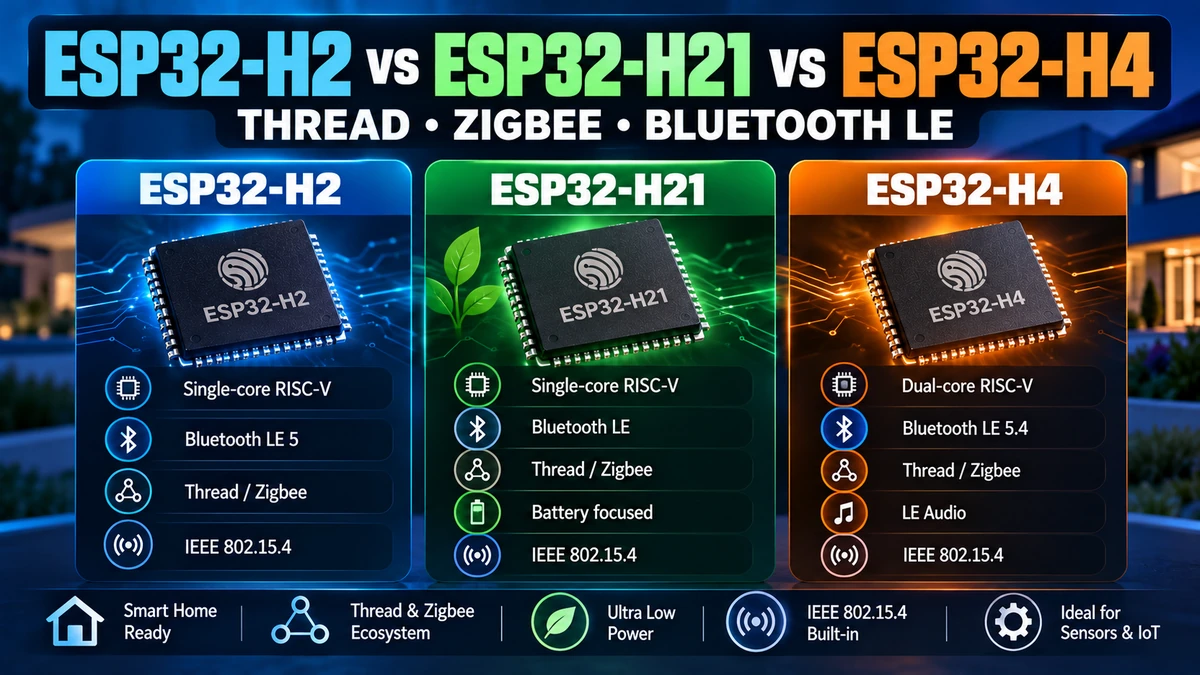
The ESP32-H2AliExpress price, ESP32-H21 and ESP32-H4AliExpress price are all low-power Espressif chips built around Bluetooth LE + IEEE 802.15.4 rather than Wi-Fi. The H2 is still the safest choice today for mature boards, Arduino support and proven Thread/Zigbee development. The H21 is the logical low-power successor to H2: it keeps the same 96 MHz single-core RISC-V / 320 KB SRAM class but adds an integrated DC-DC converter specifically to reduce active current and extend battery life. The H4 is a different class of device: dual-core 96 MHz RISC-V, 384 KB SRAM, external PSRAM support, Bluetooth 5.4 with advanced BLE features, LE Audio, PAwR, direction finding, USB OTG, CAN FD, I²S, up to 40 GPIOs and 15 touch-sensing channels — while retaining Thread 1.4 and Zigbee 3.0 radio capability. For a simple battery sensor, choose H2 today or H21 for a new power-optimised design. For a feature-rich low-power remote, audio product, wearable, smart lock, touch controller or complex Matter/Thread endpoint, choose H4. None of the three has integrated Wi-Fi.
Materials You’ll Need
| Item | Why it helps |
|---|---|
| ESP32-H2AliExpress price DevKit or H2 SuperMini | Mature baseline for Thread/Zigbee/BLE tests |
| ESP32-H21 hardware | Evaluate the integrated-DC-DC low-power architecture |
| ESP32-H4AliExpress price hardware/module | Test richer BLE, USB, touch, audio and PSRAM use cases |
| Thread Border Router | Required to connect Thread devices to the normal IP network |
| Zigbee coordinator | Required for Zigbee endpoint/router testing |
| Current-measurement setup | Makes real battery-life comparisons meaningful |
| ESP-IDF / ESPHome | Reference software paths for the newer H-series chips |
The H-Series Philosophy: No Wi-Fi on Purpose
The ESP32-H family exists because many low-power smart-home devices do not need Wi-Fi. A contact sensor, button or thermostat can spend most of its life sleeping and exchange tiny packets over 802.15.4 or BLE.
ESP32-H2AliExpress price / H21 / H4
├─ Bluetooth LE
├─ IEEE 802.15.4
│   ├─ Thread
│   └─ Zigbee
└─ NO integrated Wi-Fi
If direct Wi-Fi is mandatory, the C6/C5/S31 families are normally a better fit.
H2 vs H21 vs H4 at a Glance
| Feature | ESP32-H2 | ESP32-H21 | ESP32-H4 |
|---|---|---|---|
| CPU | 1× RISC-V @ 96 MHz | 1× RISC-V @ 96 MHz | 2× RISC-V @ 96 MHz |
| SRAM | 320 KB HP + 4 KB LP | 320 KB HP + 4 KB LP | 384 KB |
| Wi-Fi | No | No | No |
| Bluetooth | BLE 5.3 class | BLE 5 class | BLE 5.4; advanced BLE features |
| IEEE 802.15.4 | Yes | Yes | Yes |
| Thread / Zigbee | Thread 1.4 / Zigbee 3.0 | Thread / Zigbee | Thread 1.4 / Zigbee 3.0 |
| Integrated DC-DC | No headline integrated converter | Yes | Yes |
| External PSRAM | No normal PSRAM architecture | No | Yes |
| USB OTG | No; USB Serial/JTAG | No; USB Serial/JTAG | Yes |
| CAN FD | No | No | Yes |
| Touch | No | No | 15 touch GPIOs |
| Best role | Mature low-power endpoint | New battery-optimised H2 successor | Advanced low-power BLE/Thread product |
ESP32-H2: The Proven Low-Power Baseline
ESP32-H2 is the reference point because it has been available long enough to build a real ecosystem around it. It uses a single 32-bit RISC-V core at up to 96 MHz, 320 KB HP SRAM, 4 KB LP SRAM and 2 MB or 4 MB in-package flash variants.
- Bluetooth LE 5.3
- Thread 1.4
- Zigbee 3.0
- USB Serial/JTAG
- 19 programmable GPIOs
- 5 ADC channels
- mature ESP-IDF and Arduino support
For a button, contact sensor, temperature sensor or simple Matter-over-Thread endpoint, this is already plenty of hardware.
Why H2 Is Still the Easiest Choice in 2026
H2 has official DevKits, compact third-party boards, SuperMini-style hardware, examples and stable Arduino-ESP32 support. Current Arduino-ESP32 documentation lists H2 as a stable target.
ESPHome also has mature H2 platform support and currently documents H2 as a supported Zigbee target.
ESP32-H21: The Low-Power H2 Evolution
Espressif announced ESP32-H21 on 3 March 2026 as an incremental update to H2 for battery-powered Thread and Bluetooth LE devices.
- single-core 96 MHz RISC-V
- 320 KB HP SRAM + 4 KB LP SRAM
- integrated on-chip DC-DC converter
- Bluetooth LE
- IEEE 802.15.4
- 19 programmable GPIOs class
- USB Serial/JTAG
H21 does not try to become a multimedia chip. Its headline advantage is power efficiency.
Why the Integrated DC-DC Matters
Battery life depends on both sleep current and the energy consumed while awake and transmitting. The integrated DC-DC improves the efficiency of active CPU/radio operation.
Average energy
= sleep energy
+ wake/CPU energy
+ radio transmit/receive energy
The actual battery-life gain depends on battery voltage, wake frequency, radio duty cycle, regulator design and firmware. H21 should therefore be viewed as a better starting architecture rather than a guaranteed fixed percentage gain.
H21 vs H2: What Actually Changed?
| Question | H2 | H21 |
|---|---|---|
| CPU class | 96 MHz single-core | 96 MHz single-core |
| SRAM | 320 KB | 320 KB |
| Wireless concept | BLE + 802.15.4 | BLE + 802.15.4 |
| Integrated DC-DC | No headline integrated converter | Yes |
| Best reason to choose | Maturity / boards / Arduino | Battery efficiency in new designs |
ESP32-H4: A Completely Different Level of H-Series
H4 keeps the no-Wi-Fi, BLE + 802.15.4 philosophy but adds enough compute, memory and peripherals to handle much richer products.
- dual-core RISC-V up to 96 MHz
- 384 KB SRAM
- external PSRAM support
- Bluetooth 5.4
- LE Audio
- BIS/CIS isochronous channels
- PAwR
- Direction Finding (AoA/AoD)
- Thread 1.4 + Zigbee 3.0
- integrated DC-DC
- USB OTG
- CAN FD
- up to 40 GPIOs
- 15 touch-sensing GPIOs
For a simple contact sensor it is excessive. For a remote control, smart lock, audio device or complex low-power interface it can be exactly the right platform.
Bluetooth Is Where H4 Pulls Away
H4 targets modern BLE applications rather than only basic sensor links. LE Audio, PAwR and direction finding are meaningful differentiators for wireless audio, positioning, scalable beacon/sensor networks and sophisticated remotes.
| Bluetooth use case | Best chip |
|---|---|
| Simple beacon/sensor | H2 / H21 |
| BLE peripheral / remote | H21 or H4 |
| LE Audio | H4 |
| PAwR | H4 |
| AoA/AoD positioning | H4 |
H4 External PSRAM Changes What You Can Build
H4 can connect external PSRAM, which raises the application ceiling for audio buffering, larger protocol stacks, data logging, sensor fusion and display buffers.
That does not make H4 a P4/S31-class multimedia processor, but it makes advanced low-power products far easier to design.
USB OTG, CAN FD and Touch
H2/H21 mainly provide USB Serial/JTAG for development. H4 adds real USB OTG product roles, CAN FD for robust wired control and up to 15 touch-sensing GPIOs for remotes and smart switches.
H4 remote/control product
├─ capacitive touch
├─ BLE / Thread
├─ optional display/audio
├─ USB OTG
└─ CAN FD / sensors
Best Chip for a Matter-over-Thread Sensor
H2 today; H21 for a new power-optimised design. A normal Matter-over-Thread sensor does not need dual cores, PSRAM, USB OTG or CAN FD.
Best Chip for a Zigbee Battery Sensor
H2 today. It has the best current framework maturity. H21 is attractive for future low-power designs, but current ESPHome Zigbee documentation still marks H4/H21 as future targets while H2 is already supported.
Best Chip for Thread with ESPHome
Current ESPHome OpenThread documentation lists H2, H21 and H4 as supported ESP32 platforms when using ESP-IDF. A Thread Border Router is still required to connect the Thread mesh to the normal IP network.
ESPHome Zigbee vs OpenThread Maturity
| Framework path | H2 | H21 | H4 |
|---|---|---|---|
| ESPHome OpenThread | Supported | Supported | Supported |
| ESPHome Zigbee | Supported | Future/coming in current docs | Future/coming in current docs |
| ESPHome platform variant | Supported | Supported | Supported |
ESPHome 2026.7 added H4/H21 variant handling and updated the Zigbee SDK integration, but the current Zigbee component page still labels H4/H21 as future targets. Design around the component you actually need, not just the existence of a chip variant.
Arduino Support
Arduino-ESP32 currently lists ESP32-H2 as stable. H21 and H4 are much newer and are not yet in the same stable target table. If Arduino is a hard requirement, H2 remains the safest choice.
BLE Mesh vs Zigbee/Thread
H-series radios
├─ Bluetooth LE
│   └─ BLE Mesh / LE Audio / PAwR etc.
└─ IEEE 802.15.4
    ├─ Zigbee
    └─ Thread
These are separate protocol families sharing one low-power SoC. H4 is particularly interesting when a product needs both advanced BLE features and 802.15.4 networking.
Thread Border Router: H-Series Needs an IP-Side Companion
H2/H21/H4 have no integrated Wi-Fi. A Thread endpoint is fine without Wi-Fi, but a border-router architecture needs an IP-side uplink through another chip or Ethernet/Wi-Fi host.
H2 / H21 / H4
802.15.4 radio
      ↕
Wi-Fi/Ethernet companion
      ↕
normal IP network
For single-chip Wi-Fi + Thread, C6/C5/S31 is cleaner.
Battery Life: H21 vs H2
Do not publish a fixed battery-life percentage without measuring the complete board. H21 was designed to reduce active current through its integrated DC-DC, but total life still depends on sleep leakage, sensors, LEDs, regulator choices and radio duty cycle.
Battery Life: H4 vs H21
H4 also includes an integrated DC-DC, but its richer architecture is unnecessary for a simple sensor. H21 is the cleaner fit when the workload is tiny; H4 is justified when the product needs its additional features.
Simple job + long sleep → H21
Complex job + audio/touch/USB/PSRAM → H4
Best Chip by Product Type
| Project | Best choice |
|---|---|
| Door/window sensor | H21 new design / H2 easiest today |
| Temperature/humidity sensor | H2 / H21 |
| Smart lock | H4 |
| Touch remote | H4 |
| Wearable | H21 simple / H4 advanced |
| LE Audio | H4 |
| Indoor positioning | H4 |
| Industrial wireless + CAN | H4 |
Common Mistake: Choosing H4 Because It Is Newer
More cores, PSRAM and USB do not improve a sleepy contact sensor. Choose H4 for the features it adds, not for the model number.
Common Mistake: Assuming H21 Is Faster Than H2
H21 is primarily a power-efficiency update. It remains a 96 MHz single-core / 320 KB SRAM-class device.
Common Mistake: Expecting Wi-Fi
Need Wi-Fi + Thread/Zigbee in one SoC?
→ ESP32-C6 / C5 / S31

Need low-power BLE + Thread/Zigbee only?
→ H2 / H21 / H4
Decision Flow
Need Wi-Fi?
 └─ YES → consider C6/C5/S31
 └─ NO
     Need LE Audio, USB OTG, CAN FD, touch or PSRAM?
      └─ YES → ESP32-H4
      └─ NO
          Starting a new battery-optimised product?
           └─ YES → ESP32-H21
           └─ NO
               Want maximum maturity / Arduino / current ESPHome Zigbee?
                └─ YES → ESP32-H2
                └─ NO → H21
My 2026 Ranking
| Category | Winner | Why |
|---|---|---|
| Best proven low-power Thread/Zigbee | ESP32-H2 | Mature boards, Arduino and Zigbee ecosystem |
| Best new simple battery endpoint | ESP32-H21 | H2-class architecture + integrated DC-DC |
| Best advanced low-power SoC | ESP32-H4 | Dual-core, PSRAM, USB OTG, CAN FD, touch and richer BLE |
| Best LE Audio | ESP32-H4 | Advanced BLE/isoc features |
| Best current ESPHome Zigbee choice | ESP32-H2 | Current support documented |
Final Recommendation
ESP32-H2
= mature low-power Thread/Zigbee/BLE endpoint

ESP32-H21
= H2 concept optimised for battery efficiency

ESP32-H4
= advanced low-power BLE/Thread platform with real application headroom
For a simple battery sensor today, H2 remains the easiest recommendation. For a new battery product, H21 deserves priority because the integrated DC-DC addresses the active-energy budget directly. For audio, touch, USB OTG, CAN FD, PSRAM, advanced BLE or richer local logic, choose H4.
H4 is not simply the “best H chip.” It is the best advanced H chip. H2/H21 remain better engineering choices when the product is intentionally simple, small and power-sensitive.
Related ESP32 Guides
- ESP32-H2 SuperMini Pinout + Safe GPIOs
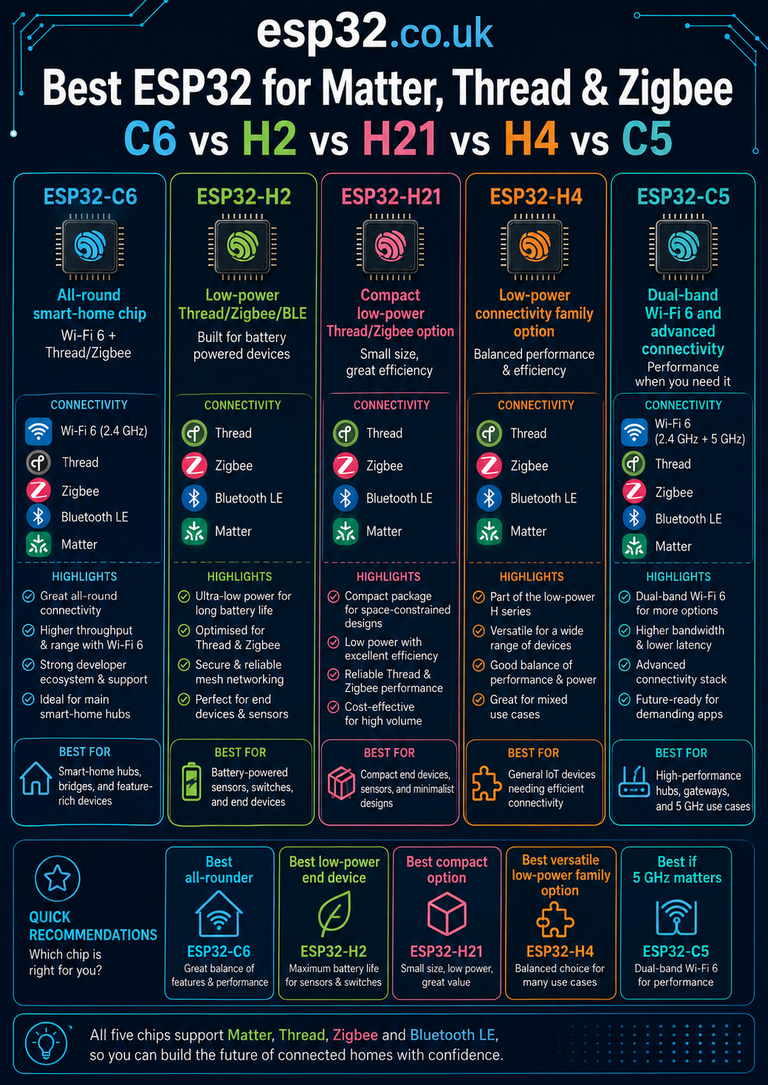
- Best ESP32 for Matter, Thread & Zigbee: C6 vs H2 vs H21 vs H4 vs C5
- ESP32-C6 SuperMini Pinout + Safe GPIOs
- ESP32 Versions Explained: Which Board Should You Buy?
Datasheets & External Resources
All manufacturer/framework references are collected here so the main article keeps readers inside esp32.co.uk.
- ESP32-H2 Series Datasheet — CPU, memory, GPIO and Thread/Zigbee/BLE specifications.
- Espressif ESP32-H21 Announcement — March 2026 launch and integrated DC-DC low-power positioning.
- Espressif H-Series Product Selector — current H21 CPU, memory, GPIO and peripheral overview.
- ESP32-H4 Product Page — dual-core CPU, BLE 5.4, Thread/Zigbee, PSRAM, USB OTG, CAN FD and touch.
- Arduino-ESP32 Supported SoCs — current stable support matrix including ESP32-H2.
- ESPHome ESP32 Platform — current H2/H21/H4 platform variants.
- ESPHome OpenThread Component — current H2/H21/H4 support and border-router requirements.
- ESPHome Zigbee Component — current H2 support and H4/H21 status.
- ESPHome 2026.7 Release Notes — H4/H21 variant integration and Zigbee SDK update.