If the ESP32-C3 was the reliable workhorse, the ESP32-C6 is what you pick in 2026 when the project touches Home Assistant, Matter, Thread, or Zigbee. Why? Because it’s one of Espressif’s first “triple-radio” parts that puts Wi-Fi 6 (2.4 GHz 802.11ax), Bluetooth LE (5.3 certified), and an IEEE 802.15.4 radio (Thread/Zigbee) onto one power-focused RISC-V SoC.
This guide keeps the best bits (simple, practical, smart-home focused), but tightens the facts and removes the fluff.
1) ESP32-C6 vs ESP32-C61: the decision that matters
ESP32-C6: “smart home king” (Thread + Zigbee included)
The ESP32-C6 includes:
- HP RISC-V up to 160 MHz + LP RISC-V up to 20 MHz (great for deep-sleep housekeeping)
- Wi-Fi 6 features like Target Wake Time (TWT) (real battery savings for sleepy devices)
- Bluetooth LE: 5.3 certified
- IEEE 802.15.4 with Thread 1.3 + Zigbee 3.0
- Memory: 320 KB ROM, 512 KB HP SRAM, 16 KB LP SRAM (plus cache)
Translation: If you want Matter over Thread, Zigbee routing, or anything 802.15.4-based, C6 is the chip.
ESP32-C61: “streamlined Wi-Fi 6 sibling” (no 802.15.4)
ESP32-C61 keeps Wi-Fi 6 + Bluetooth LE, but is positioned as a lower-cost IoT connectivity part without Thread/Zigbee. It’s still RISC-V up to 160 MHz, with 320 KB SRAM and a strong Wi-Fi 6 feature set (including TWT).
Translation: If your device is Wi-Fi + BLE only (no mesh, no Thread, no Zigbee), C61 can make sense. If you need Thread/Zigbee, C61 is a dead end.
2) “Versions” of ESP32-C6: what actually changes
Unlike older lines that felt like a zoo, ESP32-C6 is comparatively clean:
- Same core platform (HP + LP RISC-V, Wi-Fi 6, BLE, 802.15.4, security blocks, etc.)
- The practical differences you’ll run into are mainly:
- Package / GPIO count: ESP32-C6 comes in QFN40 (30 GPIOs) and QFN32 (22 GPIOs) options
- Flash arrangement: some variants rely on off-package external flash, while others appear in the ecosystem with flash “in the chip’s package” via the MINI modules/dev boards (more on that below).
Rule of thumb: as a maker/dev, you usually don’t buy bare silicon — you buy modules and dev boards. That’s where the real “variants” show up.
3) The modules (what’s actually soldered onto boards)
ESP32-C6-WROOM-1 / WROOM-1U (the standard module)
- WROOM-1: PCB antenna
- WROOM-1U: external antenna connector (U.FL/I-PEX style)
- Uses external SPI flash (module datasheets describe support up to 16 MB depending on SKU/variant).
When to pick it: you want the “normal dev board” experience, more flexibility, and often more flash options.
ESP32-C6-MINI-1 / MINI-1U (small module, “production-shaped”)
- Physically smaller
- Typically described with 4 MB SPI flash in the chip’s package (simplifies layout/BOM)
- MINI-1U versions exist for external antennas
When to pick it: you’re building compact sensors, or you want something that feels closer to a real product design.
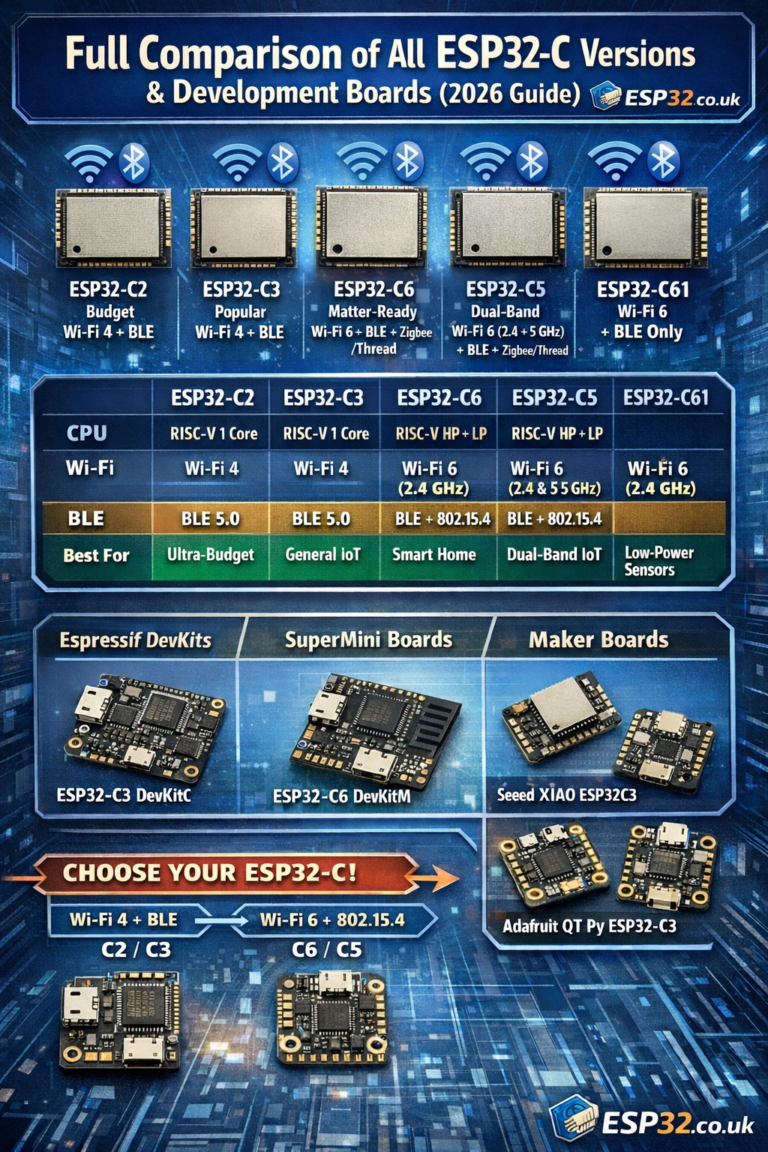
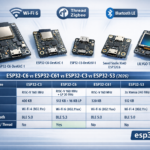
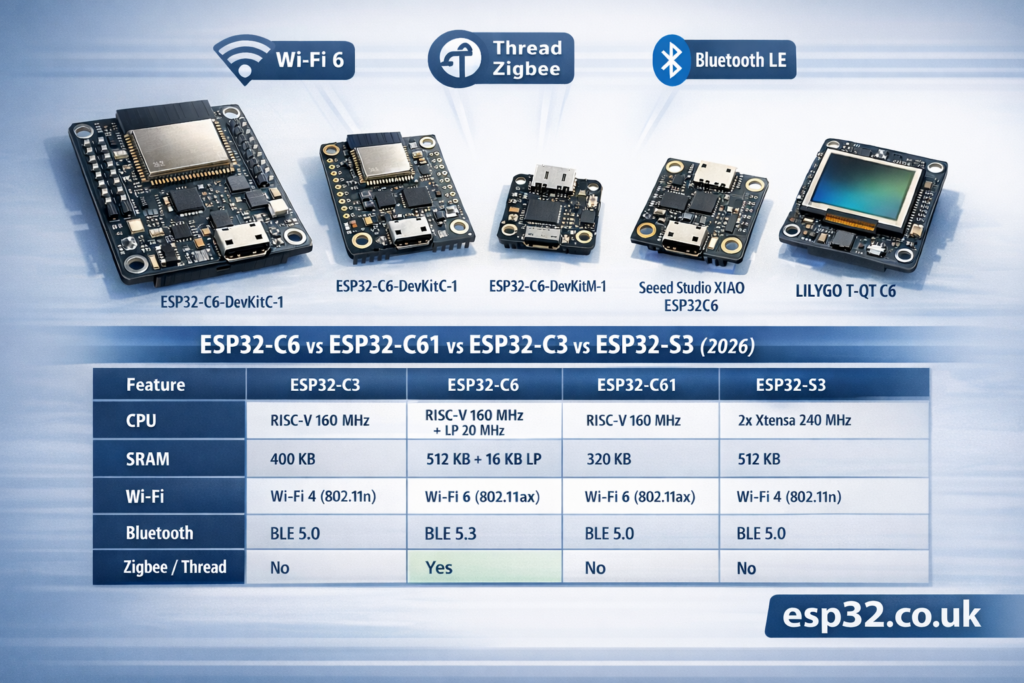
4) Head-to-head spec matrix (C3 vs C6 vs C61 vs S3)
Here’s the quick comparison that actually helps you choose:
| Feature | ESP32-C3 (older workhorse) | ESP32-C6 (smart home king) | ESP32-C61 (Wi-Fi 6 only) | ESP32-S3 (bigger compute) |
|---|---|---|---|---|
| CPU | 1× RISC-V up to 160 MHz | HP RISC-V 160 MHz + LP RISC-V 20 MHz | 1× RISC-V up to 160 MHz | 2× Xtensa LX7 up to 240 MHz |
| SRAM | 400 KB | 512 KB (HP) + 16 KB (LP) | 320 KB | 512 KB |
| Wi-Fi | 802.11 b/g/n | Wi-Fi 6 (802.11ax 2.4 GHz) + b/g/n | Wi-Fi 6 (802.11ax 2.4 GHz) + b/g/n | 802.11 b/g/n |
| Bluetooth LE | Bluetooth 5 (LE) | Bluetooth LE 5.3 certified | Bluetooth LE (Core 6.0 certified) | Bluetooth 5 (LE) |
| 802.15.4 (Thread/Zigbee) | No | Yes | No | No |
Sources: ESP32-C3 datasheet , ESP32-C6 datasheet , ESP32-C61 datasheet , ESP32-S3 product page
5) Choosing the right development board (what to buy)
Official Espressif boards (the safe picks)
ESP32-C6-DevKitC-1 (WROOM-based)
- Official “gold standard” for prototyping
- Based on ESP32-C6-WROOM-1 / WROOM-1U
Best for: breadboard work, maximum GPIO access, least drama.
ESP32-C6-DevKitM-1 (MINI-based)
- Based on ESP32-C6-MINI-1(U) and explicitly described as having 4 MB SPI flash in the chip’s package
Best for: compact builds and “this looks like a real device” prototypes.
Best third-party boards (when you want features, not just pins)
Seeed Studio XIAO ESP32C6
- Tiny footprint, designed for compact devices
- Has battery charging / power management (handy for sensors)
- Zephyr’s board docs also call out USB-C, battery charging, and an U.FL external antenna connector.
Best for: battery sensors, Thread nodes, “hide it in a small enclosure” builds.
LILYGO T-QT C6 (ESP32-C6 + display)
- ESP32-C6 MINI-1U, 4 MB flash
- Built-in 0.85″ 128×128 capacitive touch TFT
- Mentions battery features (ADC detection / PMIC)
Best for: tiny dashboards, on-device UI, “smart home controller toy projects”.
The “SuperMini ESP32-C6” clones (AliExpress specials)
They’re popular because they’re tiny and cheap — but treat them as board-by-board unknowns:
- antenna performance varies wildly
- regulators can be questionable
- pin labels and USB-UART implementations can change without notice
Best for: disposable prototypes, not long-term installs in walls/ceilings.
6) Quick recommendations (pick in 10 seconds)
- I want Thread/Zigbee/Matter experiments with least pain: ESP32-C6-DevKitC-1
- I want a compact “product-shaped” Thread sensor: ESP32-C6-DevKitM-1 or XIAO ESP32C6
- I only need Wi-Fi 6 + BLE, no Zigbee/Thread: consider ESP32-C61 (don’t accidentally buy C6 if you’ll never touch 802.15.4)
- I want a tiny UI gadget: LILYGO T-QT C6
WordPress-ready SEO extras
Suggested slug: esp32-c6-versions-dev-boards-2026
Meta description: Full ESP32-C6 comparison for 2026: C6 vs C61, WROOM vs MINI modules, and the best dev boards for Matter, Thread, Zigbee, and Wi-Fi 6.
FAQ ideas (high CTR):
- “ESP32-C6 vs ESP32-C61: which one supports Thread/Zigbee?”
- “WROOM vs MINI: which module should I choose?”
- “Best ESP32-C6 board for battery sensors?”