
The best general-purpose ESP32-S3 board for most people in 2026 is the ESP32-S3-DevKitC-1-N8R8. It combines 8 MB of flash, 8 MB of PSRAM, full-speed USB OTG and the best match with Espressif examples. If you are comparing an ESP32-S3 board, check the exact memory suffix before buying: two boards with the same name can have very different flash and PSRAM.
The familiar DevKitC-1 is the safe default, the DevKitC-1U is better inside an enclosure because it accepts an external antenna, and the N32R16V version is intended for memory-heavy displays, cameras, audio and local assets. The smaller DevKitM-1 remains usable, but Espressif has discontinued the board itself.
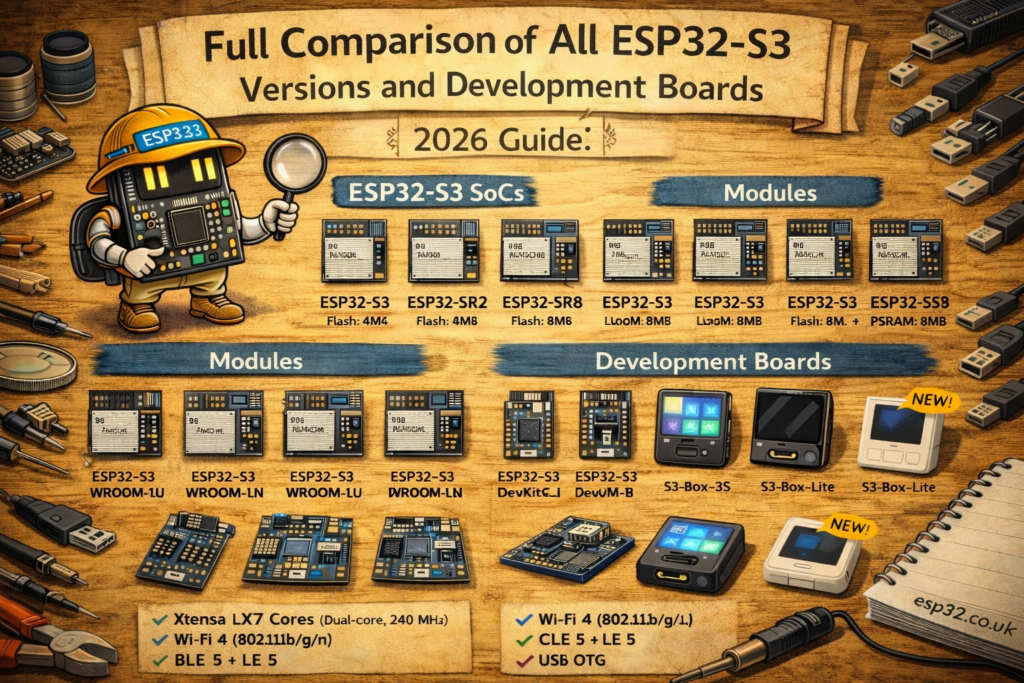
Which ESP32-S3 board should you buy?
| Requirement | Best choice | Why |
|---|---|---|
| Best default board | DevKitC-1-N8R8 | 8 MB flash and 8 MB PSRAM, broad documentation and two USB ports |
| Maximum official DevKitC memory | DevKitC-1-N32R16V | 32 MB flash and 16 MB PSRAM for large UI, camera and audio workloads |
| External antenna | DevKitC-1U-N8R8 | Same useful 8 MB + 8 MB memory with an external antenna connector |
| Smallest official module | MINI-1U | 15.4 × 15.4 mm module with an external antenna connector |
| Compact ready-made board | XIAO ESP32S3 or another reputable mini board | Much smaller than DevKitC; verify available GPIOs and battery hardware |
| Voice or smart display | ESP32-S3-BOX-3 | Integrated display, microphones and speaker-oriented hardware |
| Camera development | ESP32-S3-EYE or a PSRAM-equipped camera board | Camera connector and enough external RAM for frame buffers |
If you simply want an S3 for Arduino, ESP-IDF, PlatformIO or ESPHome, buy a board whose listing states its full ordering code. A vague listing that says only “ESP32-S3” may omit PSRAM, use less flash than expected or expose fewer pins than an official DevKitC.
What every ESP32-S3 chip shares
| CPU | Dual-core 32-bit Xtensa LX7, up to 240 MHz |
|---|---|
| Internal memory | 512 KB SRAM, 384 KB ROM and 16 KB RTC SRAM |
| Wireless | 2.4 GHz Wi-Fi 4 and Bluetooth 5 Low Energy; no Bluetooth Classic |
| USB | Full-speed USB OTG plus a separate fixed USB Serial/JTAG controller |
| GPIO | Up to 45 programmable GPIOs at chip level; modules and boards expose fewer |
| Analog | Two 12-bit SAR ADCs with up to 20 channels and 14 capacitive-touch IOs |
| Interfaces | UART, I2C, I2S, SPI, LCD/camera, SD/MMC, RMT, MCPWM and TWAI |
| Acceleration | 128-bit data path and SIMD instructions for signal-processing and neural-network libraries |
| Chip deep sleep | About 7 µA under datasheet conditions; a complete development board normally draws more |
The ESP32-S3 does not contain a separate neural-processing unit. Its “AI” advantage comes from vector instructions and optimized software such as ESP-DSP and ESP-NN. It is therefore well suited to wake-word detection, compact vision models and signal processing, but memory capacity still matters.
ESP32-S3 chip variants explained
The raw SoC name describes memory integrated in the chip package, not the total memory of every module built around it. A module can combine an S3 chip with additional flash, while variants such as R8 and R16V package PSRAM with the SoC.
| Chip | In-package flash | In-package PSRAM | Practical meaning |
|---|---|---|---|
| ESP32-S3 | None | None | Base chip used with external memory |
| ESP32-S3FN8 | 8 MB Quad SPI | None | Compact integrated-flash option |
| ESP32-S3RH2 | None | 2 MB Quad SPI | Current 2 MB PSRAM option; replaces S3R2 |
| ESP32-S3R8 | None | 8 MB Octal SPI | Common high-memory choice for UI, cameras and audio |
| ESP32-S3R16V | None | 16 MB Octal SPI | Largest listed in-package PSRAM; memory interface operates at 1.8 V |
| ESP32-S3FH4R2 | 4 MB Quad SPI | 2 MB Quad SPI | Both flash and PSRAM in-package |
| ESP32-S3R8V | None | 8 MB Octal SPI | End of life |
| ESP32-S3R2 | None | 2 MB Quad SPI | End of life and upgraded to S3RH2 |
Do not confuse these chip suffixes with complete module ordering codes. For a development board, the module code printed on the metal shield and the board ordering code are the useful identifiers.
How to read N8R8, N32R16V and U
- N4, N8, N16 or N32 indicates the module’s flash capacity in megabytes.
- R2, R8 or R16 indicates PSRAM capacity in megabytes.
- V identifies a 1.8 V memory-interface variant. It does not mean the whole board should be powered from 1.8 V.
- U in WROOM-1U or MINI-1U means an external antenna connector instead of the standard PCB antenna.
- H in relevant chip or module codes identifies a high-temperature memory option.
For example, ESP32-S3-WROOM-1-N8R8 is a WROOM-1 module with 8 MB flash and 8 MB PSRAM. ESP32-S3-WROOM-2-N32R16V combines 32 MB Octal-SPI flash with 16 MB Octal-SPI PSRAM.
WROOM-1, WROOM-2 and MINI modules compared
| Module family | Antenna | Current memory choices | Best use |
|---|---|---|---|
| WROOM-1 | PCB | 4–16 MB flash; none, 2, 8 or 16 MB PSRAM depending on code | Mainstream boards and production designs |
| WROOM-1U | External connector | Same broad range as WROOM-1 | Metal enclosures, remote antennas and difficult RF locations |
| WROOM-2 | PCB | Current N32R16V; older N16R8V and N32R8V are EOL | Maximum flash and PSRAM on an official module |
| MINI-1 | PCB | N8 or N4R2 | Compact products that do not need 8 MB PSRAM |
| MINI-1U | External connector | N8 or N4R2 | Smallest official S3 module footprint with external antenna |
WROOM is the easier default when board space is not critical. MINI saves area, but its present official variants provide either 8 MB flash without PSRAM or 4 MB flash with 2 MB PSRAM. That makes WROOM-1-N8R8 a better fit for large LVGL frame buffers, cameras, voice pipelines and other memory-hungry applications.
WROOM-2 is not simply a newer replacement for WROOM-1. It is a different high-memory option. Espressif’s current WROOM-2 table lists N32R16V, while the earlier N16R8V and N32R8V variants are marked end of life.
Official ESP32-S3 development boards
ESP32-S3-DevKitC-1
The ESP32-S3-DevKitC-1 remains the best reference board for general development. Espressif’s current v1.1 documentation lists three ordering options:
- DevKitC-1-N8R8: 8 MB Quad-SPI flash and 8 MB Octal-SPI PSRAM.
- DevKitC-1-N32R16V: 32 MB Octal-SPI flash and 16 MB Octal-SPI PSRAM.
- DevKitC-1U-N8R8: 8 MB flash, 8 MB PSRAM and an external antenna connector.
The board provides a USB-to-UART port and a separate native USB port. On v1.1 the addressable RGB LED is on GPIO38; the initial board revision used GPIO48. Our dedicated ESP32-S3 DevKitC-1 pinout guide covers the revision difference and safe GPIO choices.
ESP32-S3-DevKitM-1
The ESP32-S3-DevKitM-1 uses the smaller MINI-1 or MINI-1U module and exposes both USB-to-UART and native USB through Micro-USB connectors. It remains perfectly usable, but Espressif has discontinued production because its functionality overlaps the current DevKitC-1-N8R8 and DevKitC-1U-N8R8. The MINI-1 and MINI-1U modules themselves have not been discontinued.
A discounted DevKitM-1 can still make sense for an existing design, but it should not be presented as the current default official board.
ESP32-S3-USB-OTG
This is a specialist reference board for USB host and USB-device development. Choose it when you need to test host power, storage, HID or other USB workflows without building the supporting hardware first. For ordinary embedded USB devices, the native USB port on DevKitC-1 is usually enough.
ESP32-S3-EYE, BOX and Korvo families
- ESP32-S3-EYE is a compact camera and vision development platform.
- ESP32-S3-BOX-3 targets voice, display and smart-control-panel applications. It is also supported by Home Assistant’s voice-assistant project.
- ESP32-S3-Korvo boards are audio-reference platforms for microphone arrays, speakers and voice processing.
These kits are valuable when their integrated peripherals match your prototype. They are less convenient than DevKitC-1 for general breadboard experiments because many GPIOs are already committed to displays, microphones, cameras or audio codecs.
DevKitC versus DevKitM versus mini boards
| Board style | Strength | Trade-off |
|---|---|---|
| DevKitC-1 | Best documentation, memory choice and GPIO access | Largest general-purpose board |
| DevKitM-1 | Official compact MINI-module reference | Discontinued board and limited memory options |
| XIAO/mini format | Very compact and often battery-friendly | Fewer exposed pins; clone quality and pin maps vary |
| Feather format | Convenient battery and expansion ecosystem | Larger and usually more expensive than generic mini boards |
| Nano format | Familiar Arduino footprint and tooling | Pin naming can differ from raw ESP32 GPIO numbering |
For firmware support, an official ESP32-S3 DevKitC-1 or a well-documented branded board is the safest choice. Generic “SuperMini” boards can work well, but board definitions, voltage regulators, USB wiring and antenna performance are not consistent across sellers.
How much flash and PSRAM do you need?
| Project | Sensible minimum | Preferred headroom |
|---|---|---|
| Basic sensors, relays and ESPHome nodes | 4 MB flash, no PSRAM | 8 MB flash |
| USB HID, MIDI or serial device | 4 MB flash | 8 MB flash |
| Small display or moderate web UI | 4 MB flash + 2 MB PSRAM | 8 MB flash + 8 MB PSRAM |
| LVGL, camera or image processing | 8 MB flash + 8 MB PSRAM | 16 MB flash + 8 MB PSRAM |
| Voice pipeline or large local assets | 8 MB flash + 8 MB PSRAM | 32 MB flash + 16 MB PSRAM |
PSRAM is not automatically faster than internal SRAM, and it does not repair poor memory management. Its value is capacity: frame buffers, large images, model data, audio buffers and caches can move out of scarce internal SRAM. For small Home Assistant sensors, paying for maximum PSRAM adds little practical benefit.
USB, GPIO and board-revision traps
- Native USB uses GPIO19 and GPIO20. Do not allocate those pins to another peripheral while relying on USB OTG.
- USB OTG and USB Serial/JTAG are different controllers. The fixed Serial/JTAG block is useful for flashing and debugging; OTG is what enables HID, MIDI, CDC and host/device applications.
- GPIO35, GPIO36 and GPIO37 may be unavailable. Espressif reserves them on DevKitC-1 boards using Octal-SPI flash/PSRAM modules and WROOM-2.
- The RGB LED pin changed. Initial DevKitC-1 boards use GPIO48; v1.1 uses GPIO38.
- Development-board sleep current is not the chip figure. Regulators, USB bridges, LEDs and sensors can dominate consumption.
- ESP32-S3 has Bluetooth LE only. Choose the original ESP32 family if a project specifically requires Bluetooth Classic SPP or A2DP.
ESP32-S3 buying checklist
- Read the full board and module ordering code, not merely “ESP32-S3.”
- Choose 8 MB PSRAM for cameras, LVGL, voice or large buffers.
- Use a U module when you genuinely need an external antenna, and remember that the antenna is normally sold separately.
- Check which GPIOs the module memory and on-board peripherals consume.
- Confirm whether the board exposes native USB, USB-to-UART or both.
- Prefer a documented board definition if easy Arduino, ESPHome or PlatformIO setup matters more than minimum size.
ESP32-S3 FAQ
What is the best ESP32-S3 version?
For general development, ESP32-S3-WROOM-1-N8R8 on DevKitC-1 is the best-balanced version. It provides enough flash and PSRAM for nearly every hobby project without paying for the specialized 32 MB + 16 MB configuration.
What is the difference between ESP32-S3-WROOM-1 and WROOM-2?
WROOM-1 is the broad mainstream family with many flash and PSRAM combinations and either PCB or external antenna versions. WROOM-2 is the high-memory module family; the current datasheet lists N32R16V, while its earlier 8 MB PSRAM variants are EOL.
Is ESP32-S3-DevKitM-1 discontinued?
Yes. Espressif discontinued the DevKitM-1 development board because it overlaps the current DevKitC-1-N8R8 choices. This does not affect availability of the MINI-1 and MINI-1U modules.
Does every ESP32-S3 board have PSRAM?
No. Some modules have no PSRAM, and the board name alone does not prove the memory configuration. Look for R2, R8 or R16 in the full module code.
Can ESP32-S3 emulate a USB keyboard or MIDI device?
Yes. ESP32-S3 includes a full-speed USB OTG controller and can implement device classes such as HID, MIDI and CDC when the board exposes the native USB data pins correctly.
Is ESP32-S3 better than the original ESP32?
The ESP32-S3 is usually better for native USB, displays, cameras and vector-accelerated workloads. The original ESP32 remains preferable when Bluetooth Classic is mandatory. See our ESP32 versus ESP32-S3 comparison for the wider family differences.