When people say “ESP32 vs STM32”, they’re really comparing a Wi-Fi SoC (ESP32) with a huge family of general-purpose microcontrollers (STM32). They overlap, but they’re not aimed at the same sweet spot.
If you’re starting a new embedded project today, you’ll almost always run into these two names:
- ESP32 – low-cost Wi-Fi/Bluetooth SoC from Espressif
- STM32 – massive family of ARM Cortex-M microcontrollers from STMicroelectronics
Both are 32-bit MCUs, both are cheap, and both have strong ecosystems. But they shine in different roles.
1. At a glance – what they really are
ESP32 (family)
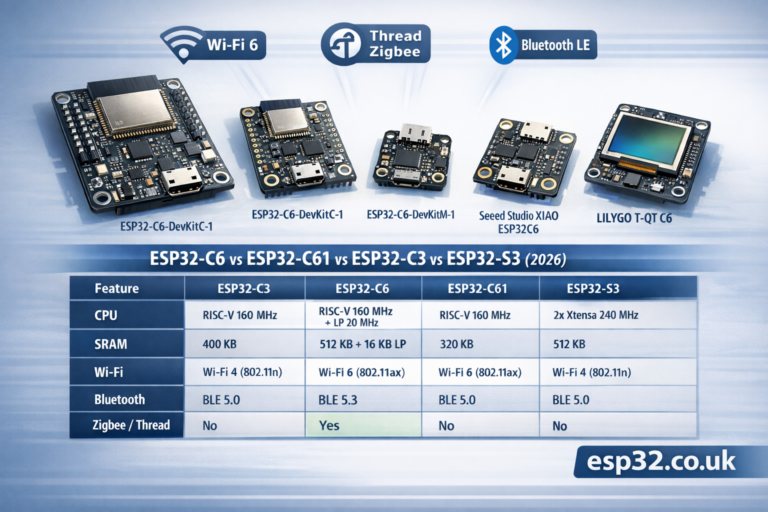
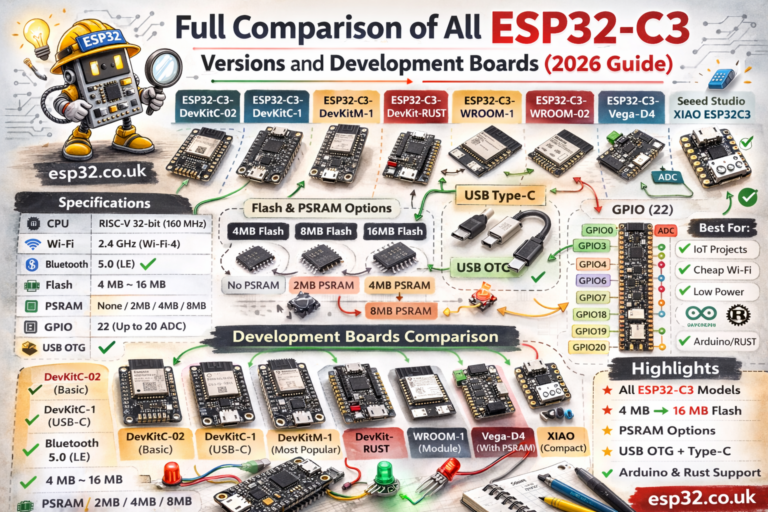
- A family of Wi-Fi + Bluetooth SoCs (ESP32, ESP32-S3, C3, C6, etc.)
- Includes:
- CPU core(s) (Xtensa or RISC-V)
- Wi-Fi + BT radio, RF front-end
- Timers, ADC, DAC (on some), etc.
- Usually sold as ready-to-use modules / dev boards (ESP32-DevKitC, NodeMCU, etc.)
- Designed for connected IoT devices: Wi-Fi, BLE, cloud, web servers.
STM32 (family)
- A huge family of 32-bit MCUs based on ARM Cortex-M0/M0+/M3/M4/M7/M33/M55 cores
- No built-in Wi-Fi in the classic lines (there are wireless variants like STM32WB for BLE and STM32WL for LoRa, but most STM32s are plain MCUs).
- Focused on:
- Real-time control
- Industrial / automotive / consumer products
- Ultra-low power and long-term availability
So:
- ESP32 = “I want Wi-Fi/BLE on the board out of the box.”
- STM32 = “I want a general-purpose MCU; I’ll add connectivity only if I need it.”
2. Quick comparison table
High-level view for typical maker / small-product use:
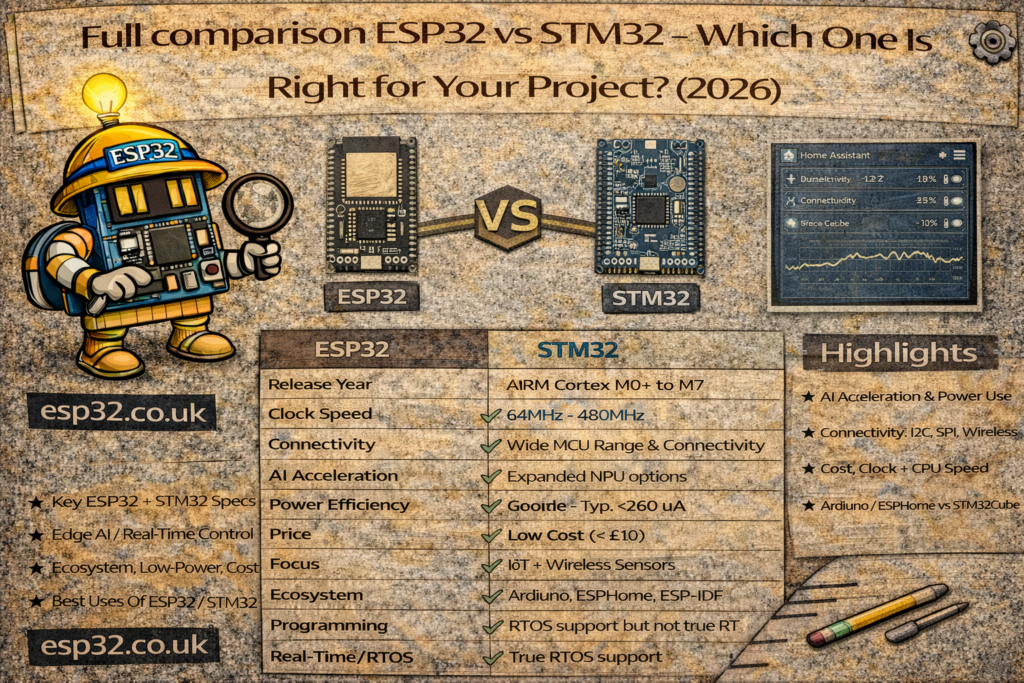
| Aspect | ESP32 family (e.g. ESP32, S3, C3) | STM32 family |
|---|---|---|
| CPU core | Xtensa or RISC-V, up to ~240 MHz | ARM Cortex-M0/M0+/M3/M4/M7/M33/M55, up to ~800 MHz |
| Connectivity | Integrated 2.4 GHz Wi-Fi, many with Bluetooth/BLE | Usually no Wi-Fi/BLE (except STM32WB/WL), external RF needed |
| Typical dev boards | ESP32-DevKitC, NodeMCU, ESP32-S3-DevKit, etc. | Nucleo, Discovery, eval boards |
| Focus | Connected IoT, web, BLE gadgets | General embedded, industrial, motor control, sensors |
| Real-time behaviour | Good, but Wi-Fi/BLE stacks can add jitter | Very good – many parts designed for strict real-time |
| Power (sleep modes) | Decent, not ultra-low-power kings | Many ultra-low-power series (L0/L4/L5/U5, etc.) |
| Tooling | Arduino, ESP-IDF, MicroPython, PlatformIO | STM32CubeIDE/HAL/LL, Arduino core for STM32, etc. |
| Typical price (MCU) | Very cheap with Wi-Fi/BLE included | Wide range; cheap to pricey, RF usually extra |
| Ideal for beginners | Yes – tons of tutorials for Wi-Fi/BLE projects | Steeper learning curve (HAL, clocks, RTOS, etc.) |
3. CPU & performance
ESP32
- Uses Xtensa LX6 / LX7 or RISC-V depending on variant.
- Clock up to ~240 MHz (e.g. classic ESP32, ESP32-S3).
- Dual-core on many chips (ESP32, ESP32-S3), single-core on C3/C6/H2.
- Newer chips (S3) add vector instructions for AI/DSP.
STM32
- Huge spread:
- Low-end: Cortex-M0/M0+ at ~24–48 MHz
- Mid-range: M3/M4 at 72–180 MHz
- High-end: M7 and M33/M55 up to ~480–800 MHz in the latest lines.
For “typical” IoT tasks (sensors + Wi-Fi + web), ESP32 already feels fast.
For heavy control/industrial or high-end DSP, you can pick an STM32H7 / H5 / F7 that outmuscles most ESP32s on CPU alone.
4. Connectivity: built-in vs external
This is the key difference.
ESP32
- Wi-Fi + Bluetooth is the whole point.
- You can:
- Host HTTP servers, MQTT clients, REST APIs
- Use BLE for sensors, HID, beacons, etc.
- No extra RF chip, antenna and certification hassle on module-based designs.
STM32
- Most STM32 MCUs do not include Wi-Fi or BLE.
- If you want wireless, you typically add:
- External Wi-Fi / BLE module (often… an ESP32 module!)
- Or pick special series STM32WB (BLE) or STM32WL (LoRa)
So if your product must be Wi-Fi/BLE connected and you don’t want extra RF work, ESP32 is the obvious first choice.
5. Real-time control & peripherals
ESP32
- Has plenty of peripherals for hobby / light industrial:
- Timers, ADC, DAC (on classic ESP32), I²C, SPI, UART, I²S, RMT, etc.
- Wi-Fi and Bluetooth stacks run in the background and can occasionally add:
- Jitter in timing
- Constraints on very tight real-time loops
For most maker projects (sensors, relays, motors, WS2812, etc.) this is fine.
For hard real-time (e.g. motor control at kHz+ with strict deadlines), you need to be more careful.
STM32
- Designed from the start for real-time embedded:
- Many timers (advanced PWM, quadrature encoders)
- High-resolution ADCs & DACs
- CAN / FD, USB, Ethernet, SDIO, etc. depending on series
- No mandatory Wi-Fi/BLE task running in the background.
- Much easier to guarantee deterministic timing on dedicated peripherals.
If your main goal is precision control (motors, inverters, power electronics, safety systems), STM32 is usually the better fit.
6. Power consumption & battery life
ESP32
- Designed as a connected IoT SoC, so:
- Active Wi-Fi current is relatively high.
- Has decent deep sleep (tens of µA), good enough for many battery nodes if you sleep aggressively and wake rarely.
STM32
- Several STM32 lines are explicitly ultra-low-power:
- STM32L0, L4, L5, U5 etc. boast very low sleep currents and efficient active modes.
- Ideal for:
- Coin-cell devices
- Long-term battery sensors
- Energy-harvesting applications
If power budget is tight and you don’t need Wi-Fi, STM32 (low-power series) wins easily.
7. Tooling, ecosystem & learning curve
ESP32
- Very friendly for makers:
- Arduino core for ESP32
- ESP-IDF (official SDK)
- PlatformIO, MicroPython, CircuitPython, etc.
- Tons of tutorials for:
- Wi-Fi web servers
- MQTT, HTTP, ESP-NOW
- BLE, Home Assistant/ESPHome
For someone coming from Arduino/DIY, ESP32 is usually faster to “fun”.
STM32
- Professional-grade tooling:
- STM32CubeIDE, STM32CubeMX, HAL/LL libraries
- Great for structured embedded work, but initially more complex.
- Also has:
- Arduino core for some boards
- PlatformIO support
- Big community (STM32Duino, STM32-base, etc.)
If you’re doing career-style embedded work, STM32 teaches you “real MCU architecture” in a very direct way (clocks, buses, interrupts, RTOS…).
8. Cost, availability & productization
- ESP32 modules (WROOM/S3/C3, etc.) are:
- Very cheap, especially considering Wi-Fi/BLE + RF certifications.
- Great for low- to mid-volume products where you don’t want to handle RF design & certification.
- STM32:
- Huge range of price points; low-end parts can be very cheap, high-end H7/L5 parts more expensive.
- You choose package, flash size, RAM, peripherals very finely.
- For wireless, you usually add a separate module (which can be an ESP32 anyway).
For a connected product where you want minimal RF headache, ESP32 module is often the simplest and cheapest path to market.
9. When to choose what (practical guidance)
Use ESP32 if:
- You need Wi-Fi and/or BLE out of the box.
- You’re building:
- Smart plugs, switches, lights
- IoT sensors that publish via Wi-Fi / MQTT
- DIY Home Assistant / ESPHome devices
- Web-configurable gadgets with REST/HTTP UI
- You want fast prototyping with Arduino or MicroPython and lots of ready-made examples.
You can still add an STM32 later as a real-time co-processor if needed, but for many projects ESP32 alone is enough.
Use STM32 if:
- You don’t need Wi-Fi/BLE, or you’re fine adding it as a separate module later.
- You care about:
- Hard real-time (motor control, industrial drives, robotics)
- Ultra-low power (months/years on a battery)
- Safety / certification / long-term availability (industrial, automotive, medical).
- You want very fine control over:
- Exact MCU series, RAM/flash size, peripherals, package
- Performance vs cost vs power trade-off.
In bigger designs, a common pattern is:
STM32 as the main real-time / control MCU
ESP32 as the Wi-Fi/BLE communication module
This way you get the best of both.
10. TL;DR
- ESP32 → Wi-Fi/BLE SoC, great for connected IoT, web and BLE gadgets, super friendly for makers and small products.
- STM32 → massive Cortex-M MCU family, ideal for real-time control, low power, industrial and long-lived products, usually without built-in Wi-Fi/BLE.