Quick summary: Arduino announced the Nano XL Link and its Connector Carrier at electronica 2026 on 10 November. The new development board combines a 120MHz Arm Cortex-M33 microcontroller with CAN FD, RS-485 and 10/100 Ethernet, while the carrier adds DIN-rail mounting, screw terminals and an RJ45 socket. Arduino has not yet announced a price or shipping date.
Arduino® has unveiled the Nano XL Link, the first board in a planned Nano XL family aimed at industrial, home and building automation. It keeps the familiar Nano pin positions but adds a second row of headers and the physical-layer hardware needed for three common wired interfaces. This is a new Microchip-based development board, not a larger revision of the ESP32PriceAliExpress price-based Nano ESP32PriceAliExpress price.
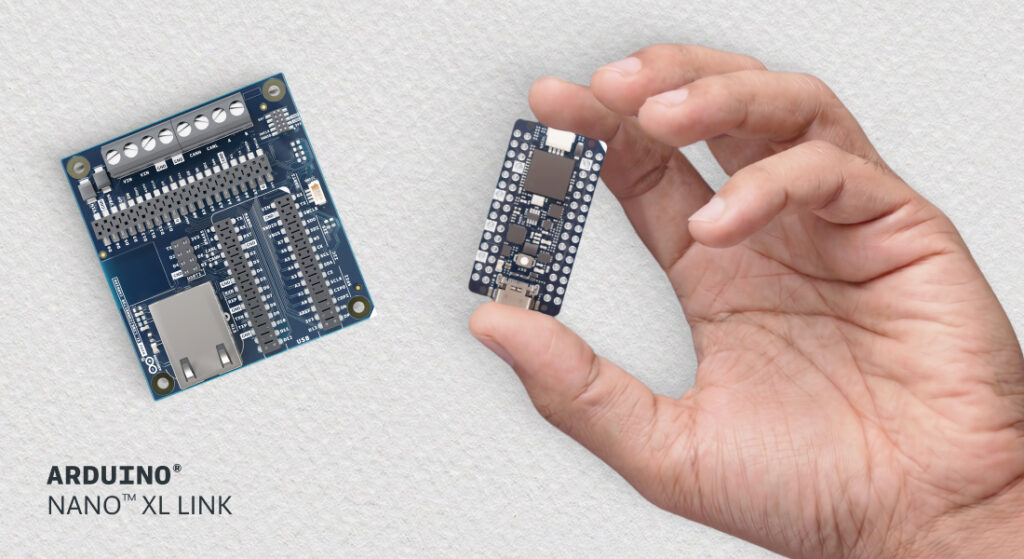
Nano XL Link specifications
| Processor | Microchip PIC32CK2051SG01144, 32-bit Arm Cortex-M33 at 120MHz |
|---|---|
| Memory | 2MB flash, 512kB RAM |
| Security | Integrated hardware security module for secure boot and key storage |
| Wired networking | CAN FD, half-duplex RS-485 and 10/100 Ethernet |
| Expansion | Two 2×15 headers and an onboard Qwiic connector |
| Power | USB-C, 7–24V DC through VIN, or regulated 3.3V |
| Temperature range | -20°C to +85°C |
| Software | Arduino sketches through the Arduino Zephyr core |
The PIC32CK device also includes a hardware security module, which Arduino documents for secure boot and protected key storage. Unlike the Nano ESP32, the announced Nano XL Link specification does not list Wi-Fi or Bluetooth. Its focus is deterministic control and wired field networks rather than wireless IoT.
CAN FD, RS-485 and Ethernet are built differently
Arduino has placed a TCAN3414 CAN transceiver on the development board. The documented interface supports classic CAN and CAN FD, payloads up to 64 bytes and data rates up to 8Mbps. A THVD2410 half-duplex transceiver handles RS-485, with Arduino pointing to its ArduinoRS485 library and Modbus RTU applications.
Ethernet needs a little more explanation. The Nano XL Link itself carries a KSZ8081 10/100 Ethernet PHY and exposes the relevant signals, but the RJ45 connector and magnetics sit on the separate Nano XL Link Connector Carrier. Similarly, the carrier turns the board’s CAN and RS-485 lines into screw-terminal connections. Buyers should therefore not read “onboard Ethernet” as meaning that the small board alone has an RJ45 socket.
Selectable termination resistors are provided for CAN and RS-485. That is useful on a bench, but deployed networks still need correct bus topology, cable selection, grounding and termination at the appropriate ends; the presence of a transceiver does not remove those design requirements.
An extended Nano rather than a normal drop-in board
Two 2×15 headers retain the classic Nano digital, analogue and power pins while adding 12 digital pins, a second SPI bus, I²C, a second UART, I²S and the fieldbus connections. An onboard 3.3V Qwiic port supports Qwiic, STEMMA QT and Modulino accessories. The layout is therefore familiar, but projects should be checked against the published pinout rather than assuming mechanical compatibility from the Nano name alone.
For context, Arduino’s existing Nano R4 exposes a CAN controller in a conventional Nano-class board, while the Arduino Opta is a complete DIN-rail programmable relay controller. Nano XL Link sits between those ideas: it is still a development board, but its companion carrier is intended to move a prototype into a control cabinet without designing the first carrier from scratch.
Zephyr-based Arduino software
Arduino’s documentation says sketches run through the Arduino Zephyr core on the Zephyr real-time operating system. That gives the board a different software foundation from the classic ATmega328P Nano. Existing Arduino source may remain familiar, but libraries that assume AVR registers, timing or peripheral layouts will still need checking against the new core and hardware.
Price and availability remain open
Arduino announced both products at electronica 2026 in Munich and is demonstrating them during the 10–13 November event. The company is collecting availability notifications, but it has not published a retail price, pre-order date or shipping date for either the Nano XL Link or Connector Carrier. They should therefore be treated as announced products, not boards currently confirmed to be shipping.
Sources
- Arduino announcement from electronica 2026
- Arduino Nano XL Link documentation and specifications
- Arduino Nano XL Link Connector Carrier documentation
- Arduino content and image licensing guidance
Arduino® is a trademark of Arduino SA.