Banana Pi and UNISOC announced the BPI-M2C on 23 November 2026. It’s an 85 × 56 mm single-board computer with the cellular modem built into its UNISOC T820 system-on-chip. That makes it an interesting option for a remote gateway where you’d otherwise have to fit a separate modem. BPI Shop lists it at $239, but shipping dates and UK availability are unconfirmed.
Quick summary. You get built-in 5G, 4 GiB of RAM, 128 GB of eMMC and one Gigabit Ethernet port. Banana Pi documents how to bring up cellular data on its software stack. Match the board variant and antenna to your carrier before ordering, particularly if the site will be difficult to get to.
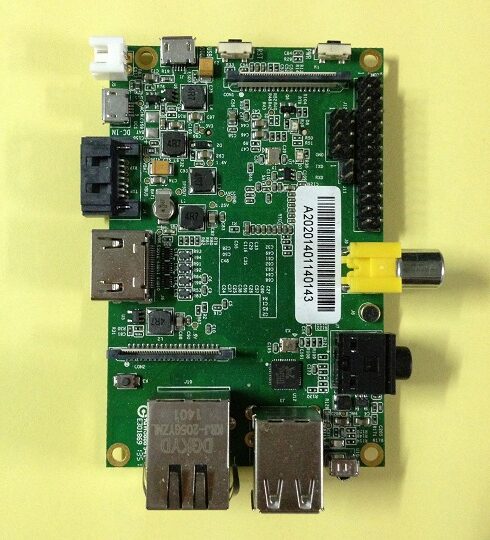
What you get on the board
The T820, also known as the UIS7885, has four Cortex-A76 cores and four Cortex-A55 cores. Banana Pi quotes up to 8 TOPS for the onboard NPU. That’s a hardware figure. How much of it you get for a particular camera model depends on the model and the vendor’s software support.
There’s a microSD slot alongside the eMMC, dual-band Wi-Fi 5, four USB 2.0 ports, HDMI, MIPI display and camera interfaces, and a 40-pin GPIO header. Gigabit Ethernet supports PoE via an external module. The built-in storage is handy for a self-contained box, while the single Ethernet port and USB 2.0 are worth factoring in if you need a second wired interface or fast external storage.
What built-in 5G gets you
You can use the cellular connection for the uplink and keep the Ethernet port free for a wired device on site. It saves having to allocate a USB port or add a separate modem carrier. You still need a suitable SIM, the right cellular antenna and the carrier’s access point name (APN). Banana Pi’s guide says band support, carrier certification and plan capabilities depend on the hardware variant, radio front end, firmware and network operator.
The guide documents modem control through oFono, ChannelManager and a vendor demo utility. It walks through reading registration status, bringing up a packet-data connection and checking the resulting Linux interface. That’s useful if you want a gateway on the vendor’s software. If you already deploy a standard distribution or router image, confirm modem and NPU support on that exact image before committing. Automatic failover also needs routing logic and a way to check that the uplink can actually reach the destination.
There’s a straightforward bench check for this sort of project. Use the SIM you’ll deploy, bring up the cellular link with Ethernet disconnected, and verify that your application reconnects after a restart. Then test what happens when the wired link comes and goes. That tells you more about whether it’ll work unattended than a one-off speed test.
For the rest of a gateway build, see our guide to gateway hardware and backup power. If cellular is just an optional uplink for a home automation host, our Home Assistant hardware comparison covers other host options.
Sources
Banana Pi and UNISOC announcement · Board specifications · Banana Pi cellular setup guide · BPI Shop listing