Quick summary: BMDS 0.3.0 and 0.3.1 arrived on 16 November 2026, only about 100 minutes apart. The first update moved applications on the ESP32-P4Price desktop into RISC-V user mode with per-program memory protection; the follow-up fixes a rare crash during writes to flash. Existing users should install 0.3.1, but the new bootloader makes an upgrade from 0.2.0 a two-stage process.
Programs can now fail without taking down the desktop
BMDS, short for Bare Metal Do Stuff, is a DOS-like graphical operating environment built by Jason Howard for the Olimex ESP32-P4-PC. Version 0.3.0 adds the most consequential change since the project’s first public release on 2 November: separately built applications now run in the processor’s user privilege mode and can reach only their own memory.
A bad pointer, illegal instruction or stack overrun should therefore end the offending program with a signal such as SIGSEGV, SIGILL or SIGTRAP while the desktop continues running. The system also rejects an invalid user pointer with EFAULT instead of writing through it. This is meaningful isolation for a microcontroller desktop, although BMDS remains a single-user FreeRTOS and ESP-IDF system rather than Linux.
The protection relies on a new bootloader and the ESP32-P4’s RISC-V privilege and memory-protection hardware. Howard reports roughly one extra microsecond per system call and about one millisecond added to application start-up, with application code itself unaffected in the project’s CoreMark test. Those are project figures, not independent benchmarks.
Why 0.3.1 followed so quickly
BMDS 0.3.1 is a corrective release. It fixes a race that could stop the system with a “Cache error” and restart it when the display completed a frame at the same moment that BMDS wrote a file to /home or /flash, or began an update. The maintainer describes the fault as rare in normal use but more likely while a program was drawing. The patch also makes the Updater’s release notes, signature warnings and bootloader prompts wrap correctly instead of clipping text.
A desktop stack, not another development board
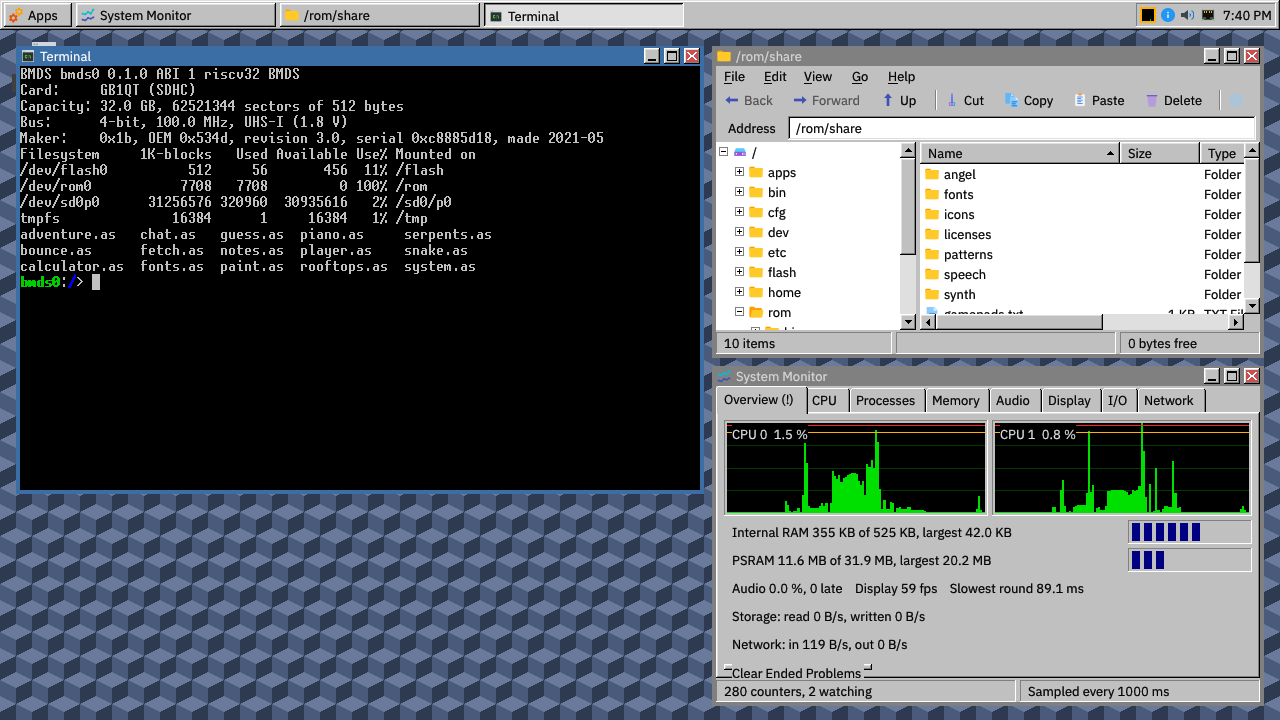
BMDS combines a 1280 × 720 windowed desktop with a shell, file manager, editor, package manager, updater, SSH and SFTP, audio playback and games. Applications are ELF binaries loaded from microSD; developers can build C software with the downloadable SDK or write AngelScript programs in the on-device editor.
The supported hardware is specifically the Olimex ESP32-P4-PC, whose official listing includes 32 MB of PSRAM, 16 MB of flash, HDMI output, four USB host ports, 10/100 Ethernet, microSD and a 3.5 mm audio output for €24.95. The ESP32-P4 itself has no Wi-Fi or Bluetooth, as explained in our ESP32-P4 versus ESP32-S3 guide.
Chip choice alone does not establish board support. BMDS currently targets ESP32-P4-PC boards with silicon revisions before v3.0; it does not claim compatibility with the SparkFun ESP32-P4 RedBoards, the SCINTIX P4 compute module or other ESP32-P4 designs. The present limitations also include a US keyboard layout and a single 720p display mode.
Availability and upgrade warning
BMDS 0.3.1 is available now from GitHub under the MIT Licence, with a browser installer for Chrome and Edge plus downloadable flash images, update packages, source and SDK files. Users already on 0.3.0 can update normally.
Moving from 0.2.0 requires two passes through the Updater because the old updater cannot replace the bootloader in the first pass. The second pass offers the package with the new bootloader. Power must remain connected while that bootloader is written; the release notes warn that an interruption at that moment requires USB reflashing, although the browser installer’s Reinstall option is designed to retain settings.