
If you run Zigbee or Thread in Home Assistant, the obvious question is whether the new Home Assistant Connect ZBT-2 is a genuine upgrade over Connect ZBT-1 or just a nicer-looking replacement. The answer is fairly simple: ZBT-2 is clearly the better official adapter, especially for new installs, but that does not mean every ZBT-1 owner needs to rush out and replace a working setup. Home Assistant says ZBT-1 is discontinued but continues to receive software updates, while ZBT-2 is the new official model going forward.
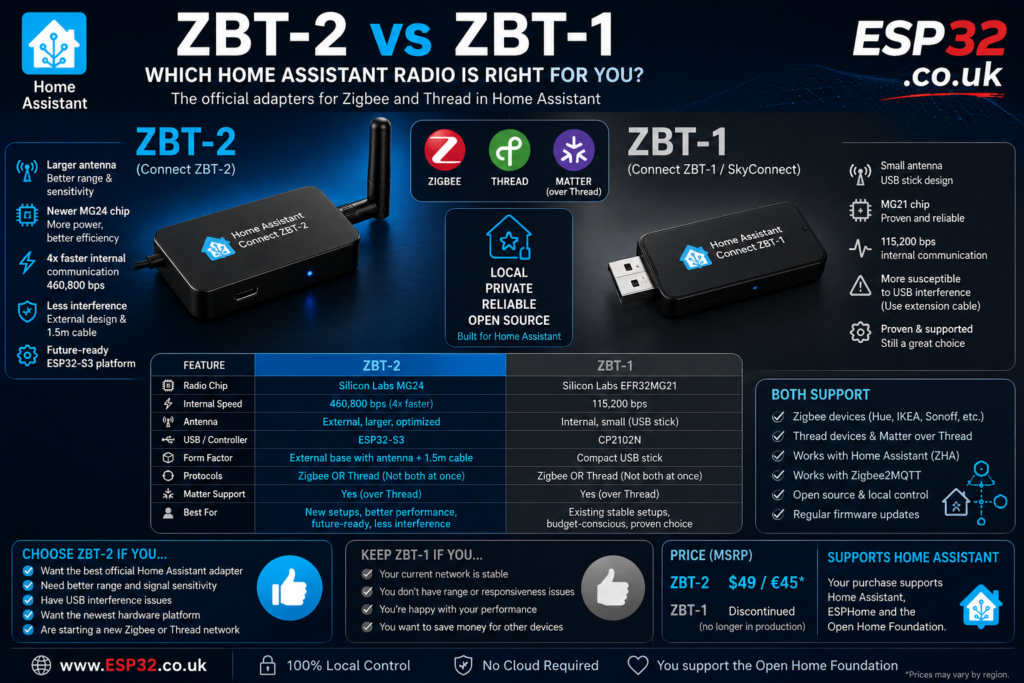
The short answer
Choose ZBT-2 if:
- you are starting from scratch
- you want the best official Zigbee or Thread hardware from Home Assistant
- you want easier placement and less interference risk
- you want the newer hardware platform with better responsiveness
Keep ZBT-1 if:
- your current network is already stable
- you do not have range or responsiveness issues
- you would rather spend money on more routers or better device placement first
That conclusion matches Home Assistant’s own positioning: ZBT-2 is the replacement and the performance step up, while ZBT-1 remains supported and is still usable long term.
What changed from ZBT-1 to ZBT-2
The biggest differences are not marketing fluff. Home Assistant explicitly calls out these upgrades in ZBT-2:
- larger, optimized external antenna and base
- newer Silicon Labs MG24 radio chip instead of MG21
- 4x higher internal communication speed, from 115,200 to 460,800 bps
- improved sensitivity to weaker signals
- a second-generation platform that also includes an ESP32-S3 USB controller
- easier physical placement thanks to a 1.5 m cable and external form factor
ZBT-1, by contrast, is the older stick-style adapter, previously sold as SkyConnect, with an EFR32MG21 radio and a CP2102N USB-to-UART bridge. It was designed as the easiest way to add Zigbee, and later Thread support, but Home Assistant also explicitly warned users about USB interference and recommended using an extension cable.
ZBT-2 vs ZBT-1 spec comparison
1. Radio chipset
Home Assistant says the MG24 brings higher processing power and better sensitivity to weak signals compared with the MG21. That is one of the main technical reasons ZBT-2 is the better coordinator on paper and in their testing.
2. Internal communications speed
Home Assistant says this 4x increase consistently improved responsiveness in testing, especially when several devices are triggered at once. Not four-times-faster bulbs, obviously, but a meaningfully snappier coordinator path.
3. Antenna and form factor
- ZBT-1: small internal antenna in a USB stick form factor
- ZBT-2: free-standing external antenna and tuned base
This is probably the most practical real-world difference. ZBT-1 is convenient, but tiny USB sticks are terrible places for radios because they sit right next to electrically noisy hardware. Home Assistant repeatedly points out that USB ports and nearby electronics can create interference, which is why ZBT-1 often benefited from an extension cable. ZBT-2 is basically designed around avoiding that problem.
4. USB/controller hardware
- ZBT-1: Silicon Labs CP2102N USB-to-UART bridge
- ZBT-2: ESP32-S3 USB controller
Home Assistant frames the ESP32-S3 as part of its second-generation platform and says it opens more possibilities for future firmware experimentation and flexibility. That does not automatically create magical new features today, but it is a more capable platform direction than the older bridge chip.
Zigbee and Thread support
Both adapters are about the same at the high level: they support Zigbee and Thread, but you should treat them as one-protocol-at-a-time radios for the best experience. ZBT-1’s page says multiprotocol remains experimental and is not recommended. ZBT-2’s page is even more direct: you dedicate it to either Zigbee or Thread.
So if you were hoping ZBT-2 finally solves “one dongle to run Zigbee and Thread perfectly at the same time,” no. Home Assistant has already tested that path extensively and concluded it does not work well enough to recommend.
Matter support: what that really means
This is where people get sloppy.
Neither adapter is a magical “Matter stick” in isolation. Matter support here mainly means Thread support for Matter-over-Thread devices. Home Assistant says ZBT-2 can be used with Matter devices that use Thread, and ZBT-1 can be used to turn Home Assistant into a Thread border router.
So:
- Zigbee is one thing
- Thread is another thing
- Matter may run over Thread for many battery devices
That distinction matters because marketing often mashes them together into a blob.
Ease of setup
This is one area where the two products are similar in spirit, but ZBT-2 is more polished in execution.
ZBT-1 was designed as an easy, plug-and-play adapter automatically detected by Home Assistant. ZBT-2 keeps that easy onboarding but adds an official setup wizard for starting Zigbee or Thread networks and improved migration tools for moving existing networks over.
For a new user, ZBT-2 is the nicer on-ramp. For an existing user, the migration tooling is arguably more important than the hardware itself.
Compatibility with software stacks
ZBT-2 is not limited to one narrow Home Assistant path. Home Assistant says it has tested it with:
- ZHA
- zigpy-cli
- Zigbee2MQTT
- matter.js
- OpenThread Border Router
ZBT-1’s product page also explicitly mentions compatibility with Works with Home Assistant Zigbee setups or Zigbee2MQTT.
So from an ecosystem point of view, this is not a case of “old one was flexible, new one is locked down.” Both are reasonably open by Home Assistant standards, but ZBT-2 is the better-supported current-generation option.
ZBT-2 advantages that actually matter in practice
Better range and listening ability
Home Assistant says the larger antenna in ZBT-2 is better not just at transmitting further, but also at hearing weaker, more distant device signals. That listening side is often ignored, but it is important for battery devices and awkward installations.
Less interference pain
ZBT-1’s own FAQ bluntly warns that USB 3.0 ports can cause serious 2.4 GHz interference and make Zigbee or Thread flaky or unusable. ZBT-2’s whole physical design is meant to reduce exactly that problem.
Better responsiveness under load
Home Assistant says its testing showed more consistent responsiveness with ZBT-2, especially when several devices are controlled together. That fits with the faster baud rate and newer radio.
Better future platform
The MG24 plus ESP32-S3 combination makes ZBT-2 the more future-looking hardware platform. Home Assistant also emphasizes the open design, unlocked bootloader, and modifiable firmware.
Reasons not to upgrade from ZBT-1
If your ZBT-1 network is already stable, covers the house properly, and is not dropping devices, then upgrading may be more of a nice-to-have than a need-to-have. Home Assistant explicitly says ZBT-1 is still supported and should keep working far into the future.
Also, in a bad Zigbee setup, the real problem is often not the coordinator. It is usually one of these:
- poor placement
- too few mains-powered routers
- bad channels
- too much 2.4 GHz interference
- flaky end devices
A better coordinator helps, but it does not fix a badly built mesh by itself.
Reasons to upgrade from ZBT-1
Upgrading makes more sense if:
- you are rebuilding your network anyway
- you have range issues
- you have USB interference pain with ZBT-1
- you want a cleaner official path for Thread or Matter-over-Thread
- you want the strongest official Home Assistant adapter available now
Home Assistant even suggests a practical reuse path: if you upgrade Zigbee to ZBT-2, you can keep ZBT-1 around and repurpose it for Thread.
What about price and availability
Home Assistant says ZBT-2 starts at $49 / €45 MSRP, with regional variation. ZBT-1 is no longer in production, so at this point you are mostly dealing with existing stock or second-hand availability for that older model.
That alone makes the comparison slightly lopsided. One is the old still-supported model; the other is the one Home Assistant actually wants new buyers to use.
Verdict
Buy ZBT-2 if you are new
This is the easy one. If you are buying your first official Home Assistant Zigbee/Thread adapter today, get ZBT-2. It has the better radio platform, better antenna design, higher speed, better placement flexibility, and it is the model Home Assistant is actively pushing forward.
Keep ZBT-1 if it already works well
If you already own ZBT-1 and your network is solid, there is no urgent reason to rip it out just because a newer model exists. It is still supported, still functional, and still a valid radio for many setups.
Upgrade if you want better headroom
If your current setup is stretched, flaky, interference-prone, or you simply want the best official coordinator Home Assistant offers, then ZBT-2 is the worthwhile upgrade.
The honest summary is this: ZBT-2 is better hardware; ZBT-1 is still good enough for many people. That is the real comparison.
ZBT-2 is not just a rename. It brings a new radio, faster internals, a much better antenna strategy, and a cleaner current-generation platform. But ZBT-1 is not suddenly junk either. Home Assistant still supports it, and if your mesh is healthy, you may gain less from upgrading than you would from fixing topology, placement, or adding a few solid router devices