If you’re looking for the true modern successor to the legendary ESP8266, this is it. While the ESP32 family has expanded into multi-core, AI-friendly, Matter-ready chips, the ESP32-C2 was built for one mission: the cheapest, most power-efficient, high-volume Wi-Fi IoT.
In the real world, you’ll see the ESP32-C2 ecosystem sold mostly under the ESP8684 name, especially for parts with in-package flash (a big reason C2 is used inside smart plugs, bulbs and basic sensors). Espressif positions ESP32-C2 as a Wi-Fi + BLE SoC for cost-sensitive products.
This guide explains:
- the naming (ESP32-C2 vs ESP8684)
- the H2/H4 and H2X/H4X variants (v1.x vs v2.0 silicon)
- the main modules you’ll actually buy
- the official development boards
- the popular “drop-in replacement” module footprints used for Tuya swaps
1) ESP32-C2 vs ESP8684: the naming confusion
ESP32-C2 is the SoC family name.
ESP8684 is the naming used heavily for in-package flash variants and modules built around them. Espressif’s own dev-kit documentation for C2 boards uses the ESP8684 module names (WROOM/MINI families), and those are what you’ll see in shops in 2026.
Bottom line: if you buy “ESP32-C2 dev boards” today, you’re usually buying ESP8684 modules/devkits.
2) The “real” C2 lineup (what you can actually buy)
2.1 Legacy variants (v1.2 and earlier)
You’ll still see these in old stock and cheap listings:
- ESP8684H2 → 2 MB in-package flash
- ESP8684H4 → 4 MB in-package flash
These are referenced as the “v1.2 and earlier” chip revisions in Espressif’s revision docs.
2.2 New 2025/2026 “X” variants (v2.0 silicon)
This is the key upgrade most people should prefer in 2026:
- ESP8684H2X and ESP8684H4X are upgraded versions of H2/H4.
- Espressif documents that chip v2.0 provides +20 KB SRAM and ~100 KB additional flash space (actual gain depends on app/build).
- Espressif also changed ordering codes specifically to distinguish v2.0 parts and notes v2.0 requires a specified ESP-IDF version.
Quick recommendation:
If you’re buying new boards/modules in 2026, aim for H2X/H4X (v2.0). The extra SRAM alone is worth it on memory-tight nodes.
3) Core specs (what C2 is, in plain terms)
From Espressif’s ESP8684 / ESP32-C2 documentation, the platform is:
- 32-bit RISC-V single-core up to 120 MHz
- Wi-Fi 4 (2.4 GHz)
- Bluetooth LE (ESP8684-WROOM-05 datasheet notes Bluetooth 5.3 certified for that module family)
- Typical on-chip memory shown by Espressif: 576 KB ROM, 272 KB SRAM (16 KB cache)
- Strong security feature positioning (Secure Boot / flash encryption / crypto acceleration is part of the C2 platform positioning).
4) The v2.0 (“X”) upgrade: what changed and why you care
Espressif explicitly states for chip revision v2.0:
- ~20 KB more SRAM
- ~100 KB more usable flash space (application dependent)
Espressif also published a product change notice detailing the move from v1.2 → v2.0 and updated ordering codes for modules and dev boards (example: DevKitC-02C-N4 → N4X).
Practical meaning for makers:
- v2.0 (“X”) parts reduce “random instability” caused by tight heap in bigger frameworks (ESPHome/Tasmota-style builds).
- the “extra flash space” helps with partition layouts and OTA headroom.
5) Head-to-head: ESP8266 vs ESP32-C2 vs ESP32-C3 (context table)
This table is intentionally practical (what changes your life).
| Feature | ESP8266 | ESP32-C2 / ESP8684 (H2/H4) | ESP32-C2 v2.0 (“X”) | ESP32-C3 (for scale) |
|---|---|---|---|---|
| CPU | 80/160 MHz class (Tensilica L106) | RISC-V single core up to 120 MHz | same + more usable memory | RISC-V single core up to 160 MHz |
| Wi-Fi | Wi-Fi 4 | Wi-Fi 4 | Wi-Fi 4 | Wi-Fi 4 |
| Bluetooth | none | BLE (BT5 LE positioning) | BLE + more headroom | BLE |
| Flash | external (varies) | 2 MB or 4 MB in-package (H2/H4) | same + ~100 KB extra usable | external flash (varies) |
| “Why pick it” | legacy cheap Wi-Fi | cheapest modern Wi-Fi+BLE | cheapest modern Wi-Fi+BLE with fewer memory headaches | more performance & ecosystem |
6) Modules you’ll actually see (the C2 “versions” in shops)
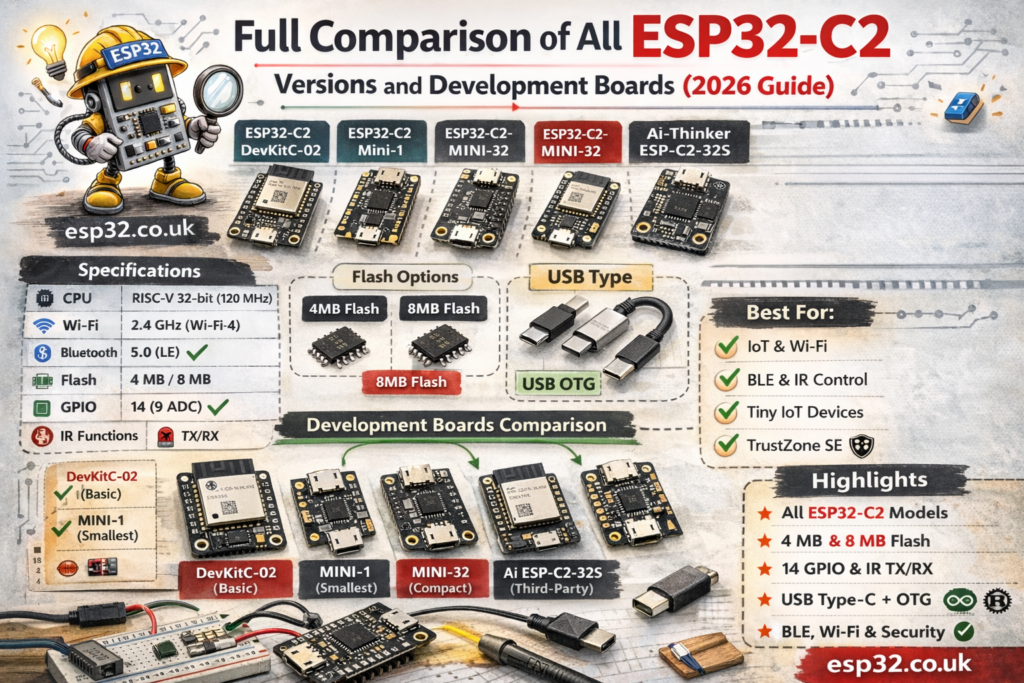
6.1 ESP8684-WROOM-02C / 02UC (common DevKitC module family)
Espressif’s WROOM-02C datasheet covers the module family used on C2 DevKitC-02 boards.
- 02C: PCB antenna
- 02UC: external antenna connector (u.FL/IPEX style) (module family naming convention; check exact module)
6.2 ESP8684-MINI-1 / MINI-1U (common DevKitM module family)
MINI modules show up on DevKitM boards. Espressif’s change notices also list MINI-1 and MINI-1U ordering changes for v2.0 (“X”) parts.
6.3 ESP8684-WROOM-05 (Tuya “drop-in replacement” footprint)
This is the one DIY users care about for retrofit work:
- Espressif’s PCN explicitly lists ESP8684-WROOM-05 and its move to v2.0 variants (H2X/H4X).
- The community uses the WROOM-05 footprint as a replacement for several Tuya module shapes (CB2L/WB2L/etc).
Important practical note:
2 MB (H2/H2X) versions can be tight for larger firmware images; 4 MB (H4/H4X) is usually the safer pick for real-world builds.
7) Official development boards (the ones worth targeting in tutorials)
7.1 ESP8684-DevKitC-02
Espressif’s official entry-level “DevKitC” board for this family. It’s the familiar header-style dev board format.
Pick DevKitC-02 if you want:
- maximum GPIO access on headers
- easy jumper-wire prototyping
- a board format most readers immediately recognize
7.2 ESP8684-DevKitM-1
Espressif’s entry-level “DevKitM” board based on the MINI module ecosystem. It’s compact and often better for small enclosures. Espressif notes the board includes an RGB LED (GPIO0/GPIO1/GPIO8) in the user guide.
Pick DevKitM-1 if you want:
- smaller footprint than DevKitC
- MINI module ecosystem
- a dev board that’s easy to embed later
8) Choosing the right C2 “version” (simple buyer checklist)
If you’re building basic Wi-Fi+BLE IoT (sensors/plugs/lights)
- Choose ESP32-C2 / ESP8684.
- Prefer v2.0 “X” variants for extra SRAM and flash headroom.
If you want OTA + filesystem + less pain
- Choose 4 MB flash variants (H4/H4X).
If you’re installing inside a box / need better RF
- Prefer modules/dev boards with external antenna connector (the “UC/U/1U” style variants depending on module family).
If you’re doing Tuya module swaps
- Look for ESP8684-WROOM-05 footprint modules (community-documented replacements for CB2L/WB2L/TYWE2L and similar).
9) Common mistakes (and how to avoid them)
- Buying 2 MB flash for large frameworks
- Works for small firmware, but gets tight quickly (OTA + TLS + logging + bigger builds). Prefer H4/H4X.
- Assuming “ESP32-C2” boards all have the same pin behavior
- DevKitM has board-tied peripherals (e.g., RGB LED pins). Always check board docs before choosing “safe pins”.
- Missing the v2.0 requirement
- Espressif notes v2.0 parts must be used with specified ESP-IDF versions; if you build in ESP-IDF, don’t ignore that.
Official references
ESP8684 Series datasheet (v2.0 memory uplift notes):
https://documentation.espressif.com/esp8684_datasheet_en.html

ESP32-C2 product page:
https://www.espressif.com/en/products/socs/esp32-c2

Espressif PCN (v1.2 -> v2.0, H2/H4 -> H2X/H4X, ordering code changes):
https://www.mouser.com/PCN/Espressif_Systems_PCN20250101_Upgrade_ESP32_C2_Series_Products.pdf

ESP8684-WROOM-02C/02UC datasheet:
https://www.espressif.com/sites/default/files/documentation/esp8684-wroom-02c_datasheet_en.pdf

ESP8684-WROOM-05 datasheet:
https://documentation.espressif.com/esp8684-wroom-05_datasheet_en.html

Tuya footprint replacement references (community):
https://templates.blakadder.com/ESP8684-WROOM-05.html
https://blakadder.com/replace-tuya-cb2l-wb2l-bw2l/