If you’ve looked at Espressif’s lineup lately, you’ve seen the shift: “ESP32” is now a family, and the ESP32-C series is the RISC-V branch built for modern, power-efficient IoT.
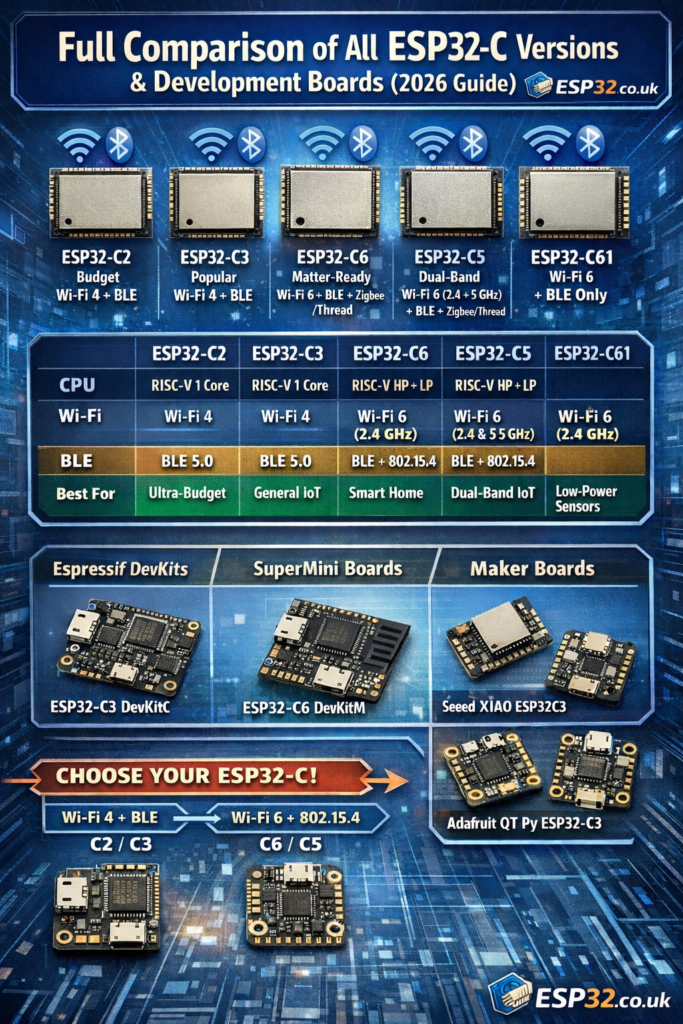
In 2026, the C-series splits cleanly into two camps:
- C2 / C3 → Wi-Fi 4 + BLE (simple, cheap, mature)
- C6 / C5 → Wi-Fi 6 + BLE + 802.15.4 (Thread/Zigbee/Matter-ready)
- C61 → Wi-Fi 6 + BLE but no 802.15.4 (a streamlined Wi-Fi 6 option)
Below is the straight comparison: chips, what they’re for, and which dev boards make sense.
1) The ESP32-C lineup in one page
ESP32-C2 (aka “ESP8684 family” in many modules/boards)
This is the extreme budget option: designed for simple, high-volume products (smart plugs, basic lighting, simple sensors). Espressif positions it as low-cost Wi-Fi 4 + BLE and explicitly frames it as a modern alternative to ESP8266-class use cases.
Key specs (headline)
- Single-core 32-bit RISC-V
- Wi-Fi 4 (2.4 GHz) + Bluetooth LE (Bluetooth 5 LE)
- On-chip memory noted by Espressif: 272 KB SRAM + 576 KB ROM
Best for
- Ultra-cheap Wi-Fi nodes
- BLE beacons / simple BLE peripherals
- “ESP8266 replacement” projects where you don’t need extra horsepower
ESP32-C3 (the popular workhorse)
The C3 is the “default” C-series chip for most people: mature ecosystem, lots of boards, Wi-Fi 4 + BLE, and strong security features. Espressif highlights a 160 MHz max clock and 400 KB internal RAM on the product page.
Key specs
- Single-core 32-bit RISC-V up to 160 MHz
- Wi-Fi 4 (2.4 GHz) + Bluetooth LE
- “400 KB internal RAM” (Espressif product page)
Best for
- Standard IoT (MQTT, web servers, sensors)
- Battery sensors (with sane sleep duty cycle)
- Modern replacement for ESP8266/older Wi-Fi nodes
ESP32-C6 (the smart-home / Matter king)
C6 is Espressif’s first C-series that combines Wi-Fi 6 (2.4 GHz) + BLE + 802.15.4 (Thread/Zigbee). It includes a high-performance RISC-V core up to 160 MHz and a low-power (LP) RISC-V core up to 20 MHz.
Key specs
- Wi-Fi 6 (2.4 GHz) + BLE + 802.15.4 (Thread/Zigbee)
- HP core up to 160 MHz + LP core up to 20 MHz
- Espressif product page calls it a cost-effective multi-protocol SoC
Best for
- Matter-ready devices
- Thread border routers / Zigbee-Thread bridges (depending on your stack)
- New smart-home endpoints that must be future-proof
ESP32-C5 (dual-band powerhouse)
C5 is the big leap: it brings dual-band Wi-Fi 6 (2.4 + 5 GHz) plus BLE + 802.15.4. The C5 datasheet describes HP CPU up to 240 MHz, plus an LP RISC-V core up to 40 or 48 MHz.
Key specs
- Dual-band Wi-Fi 6 (2.4 & 5 GHz)
- Bluetooth LE + 802.15.4 (Thread/Zigbee)
- HP RISC-V up to 240 MHz
- LP RISC-V up to 40/48 MHz
Best for
- Homes/apartments with congested 2.4 GHz (5 GHz helps)
- Smart-home hubs / gateways / high-efficiency wireless products
- “Premium” Matter/Thread builds where dual-band Wi-Fi is valuable
ESP32-C61 (streamlined Wi-Fi 6 + BLE)
ESP32-C61 is basically “C6-style Wi-Fi 6 + BLE”, but without 802.15.4. Espressif’s product page describes single-core RISC-V up to 160 MHz, 320 KB SRAM, 256 KB ROM, and support for in-package PSRAM.
Key specs
- Wi-Fi 6 (2.4 GHz) + BLE
- Single-core RISC-V up to 160 MHz
- 320 KB SRAM + 256 KB ROM
- In-package PSRAM support
Best for
- Wi-Fi 6 sensors/adapters that don’t need Thread/Zigbee
- Low-power Wi-Fi 6 applications where memory headroom helps
- “Modern Wi-Fi 6 C-series” without multi-radio complexity
2) Head-to-head matrix (chips)
| Feature | ESP32-C2 | ESP32-C3 | ESP32-C6 | ESP32-C5 | ESP32-C61 |
|---|---|---|---|---|---|
| CPU | RISC-V 1 core | RISC-V 1 core | RISC-V HP + LP | RISC-V HP + LP | RISC-V 1 core |
| Max HP clock | (low-cost class) | 160 MHz | 160 MHz | 240 MHz | 160 MHz |
| Wi-Fi | Wi-Fi 4 | Wi-Fi 4 | Wi-Fi 6 (2.4) | Wi-Fi 6 dual-band | Wi-Fi 6 (2.4) |
| BLE | BLE (BT5 LE) | BLE | BLE | BLE | BLE |
| 802.15.4 | No | No | Yes | Yes | No |
| “Pick it when…” | cheapest Wi-Fi+BLE nodes | mainstream Wi-Fi+BLE | Matter/Thread/Zigbee focus | dual-band + Matter | Wi-Fi 6 + BLE only |
3) Development boards: what exists and what to buy
3.1 Official Espressif boards (DevKitC / DevKitM / DevKit variants)
These are the most “boring” choice — and that’s good. Stable power, predictable pinout docs, fewer surprises.
ESP32-C2 / ESP8684
- ESP8684-DevKitC-02: entry-level board based on ESP8684-WROOM-02C/02UC (in-package flash), Wi-Fi + BLE.
ESP32-C3
- ESP32-C3-DevKitC-02: based on ESP32-C3-WROOM-02/02U, Wi-Fi + BLE.
- ESP32-C3-DevKitM-1: based on ESP32-C3-MINI-1/1U, Wi-Fi + BLE.
ESP32-C6
- ESP32-C6-DevKitC-1: based on ESP32-C6-WROOM-1(U), Wi-Fi + BLE + Zigbee/Thread.
- ESP32-C6-DevKitM-1: based on ESP32-C6-MINI-1(U), Wi-Fi + BLE + Zigbee/Thread.
ESP32-C61
- ESP32-C61-DevKitC-1: based on ESP32-C61-WROOM-1, with up to 8 MB flash + 2 MB PSRAM (board doc).
3.2 “SuperMini” style boards (tiny, USB-C, fewer pins)
These have become popular because they fit in small enclosures and are easy to power/program over USB-C. A common example is the ESP32-C3 Super Mini, which is widely used in tutorials.
Trade-offs
- Pros: tiny, USB-C, easy packaging
- Cons: fewer broken-out GPIOs, sometimes confusing LED pin choices (e.g., onboard LED on GPIO8 is a common gotcha)
3.3 Third-party “maker” boards (XIAO / QT Py / etc.)
These are great when you want “features on the PCB” instead of wiring them yourself:
- Seeed Studio XIAO ESP32C3: tiny form factor; the wiki highlights built-in battery charging support.
- Seeed Studio XIAO ESP32C6: Matter-friendly positioning; the wiki lists power modes and sleep current figures, plus the same tiny footprint.
- Adafruit QT Py ESP32-C3: compact board with STEMMA QT; Adafruit notes the ESP32-C3 feature set and (importantly) that C3 has no DAC and no native capacitive touch.
Trade-offs
- Pros: tiny, polished, often battery-ready, great connectors
- Cons: not always “max GPIO”, sometimes higher cost than bare DevKit boards
4) How to choose (simple decision flow)
If you just need Wi-Fi + BLE (no Thread/Zigbee)
- C3 is the safe default: broad ecosystem, lots of boards.
- C2/ESP8684 when cost is the primary constraint.
- C61 when you specifically want Wi-Fi 6 benefits without 802.15.4 complexity.
If you need Matter / Thread / Zigbee (802.15.4)
- C6 is the mainstream “smart home” chip: Wi-Fi 6 + BLE + 802.15.4, with HP+LP cores.
- C5 if you also want 5 GHz backhaul (dual-band Wi-Fi 6) and don’t mind being closer to the cutting edge.
If you care about enclosure/range
- Prefer module variants with external antenna connectors (often “U” module variants on DevKits) — especially for metal/plastic enclosures and noisy environments.
5) Common mistakes (and the fast fixes)
- Buying C6/C5 “because future” when you only need Wi-Fi + BLE
You’ll pay in complexity. If you don’t need 802.15.4, C3/C2/C61 are simpler. - Assuming all “ESP32” have the same peripherals
Example: C3 boards/chips are commonly noted as having no DAC and no native capacitive touch. - Using tiny boards then running out of GPIO
SuperMini/XIAO/QT Py form factors are amazing — but you often get fewer pins. Make sure the board breaks out what your project actually needs. - Assuming “Wi-Fi 6” means “more speed” for IoT
On IoT nodes, Wi-Fi 6’s win is often efficiency and coexistence rather than raw throughput (especially on 2.4 GHz). That’s why C6/C61 are attractive even for sensors.
6) Recommended “buy list” by project type
- Beginner / general Wi-Fi + BLE: ESP32-C3-DevKitC-02
- Compact general Wi-Fi + BLE: ESP32-C3-DevKitM-1
- Matter / Thread / Zigbee: ESP32-C6-DevKitC-1
- Wi-Fi 6 + BLE only: ESP32-C61-DevKitC-1 (flash + PSRAM listed in the board docs)
- Tiny battery-friendly builds: XIAO ESP32C3 / XIAO ESP32C6
- Tiny + connectors (I²C sensors easy mode): QT Py ESP32-C3 (STEMMA QT ecosystem)
Official references
ESP32-C2 product page:
https://www.espressif.com/en/products/socs/esp32-c2

ESP32-C3 product page:
https://www.espressif.com/en/products/socs/esp32-c3
ESP32-C3 datasheet:
https://www.espressif.com/sites/default/files/documentation/esp32-c3_datasheet_en.pdf

ESP32-C6 product page:
https://www.espressif.com/en/products/socs/esp32-c6
ESP32-C6 datasheet:
https://www.espressif.com/sites/default/files/documentation/esp32-c6_datasheet_en.pdf
ESP32-C6-DevKitC-1 docs:
https://docs.espressif.com/projects/esp-dev-kits/en/latest/esp32c6/esp32-c6-devkitc-1/index.html
ESP32-C6-DevKitM-1 docs:
https://docs.espressif.com/projects/esp-dev-kits/en/latest/esp32c6/esp32-c6-devkitm-1/index.html

ESP32-C5 product page:
https://www.espressif.com/en/products/socs/esp32-c5

ESP32-C61 product page:
https://www.espressif.com/en/products/socs/esp32-c61
ESP32-C61 datasheet:
https://www.espressif.com/sites/default/files/documentation/esp32-c61_datasheet_en.pdf
ESP32-C61-DevKitC-1 docs:
https://docs.espressif.com/projects/esp-dev-kits/en/latest/esp32c61/esp32-c61-devkitc-1/index.html

ESP32-C3-DevKitC-02 docs:
https://docs.espressif.com/projects/esp-dev-kits/en/latest/esp32c3/esp32-c3-devkitc-02/index.html
ESP32-C3-DevKitM-1 docs:
https://docs.espressif.com/projects/esp-dev-kits/en/latest/esp32c3/esp32-c3-devkitm-1/index.html

Seeed XIAO ESP32C3 getting started:
https://wiki.seeedstudio.com/XIAO_ESP32C3_Getting_Started/
Seeed XIAO ESP32C6 getting started:
https://wiki.seeedstudio.com/xiao_esp32c6_getting_started/

Adafruit QT Py ESP32-C3 learning guide:
https://learn.adafruit.com/adafruit-qt-py-esp32-c3-wifi-dev-board/overview