Sensirion’s SHT-series sensors are considered the gold standard in temperature and humidity sensing.
They are used in industrial HVAC, medical devices, consumer electronics, environmental monitoring, and high-accuracy IoT projects.
This article compares all SHT sensors, highlighting accuracy, stability, power consumption, differences, and best use cases.
1. SHT Sensor Family Overview
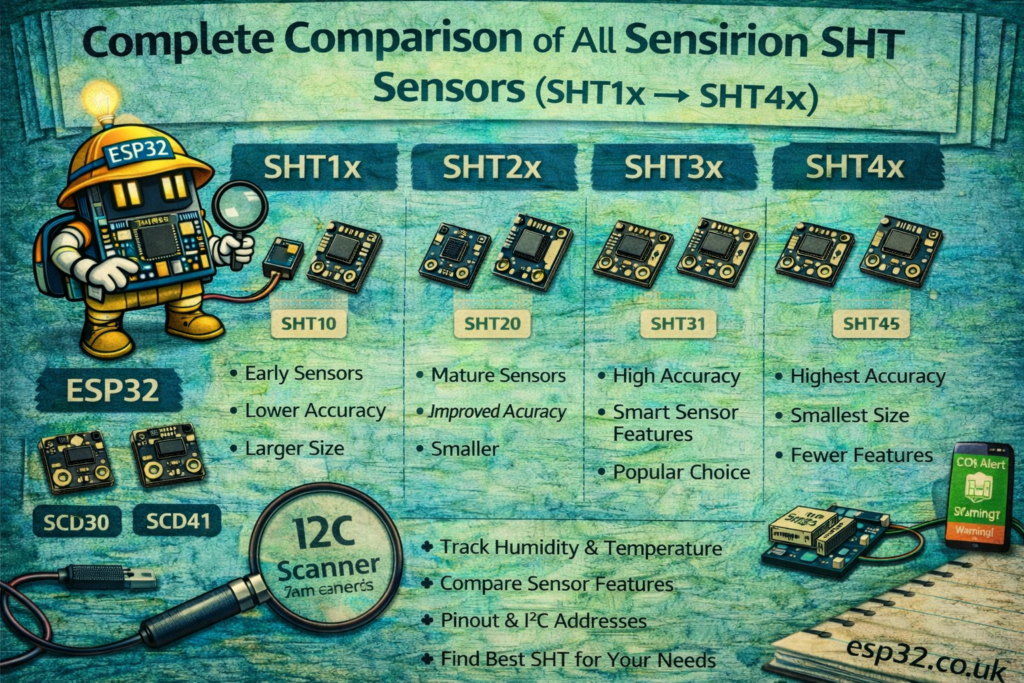
Sensirion’s sensors are divided into four major generations:
| Generation | Example Sensors | Key Features |
|---|---|---|
| SHT1x (Old) | SHT10, SHT11, SHT15 | Early sensors, 2-wire interface |
| SHT2x | SHT20, SHT21, SHT25 | Improved accuracy, I²C, lower power |
| SHT3x | SHT30, SHT31, SHT35 | Higher accuracy, fast response, alert pin |
| SHT4x | SHT40, SHT41, SHT45 | Latest generation, best accuracy, ultra-low power, tiny size |
2. Detailed Specifications & Comparison Tables
2.1 Feature Comparison (All SHT Sensors)
| Sensor | Temp | Humidity | Interface | Accuracy | Power | Notes |
|---|---|---|---|---|---|---|
| SHT10/11/15 | ✔ | ✔ | Proprietary 2-wire | Medium | Medium | Legacy sensors |
| SHT20 | ✔ | ✔ | I²C | ±0.3°C / ±3% RH | Low | Popular in hobby IoT |
| SHT21 | ✔ | ✔ | I²C | ±0.3°C / ±2% RH | Low | Stable & inexpensive |
| SHT25 | ✔ | ✔ | I²C | ±0.2°C / ±1.8% RH | Low | Industrial-grade |
| SHT30 | ✔ | ✔ | I²C | ±0.3°C / ±3% RH | Low | Low cost |
| SHT31 | ✔ | ✔ | I²C | ±0.2°C / ±2% RH | Low | Very popular |
| SHT35 | ✔ | ✔ | I²C | ±0.1°C / ±1.5% RH | Low | High precision |
| SHT40 | ✔ | ✔ | I²C | ±0.2°C / ±1.8% RH | Very low | Next-gen |
| SHT41 | ✔ | ✔ | I²C | ±0.2°C / ±1.7% RH | Very low | Higher accuracy |
| SHT45 | ✔ | ✔ | I²C | ±0.1°C / ±1% RH | Ultra-low | Best accuracy available |
2.2 Temperature Accuracy Comparison
| Sensor | Accuracy |
|---|---|
| Old SHT1x | ±0.4°C – ±0.5°C |
| SHT20/21 | ±0.3°C |
| SHT25 | ±0.2°C |
| SHT30 | ±0.3°C |
| SHT31 | ±0.2°C |
| SHT35 | ±0.1°C |
| SHT40/41 | ±0.2°C |
| SHT45 | ±0.1°C (best) |
2.3 Humidity Accuracy Comparison
| Sensor | RH Accuracy |
|---|---|
| SHT1x | ±3.5–5% |
| SHT20 | ±3% |
| SHT21 | ±2% |
| SHT25 | ±1.8% |
| SHT30 | ±3% |
| SHT31 | ±2% |
| SHT35 | ±1.5% |
| SHT40 | ±1.8% |
| SHT41 | ±1.7% |
| SHT45 | ±1.0% (best) |
2.4 Power Consumption Comparison
| Sensor | Power Use | Notes |
|---|---|---|
| SHT1x | Medium | Older tech |
| SHT20–25 | Low | Good for battery devices |
| SHT30–35 | Low | Efficient |
| SHT40–45 | Very low | Best for wearables & wireless nodes |
SHT4x sensors are significantly more efficient than older generations.
3. Individual Sensor Family Analysis
3.1 SHT1x Series (Legacy)
SHT10, SHT11, SHT15
- Released ~2003
- Proprietary interface (not I²C)
- Still found in older industrial equipment
Pros
- Long-term stability (10+ years proven)
Cons
- Lower accuracy than newer sensors
- More expensive
- Harder to use (custom protocol)
3.2 SHT2x Series — Affordable & Reliable
SHT20, SHT21, SHT25
Improvements over SHT1x:
- Better accuracy
- Native I²C
- Much lower power
- Better calibration
SHT20
- ±3% RH
- Most commonly found in cheap boards (DFRobot, Aosong clones)
SHT21
- ±2% RH
- Very stable for indoor measurement
SHT25
- ±1.8% RH
- Higher precision
- Industrial-grade reliability
3.3 SHT3x Series — Fast & Accurate
SHT30, SHT31, SHT35
These sensors are extremely popular in modern IoT.
Improvements:
- Faster response
- Higher accuracy
- Configurable alert pins
- Voltage range down to 2.15 V
- Fully I²C compatible
SHT30
- Budget version
SHT31
- ±2% RH / ±0.2°C
- Most common in consumer electronics
SHT35
- Very high accuracy: ±1.5% RH, ±0.1°C
- Comparable to professional-grade dataloggers
3.4 SHT4x Series — Latest Generation
SHT40, SHT41, SHT45
These sensors replace SHT3x and improve almost every metric.
Key Improvements:
- Smallest footprint
- Best humidity accuracy
- Lowest power consumption
- Excellent long-term stability
- High-temperature operation (125 °C)
SHT40
- ±1.8% RH
- Great for low-power IoT
SHT41
- ±1.7% RH
- Middle ground between 40 and 45
SHT45
- The BEST SHT sensor available today
- ±1% RH accuracy
- ±0.1°C temperature accuracy
- Designed for medical, scientific, and high-precision monitoring
4. Comparison: SHT vs BME Sensors
If you want only temperature + humidity, and you need the highest accuracy, SHT sensors outperform Bosch BME sensors.
| Sensor | Temp Accuracy | Humidity Accuracy |
|---|---|---|
| BME280 | ±1°C | ±3% |
| BME680 | ±1°C | ±3% |
| BME688 | ±1°C | ±3% |
| SHT35 | ±0.1°C | ±1.5% |
| SHT45 | ±0.1°C | ±1.0% |
For humidity-critical applications (healthcare, labs), Sensirion is the industry standard.
5. Best Sensor for Each Use Case
Best Balance of Price & Accuracy
➡ SHT31
Best for Home Automation (Home Assistant, ESP32 projects)
➡ SHT21 or SHT31
Best for Battery-Powered Sensors
➡ SHT40
Best for Professional Accuracy
➡ SHT35
Best Overall (2025)
➡ SHT45
Highest accuracy, lowest drift, best for scientific use.
6. Final Summary Table (All SHT Sensors)
| Sensor | Accuracy Temp | Accuracy RH | Power | Notes |
|---|---|---|---|---|
| SHT10 | ±0.4–0.5°C | ±4% | Med | Legacy |
| SHT11 | ±0.4°C | ±3.5% | Med | Improved 10 |
| SHT15 | ±0.3°C | ±2% | Med | Best of 1x |
| SHT20 | ±0.3°C | ±3% | Low | Very cheap |
| SHT21 | ±0.3°C | ±2% | Low | Popular |
| SHT25 | ±0.2°C | ±1.8% | Low | Industrial |
| SHT30 | ±0.3°C | ±3% | Low | Budget |
| SHT31 | ±0.2°C | ±2% | Low | Great all-around |
| SHT35 | ±0.1°C | ±1.5% | Low | High precision |
| SHT40 | ±0.2°C | ±1.8% | Very low | New gen |
| SHT41 | ±0.2°C | ±1.7% | Very low | Improved |
| SHT45 | ±0.1°C | ±1% | Ultra-low | Best available |
7. Conclusion
Sensirion’s SHT sensors remain the most accurate and stable humidity+temperature sensors on the market.
While the older SHT1x and SHT2x are still useful, the newer SHT3x and SHT4x series deliver superior performance, reliability, and energy efficiency.
If you want the best overall sensor in 2025:
⭐ Choose the SHT45
Unmatched accuracy and long-term stability.
If you’re building ESP32 IoT devices and want reliability: